Category Archives: Shipping

Liners get a preview of alternative fuel costs

A new technical and commercial comparison of alternative fuels for ocean carriers compares expected bunker costs for different size and differently equipped ships. Alphaliner, a consultancy for ocean carriers, has reviewed that comparison.

Alphaliner’s review shows the ship owner and operator what they can expect in economy over the next few years. The results indicate that as the new regulations for CO2 emissions kick in, fuel costs will become a much larger percentage of total ship operating costs, perhaps double, or even more.

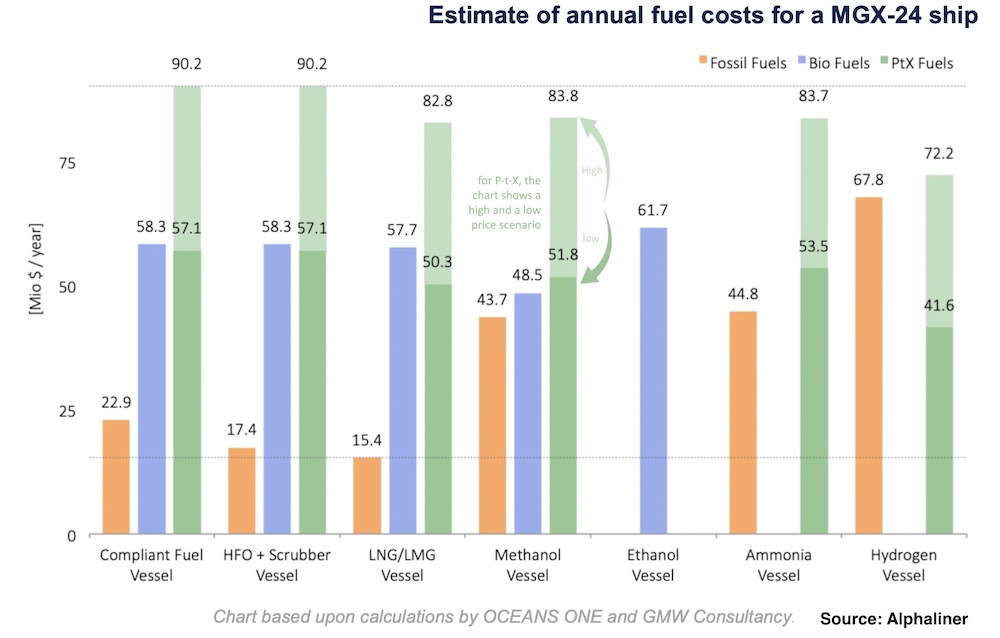
For instance, the graph they publish shows fuel costs for differently equipped Megamax-24 (MGX-24) ships. A megamax-24 ship is typically 400 meters long and 61 meters wide, with a depth of about 33.2 meters. It should carry around 23,500 twenty-foot equivalent (TEU) containers (Alphaliner newsletter).

The graph compares use of fossil fuels, bio fuels, and power-to-fuel (PtX) fuels (read about them). The PtX fuels convert renewable sources such as wind, sun, hydro, and geothermal, to fuel products such as hydrogen, ammonia, or products containing carbon, such as syn-crude. If carbon is used in the PtX process it should be from non-fossil sources or unavoidable industrial carbon emissions capture and reuse.
Source: Splash247 article.

Even bio-fuels cost a lot more than conventional fuels when all the upstream supply chain emissions are considered, for these very large ships.

The graph seems to imply that scrubbers are still a very important technology in the fight to clear the air. And LNG has a role to play, though it might be temporary. At their best, the PtX technologies such as electric-powered ships are comparable to or better than bio-fueled vessels.

There’s clearly a long way to go for ocean shipping to go where it needs to in the race to clean up global emissions.

However, some of these non-fossil technologies will adapt over the next few years, and costs will come down. It’s hard to do much more with the fossil fuel technology.

The argument Alphaliner makes is that soon fixed costs will be a smaller part of the total cost of a large ship than fuel operating costs. As these proportions change, emphasis will come more on building ships with desirable emissions control power systems, since the availability and price of fuel will be driving overall costs.

That’s an interesting point. We will see the extent to which it influences the next generation or two of ship orders.

Sam Chambers July 27, 2022

Liners get a preview of alternative fuel costs – Splash247

Ripples from Black Sea shipping crisis hitting regional supply chains

It is interesting to hear about changes in regional supply chains. The Ukraine war provides a chance to see what disruption occurred and how it is impacting routes to move cargo in the area of the Black Sea. This article covers the effects of the blockade of Ukranian ports.

Naturally costs have changed, and so have equipment imbalances.

Finally, the markets for freight into and out of the area have changed a lot. Many shippers and carriers have been actively looking for alternatives, and have needed to create some new ones.

And sanctions imposed by the EU and US have forced other changes.

By Daniil Melnychenko data analyst at Informall BG 26/07/2022

Ripples from Black Sea shipping crisis hitting regional supply chains – The Loadstar

Container glut pushes down second-hand prices, but carriers still ordering new

There are now too many containers in the world. And they are cluttering up the ports and yards we need to move containers through. And they cause detention and demurrage charges, because lines won’t move them out of ports.

The global container pool is around 50 million TEU right now. According to Drewry, that is an excess of 6 million TEU. However, Drewry is not too concerned about the excess at present, feeling they can be absorbed if trade picks up. Interestingly, Drewry seems to think that the excess will be absorbed by ‘slower sailing’!

As economics tells us to expect, the price of second-hand containers is falling. However, some carriers, such as Evergreen, continue to order more. Most containers are built in China these days. Three Chinese firms, with state connections, are the primary sources. The problem is that empty used containers cost a lot to return to exporting destinations. They displace paying cargo, forcing ocean carriers to use space to carry them. And especially, with the cost of bunker fuel in the stratosphere, and the need to use very low sulfur fuel in some busy port areas, the transportation cost is high. Ocean carriers have to ‘bundle’ the cost of returns into the one-way cost of the loaded shipment. Either that, or they take a hit by moving the old containers back.

The Seatrade article by Gary Howard has nice graphs showing the average price of 40-foot used containers in Europe, and in China, provided by Container xChange. Again the question of where excess containers will be stored is raised. There haven’t been many answers to that one yet.

By Martina Li in Taiwan 19/07/2022

Container glut pushes down second-hand prices, but carriers still ordering new – The Loadstar
Seatrade logo

Gary Howard | Jul 19, 2022

6m teu oversupply of containers after ‘reactionary’ ordering