Category Archives: Trucking

ATA Truck Tonnage Index Rose 0.5% in May

Truck tonnage saw a slight increase in May, according to the latest American Trucking Associations (ATA) survey of its members.

This index is considered quite reliable. Its base year is 2015, so a value of 117.1 shows the percent gain since 2015. On the graph below you can see the big plunge in early 2020 due to COVID, the rapid recovery, and the more recent upward trend. There’s nothing to make you believe the general upward trend over the last 6 months is broken yet.
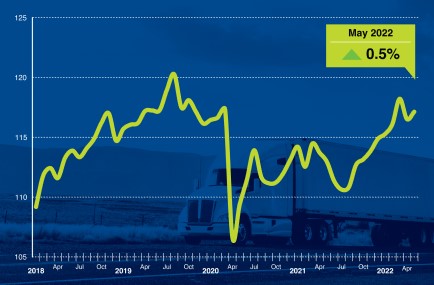
Source: ATA website https://www.trucking.org/news-insights/ata-truck-tonnage-index-rose-05-may

The index is dominated by results from contract trucking. The ATA release proposes a theory about the relation with the spot freight market, which has been slowing.

If a recession arrives, we can predict a tailing off of the need for trucking. We hear that inventories are replenished at most big box stores, so demand for refilling may be down. At the supermarket we still see spot shortages, but not like over the winter. The threat to trucking volumes would be if consumers slow down their buying, forcing outlets to reduce inventories.

We hear anecdotally almost that the driver shortage is much less severe than it was over the winter. We also hear that more drivers are exiting ownership, which is affecting used truck auction prices. We don’t know if these drivers were captured in the ATA survey.

Perhaps there’s a downturn coming. Transportation is often a reliable index of the quality of the economy.

ATA Truck Tonnage Index Rose 0.5% in May | American Trucking Associations

ATA Truck Tonnage Index Rose 0.5% in May | American Trucking Associations

Used truck auction prices plunge as freight market cools

All of a sudden, it seems, used trucks are losing value. It could be because some truckers are finding the trucking business hard to make a living in right now. Spot rates for cargo have fallen recently. Sometimes they are even below contract rates for recently negotiated contracts.

I think the recession is starting to hit trucking. Inventories of many firms are fully stocked, and if business sales slows these firms won’t need to replenish so fast. Hence less trucking needed.

Some of the hot spots for truckers, like the West Coast ports, are starting to slow down also, so less drayage or off-port hauling is needed. There are just fewer loads available.

It’s a good sign for supply chain congestion, but not so good for those who recently entered the business.

So truckers are selling their rigs more frequently.

It’s not an easy business to make a buck in.

Alan Adler Thursday, June 16, 2022

Used truck auction prices plunge as freight market cools – FreightWaves

FMCSA revising guidance on freight brokers and agents

The list of questions to be asked to test whether freight broker functions are being satisfied is interesting.

An important controversy is whether load boards are performing broker services. Usually these boards provide load choices for truckers for a membership fee. The actual transaction is between the shipper and and the carrier, and the freight payment is not processed by the load board.

Conventional brokers perform these matching services but collect the fees for each deal, paying the carrier directly using the money collected from the shipper, and deducting their brokerage fee.

The load board service is in some ways similar, and in some ways different. So there are arguments to be made on both sides. A study is required to see if the FMCSA should weigh in to make definitions differently and impose any rules changes.

The main requirements for brokers are to register with the FMCSA, and to file a bond to cover cases when the broker and the other parties cannot agree on the settled amounts of a transaction, or the resolution of claims when the broker goes out of business.

To what extent should load boards be required to do these things? Or is a different type of registry required, to be sure that load boards follow established business principles?

There’s a similar scenario in US government regulation: the FMC’s regulation of ocean freight forwarders or brokers and non-vessel-owning common carriers (NVOCCs). While the differences between the two are not similar to the truck broker case, the pattern of having two registration entities is the same.

It will be useful to see if the FMCSA can find any specific performance reasons why load boards or matching services should be subject to specific regulations.

I suspect that there should be some controls on their practices. But the controls required may not be well covered by making them freight brokers, as the rules are currently framed.

Truckers probably need some protection if a load board goes out of business or fails to deliver load contracts as they promise. And there should be some regulations to speak to the nature of contracts offered and their fine print that might be unfair to either the trucker or the shipper. But these shouldn’t be more severe or more far-reaching than those imposed on true brokers.

Truckers certainly have much more freedom to use a load board or not, and to accept contracts generated or not, and this is an advantage for them individually. They can select the kind of service relation they would like to provide.

John Gallagher Thursday, June 9, 2022

FMCSA revising guidance on freight brokers and agents – FreightWaves