It’s unusual for small ships to be more valuable than large ones. But that has been happening in the tanker and dry bulk shipping area. The disruptions of 2022, following on Covid, have created markets better served by smaller ships.
One source of large dislocations in markets is a result of the Ukraine war. Because of sanctions, China has stopped shipping crude from Arabia. That was a channel that favored VLCC tankers. In addition, Russian exports of oil favor the use of smaller ships.
But other markets, too, have seen this effect as well. China, for instance, has reduced imports of iron ore and coal, partly due to Covid restrictions, and partly due to the deep slowdown in Chinese construction, requiring less steel production.
Clarksons, the shipping consulting firm, expects a reversal to more normal price differentials by 2024.
There’s more to this story than just some Greeks shipping oil for Russia. Apparently Russia has been engaged in shipping Ukranian wheat via ‘dark shipping’ for a while now. Some Greek shipping magnates believe the sanctions on Russia are ‘bullshit’. With that belief, they feel little concern for making them work. Since Greek shipping moves a large amount of oil, this is a problem for the EU and for people who support Ukraine.
In dark shipping, ships turn off their AIS tracking when they are near ports where suspect cargo can be loaded. While draft upon entering and leaving can be observed, you can’t tell what’s been loaded or unloaded by the location where they docked. It’s an ideal way to transport forbidden materials without actually opting out of the universal tracking system.
All’s fair in war. And business is war. There’s no love here.
Drewry’s Weekly Feature Articles are usually full of good information, though at an aggregate level. This week’s issue is notable for its information on when the congestion and high ocean prices will end.
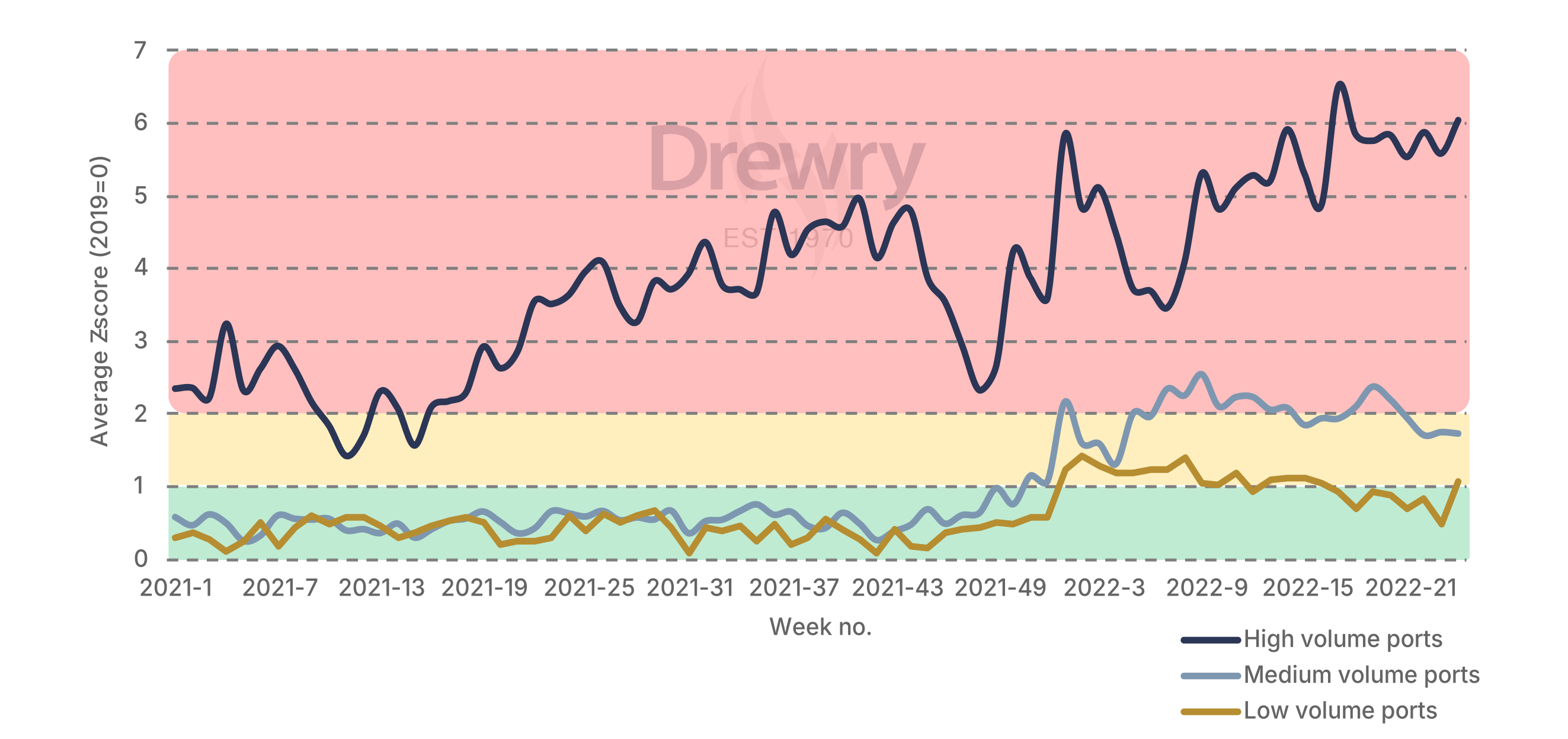
This graph shows that high volume ports are still seriously congested, while medium and low volume ports are far better off. The Z-scores are based on the 2019 average, so they represent the difference from that baseline level of congestion.
Source: Drewry Maritime Research Note: Based on the z-score deviation from 2019 averages of the number of ships waiting outside selected ports. Only considers waiting events longer than 4 hours to avoid capturing ships passing through port waiting zones.
The current Drewry customer surveys show that most customers think the congestion in North America won’t dissipate until 2023, perhaps the first half; or maybe even the second half. The reasons given seem to be that there has not been much change in the supply chains that serve the ports, especially the large ports. It’s clear that US supply chain participants such as rail lines, truckers, warehouses, and equipment suppliers such as chassis yards and suppliers, are having trouble cooperating to get goods to move faster and empties returned and refilled in timely ways. There’s little confidence that that will change.
The threat of a longshoremans’ strike at LA/Long Beach, where negotiations have begun, is another factor. I, for one, think that the negotiations will be successful, though not done on time. I think both sides have too much political capital to lose by failing to agree. It would be catastrophic for both the Pacific Maritime Association (PMA) who negotiates for the management side, and the International Longshore Workers Union (ILWU), representing labor, if they can’t forge a position. We can’t predict whether the major issue, how to implement automation without eliminating longshore union jobs, will be settled to allow a lot more automation this time. But they don’t have to completely settle this right now; it can come up again in a later round, and the ports on the West Coast can meet quite good throughput goals without changing much in the automation activity right now.
Unfortunately, the PMA has a history of being sticky in negotiations. It’s sad, because some of my former students at Cal State Maritime work for the PMA, and others are with the terminals at the ports. But I’m no expert on PMA dynamics. I just hope everyone is adopting a reasonable attitude.
The expectations for easing in Europe and Asia are similar, with customers of Drewry’s believing the congestion problems will continue into 2023. There are different issues there, though including China’s COVID shutdown policies.
Most of the survey participants believe that ocean carriers will continue ‘capacity discipline’ far into next year. This can be translated as blanked sailings. So there is little hope of reliability turning around for the foreseeable future. Private or dedicated fleets could continue to be a good idea for very large importers to the US.
Theo Notteboom and Pierre Cariou have just written a paper contrasting Walmart and Nike’s dedicated fleets with the standard ocean liner trade to West Coast North America, in the light of COVID disruptions. You can find the paper here. It indicates that quite different strategies combining choice of origin and destination and hinterland inventory locations are possible for dedicated fleets. They offer these larger shippers good opportunities to increase reliability and reduce costs. It’s done by thinking about the entire supply chain rather than just the maritime link. Perhaps 3PLs can help other shippers s well, by offering different packages with dedicated portions. Flexport has done some of that with air shipments in past years, with their own airfreight contracts.
But in general, it’s very hard to get supply chain participants to think in a cooperative manner. We see this every day in the complaints being made when any proposal for coordination is brought forward. With dedicated service there’s only one decision point.
Cooperation is going to take massive effort on the part of supply chain participants. Visibility is nice but will only go so far. Coordination schemes have to be found to keep congestion at bay.
Reading Drewry’s is a good way to stay in touch with the bigger picture.
Drewry – Weekly Feature Articles – Beginning of the end for carriers’ bull run





 Supply Chain and Logistics