Tag Archives: supply chains

State of the Logistics Union 2017

Dan Gilmore’s take on the latest report from CSCMP on the state of logistics.  A copy would be good reading, but you have to be a CSCMP member to get it free.

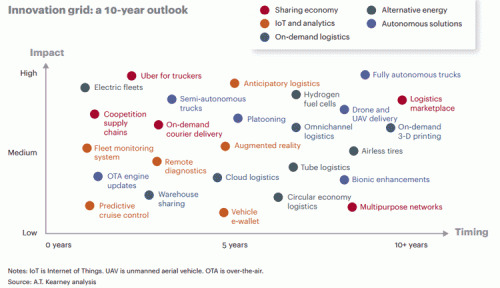
One interesting chart is this one showing innovations.  It’s a classic innovation grid showing estimated impact vertically, and when it’s likely to be mainstream horizontally. The authors think co-opetition in supply chains, a high-impact innovation, is going to be mainstream in a couple of years. While I agree it has high impact potential, I think it’s a lot farther off than that.  Especially in the US, we seem to be reverting to an unregulated world where markets rule, and this makes it very hard to hold cooperative schemes together.  Similarly, Brexit blows apart many attempts at cooperation cross-border, and as nations start trying to foist their local problems off on others we’ll see natural reactions.

Supply Chain Digest LogoLogistics Costs as Percent of GDP Down Again in 2016, Falling in Relative and Absolute Terms

Source: State of the Logistics Union 2017


Why Amazon is buying Whole Foods

A great article by DEREK THOMPSON

It is right on target about the reasons– they are supply chain reasons.  Amazon covets the urban locations to speed up deliveries; but it would be fantastically complex to procure and engineer these one at a time.  With the Whole Foods locations, they now have drop-off points for overnight delivery, and mini-warehouses for food items, especially those that need ‘fresh’ or ‘frozen’ treatment. $14 billion is cheap in terms of accessibility to a population, say within a circle of a given radius.

Perhaps we should rate warehouses and depots by a distribution of the number of customers in a unit of area.

  The retailer’s $14 billion bet isn’t just about the future of food. It’s about becoming the one-stop shop for your entire life.

Source: Why Amazon Bought Whole Foods – The Atlantic

Does Lean Leveling Reduce Shipment Variability? 

A nice piece of research on another approach to reducing the economic impact of imbalances between supply and demand in retail. The approach is a two-phase ordering policy. The ‘steady’ phase places EOQ-like regular orders to cover some base level of demand. The ‘balancing’ phase (my terms) orders extra in some periods, perhaps in a more expedited fashion, to handle the peaks and valleys of actual demand.  It amounts to decomposing the demand stream into a steady part and a peak-and valley part, and matching the supply technique to the portion of demand in each ‘frequency’.

The expectation is that problems of promotions, outlet overstocks and shortages, and massive inventory-building on the part of consumers will be addressed at lower cost.  The simulations seem to tell the students that the effect on cost will be positive!

It’s a unique approach, executed for a real business, and therefore rates a careful look. I hope it shows up in a published paper with a heuristic for deciding how to partition the demand forecast.

Article from Supply Chain Management Review

Here’s the article in SCMR where the news was posted.

  Supply chain professionals are often confronted with the challenge of managing highly volatile customer shipments resulting from the bullwhip effect. This volatility leads to supply chain-wide inefficiencies, high operational complexity, low service levels and substantial costs.

Source: Does Lean Leveling Reduce Shipment Variability? – Article from Supply Chain Management Review