Category Archives: Sustainability

Bulk carriers and containerships moving at slowest speeds

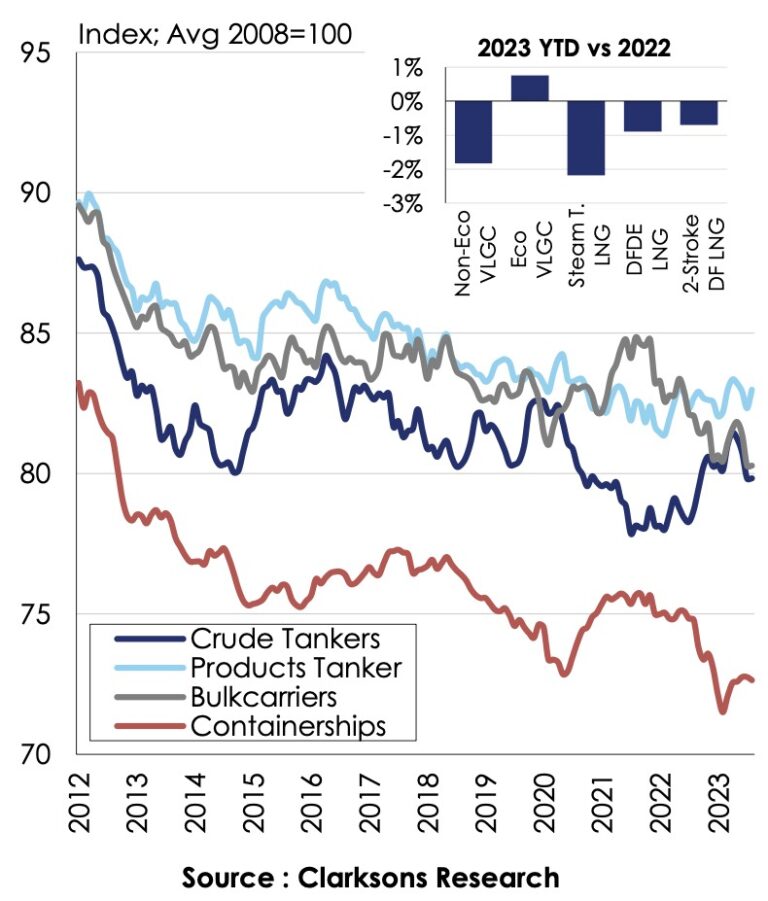
Slow steaming is a good way to save on fuel costs and meet the new IMO requirements. So ships have slowed down. But I was amazed at the graph below, showing a trend for quite a while.

Slowing down is an important way of cutting CO2 emissions from fuel oil. It also implies that more ships are needed to meet planned sailings on a scheduled route. It’s a deliberate reduction of individual ship ‘productivity’, since fewer paid cargo-carrying trips can be made in a year. But it may be a better fit with the demand for shipments right now, and it might result in fuller vessels.

We should remember that slow steaming will not eliminate CO2 emissions problems; it’s a stopgap at best. New types of power with very low or zero emissions through their life cycle well-to-wake must be developed. The investments have to be made.

Sam Chambers October 2, 2023

Bulk carriers and containerships moving at slowest speeds on record this year

Ammonia-fuelled gas carriers could compete effectively by 2026

The Copenhagen-based Global Maritime Forum (GMF) has completed a study that concludes ammonia-powered gas carriers could compete effectively as soon as 2026.

The findings are based on a route from the US Gulf Coast to northwestern Europe. The route has been approved in principle by DNV, a classification society and expert in assurance and risk management. The ship would fuel only in the US, and make the most of subsidies from the US government via the Inflation Reduction Act (IRA), and the EU’s Fit for 55 measures. So, not subsidy-free!

The design is completed and could be used for a shipyard tender.

Gas carriers are important today because of the Ukraine War sanctions and actions by the EU to eliminate gas imported from Russia. The EU is now a prominent destination for US export gas.

Seatrade logo

Paul Bartlett | Sep 01, 2023

Ammonia-fuelled gas carriers could compete effectively by 2026

EU states agree to expand EV-charging station network

It’s clear that the EV ‘supply chain’ of charging stations has to expand to make EVs a success. So far, it takes longer to charge than to fill up with a liquid fuel, and the charging stations are not common enough. Couple that with a lack of standards for charging ‘nozzles’, and we see help is needed.

The European Union (EU) took a big step forward by passing a law that would greatly increase the number of EV charging stations. Every country in the EU now has to provide charging stations every 60km along roadways. Hydrogen stations also have to be provided every 200km. The number of stations is tied to the number of EVs sold in the countries.

By 2025, that would make about 600,000 charging stations in the EU, according to an estimate. There are 450,000 stations now. It’s not so many.

The new law is an example of how the EU leads the world in emissions control rules and intentions. Other nations need to step up.

By Jonathan Packroff | EURACTIV.de | translated by Daniel Eck

EU states agree to expand bloc’s EV-charging station network