Tag Archives: Ammonia-powered ships

Exploring Green Maritime Fuels: CMB.Tech’s Ammonia Plans

We are seeing quite a few announcements of green maritime fuels projects that seem viable. Ammonia is one of those, provided it can be produced in a green fashion. CMB.Tech, one of the maritime shipping and services firms that features sustainable options, has initiated an effort that will begin in January 2026.

CMB.Tech announced it will buy green ammonia from the China Energy Engineering Group (CEEC) Songyuan project, a producer in Jilin province, China. China is a good place to look for green fuels, because of its large and increasing use of solar energy to generate green electricity. Green ammonia production uses lots of electricity.

CMB.Tech will obtain 11 dual-fuel ammonia-powered ships in 2026. It is also planning to operate in the ammonia distribution business, and has obtained an interest in a Chinese ammonia supply chain company, Andefu. The first ammonia for maritime use will be transported to Panjin Port, initially by truck and possibly later by unit train.

Alexander Saverys, CEO of CMB.Tech says: “Today marks a big milestone in our decarbonisation journey. With an investment in the Chinese ammonia supply chain, CMB.Tech will be able to provide green ammonia to its ships.”

His firm is in the forefront of green maritime investment, and is not stopping despite the slowdown of green progress in the international political scene.

Gary Howard, Middle East correspondent

December 16, 2025

https://www.seatrade-maritime.com/alternative-fuels/cmb-tech-invests-in-chinese-green-ammonia
Is Ammonia cheapest long-term for IMO carbon rules?

University College London has published a new study considering in detail how shipowners can comply with the IMO rules for carbon emission compliance. It’s very detailed and takes into account not only the different technologies available, such as methanol and LNG, but also the timing of implementing the various regulations. One has to consider all these factors over the 25 or so years of the lifetime of a ship.

Granted, new technologies and availability of different fuel choices can change from what we can see now, but this impartial study favors ammonia-powered ships over the longer time frame. They suggest dual-fuel ammonia ships might be the best bet for investors in new shipping.

“Although there are significant complexities and uncertainties in what was agreed [at IMO MEPC 83] in April, even conservative projections of how remaining policy details will be finalised results in a ‘no brainer’ choice for shipowners in dual fuel ammonia,” said Dr. Tristan Smith, Professor of Energy and Transport at the UCL Energy Institute. 

The report is available here.

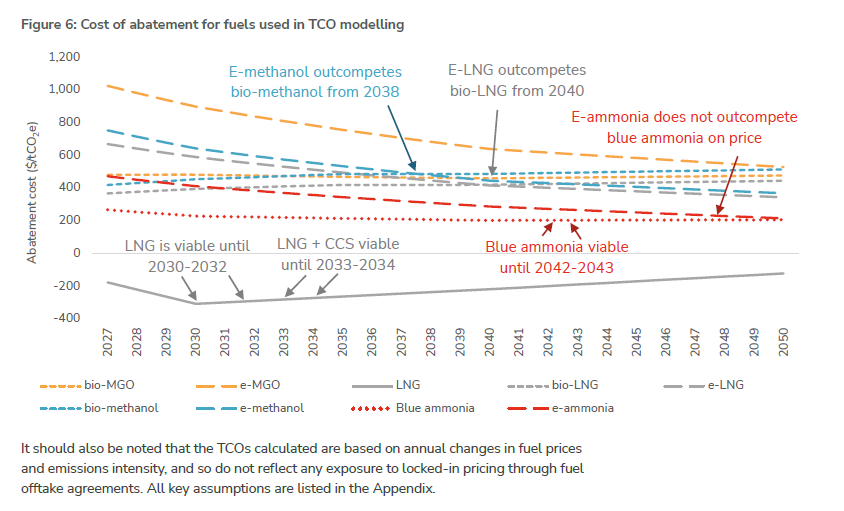
This figure from the report indicates when different fuel choices become cheapest in terms of abatement cost. It seems that e-ammonia never outcompetes blue ammonia before 2050. And LNG remains viable for quite a while, especially with integrated carbon capture.

There are a lot of assumptions in any such study, and the IMO could change the rules in the meantime. But shipowners should be thinking hard about ammonia, and so should international bunker fuel providers.

Published May 29, 2025 9:08 PM by The Maritime Executive

https://www.maritime-executive.com/article/ucl-ammonia-is-the-cheapest-compliance-option-for-new-imo-carbon-rules

Update 6/5/2025: Fortescue is jumping on the dual-fuel ammonia bandwagon, and has some not-so-polite comments about others in shipping sticking with LNG.

Sam Chambers June 5, 2025

https://splash247.com/fortescues-mission-to-champion-ammonia-goes-global/

Ammonia-fuelled gas carriers could compete effectively by 2026

The Copenhagen-based Global Maritime Forum (GMF) has completed a study that concludes ammonia-powered gas carriers could compete effectively as soon as 2026.

The findings are based on a route from the US Gulf Coast to northwestern Europe. The route has been approved in principle by DNV, a classification society and expert in assurance and risk management. The ship would fuel only in the US, and make the most of subsidies from the US government via the Inflation Reduction Act (IRA), and the EU’s Fit for 55 measures. So, not subsidy-free!

The design is completed and could be used for a shipyard tender.

Gas carriers are important today because of the Ukraine War sanctions and actions by the EU to eliminate gas imported from Russia. The EU is now a prominent destination for US export gas.

Seatrade logo

Paul Bartlett | Sep 01, 2023

Ammonia-fuelled gas carriers could compete effectively by 2026