Tag Archives: Mississippi River

Water isn’t rising on Mississippi, but barge rates have steadied for now

America’s most prominent inland waterway for commerce is the Mississippi River. It’s been plagued this year by low water. There hasn’t been enough rain in the middle of the continent.

Low water causes barges to run aground, and the remedy is to put less in them, reducing the capacity of the routes. That has been the state of affairs on the river this year as we get into grain harvesting times. The majority of grain exports from the US are from the Gulf Coast, using the Mississippi as the feeder.

It’s a financial blow for farmers and their co-ops if grain deliveries slow. Grain is one of the most important of the US export products, and helps to reduce our balance of payments.

You would think that freight rates would go sky high. But they appear to have steadied right now, in harvest season.

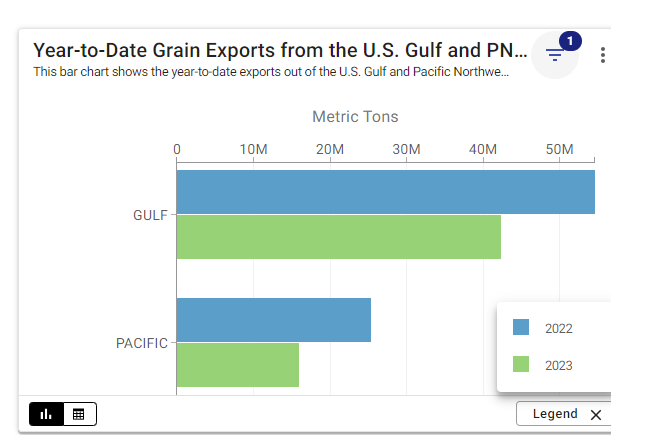
The United States Department of Agriculture (USDA) publishes a Grain Exports Dashboard showing numerous statistics. Grain exports from the US are down from both Gulf Coast and Pacific ports this year.
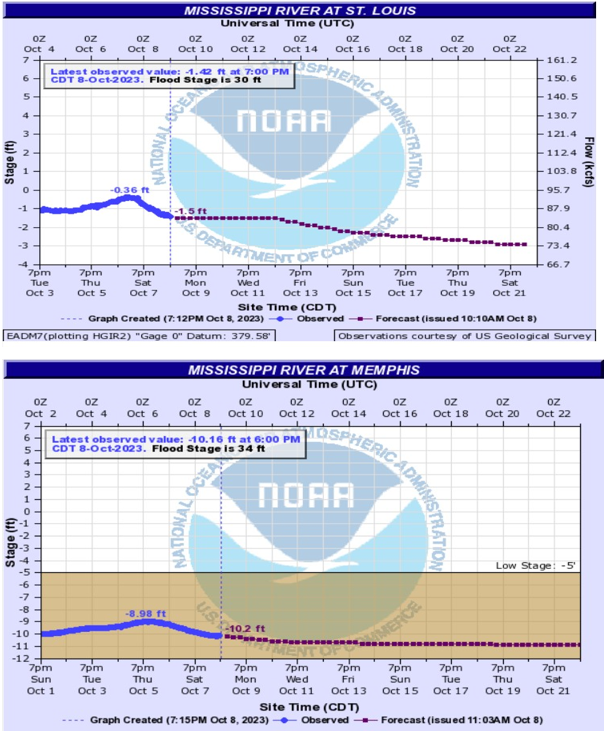
An interesting aspect of the article below is the water level graphs from the United States Geological Survey (USGS). These show a deficit of more than 10 feet at Memphis, and around 3 ft currently at St Louis. Accordingly, drafts of barges have to be reduced, as much as 32% at St. Louis.

Maintaining conditions for commerce on the Mississippi is the responsibility of the US Army Corps of Engineeers.

Grain exports from the Mississippi have been an interest of mine since 2012, when Chris Clott and I and other authors wrote about soybean exports.

John Kingston Monday, October 09, 2023

Water isn’t rising on Mississippi, but barge rates have steadied for now

Mississippi barge quagmire leaves exporters looking for alternative routes

Low water in the Mississippi river is hampering barge traffic. This river is a main pathway for soybean exports, which travel downriver to the New Orleans area to be loaded for the Far East.

Barge traffic is much cheaper than rail or truck. For agricultural exports, cost is the main thing to email competitive with Brazil, the largest competitor. While the voyage from Brazil to the Far East is days longer than from the US, and Brazil’s inland infrastructure is not as developed as the US, the final product, soybeans, is about the same price today.

The situation is complicated by the fact that the US harvest in October is diametrically opposite that of Brazil, which is in the Southern Hemisphere. So a large buyer like a Chinese pig farmer or processing plant tends to buy from whoever is cheaper, which is usually who has just completed the harvest. Beans are cheapest when the harvest comes in, because it costs money to store them, and losses of quality and spoilage occur in storage. Farmers store only when they think the current price offered is too low and they believe it will go up.

There is also hedging. Elevators can sell beans for future delivery, which means a contract for a fixed quantity and quality to be transferred to the new owner at a later date. This can be called hedging. It’s a good thing for farmers and bean consumers like processors alike. They can control their cost or gain. While there are speculators for any agricultural commodity, they have to outguess the actual price performance of the market, and that is hard to do.

But back to the logistics. The state of the Mississippi locks has been an issue for many years; the locks are old, and some have not been kept in good repair. It’s the responsibility of the US Army Corps of Engineers to maintain the locks, but for years Congress failed to vote enough funds to keep up the repairs. However, since the supply chain crisis following COVID, Congress’s attention came around, and money is now flowing more freely.

But it isn’t much help if the rain stops coming. A drought in the central US means the water level in the Mississippi River has dropped to levels so low that barges are restricted from carrying full loads. the effective draft allowed is just over 9 ft, which means a loss of carrying capacity for barges. So farmers and grain elevators cannot get enough grain to market especially abroad.

The situation is dire enough for farmers to choose to ship by rail to the West Coast for transport by bulk carrier to the Far East. But with the problems rail transport is having right now, it’s hard to pull off. Railcars and trains simply aren’t available. It’s a version of the blanking of sailings we see in container transport today. Railroads are running fewer trains, so shipments occur less often. The trains are longer, so the turnaround time for the cars is slower. There is a strike of rail workers pending. And rail crews have been stretched thin by precision scheduled railroading (PSA), a form of lean operation that seems not to fully take into account the needs of customers.

It’s quite a dilemma, and there are no easy answers. Wish it would rain!

By Ian Putzger, Americas correspondent 02/11/2022

Mississippi barge quagmire leaves exporters looking for alternative routes – The Loadstar