Tag Archives: ocean shipping

Accidents involving shadow fleet cast dark light

This account of the aftermath of the Pablo explosion on May 1 is chilling. Three crew were killed. But now no one is standing up to take charge of disposal of the wreck, much less the other damages it caused. Malaysia is the nation where the ship blew up.

No hull insurers have stepped forward. The ship was flagged in Gabon, not known for strict enforcement of owner obligations. And the ship is operated as a single-ship shell company, based in Marshall Islands. It appears not to have insurance.

It’s clear the vessel was engaged in transporting sanctioned oil. The cleanup will likely never be paid for.

The ship is not yet a ‘wreck’ in the sense of the Nairobi Wreck Removal Convention, which would allow a state (Malaysia) to remove it if it posed a danger to safety of lives, goods, sea traffic, or the environment. The hull might have some salvage value, so a hull insurance firm might be interested. So we have to wait to see what happens.

International rules are set up so that accidents like this will be taken care of, even though extensive and complex litigation may be required. But the countries engaging in sanctioned trade are placing others at risk and expense when something goes wrong.

It’s certainly a negative for Russia, Iran, Venezuela, and other nations who are using these shadow ships to move their oil. Those countries ought to step up and guarantee the costs through their insurers when these maritime accidents happen.

 Sam Chambers June 21, 2023

Exclusive satellite images of wrecked Pablo tanker cast dark light over shadow fleet

Seatrade logo

Marcus Hand | Jun 23, 2023

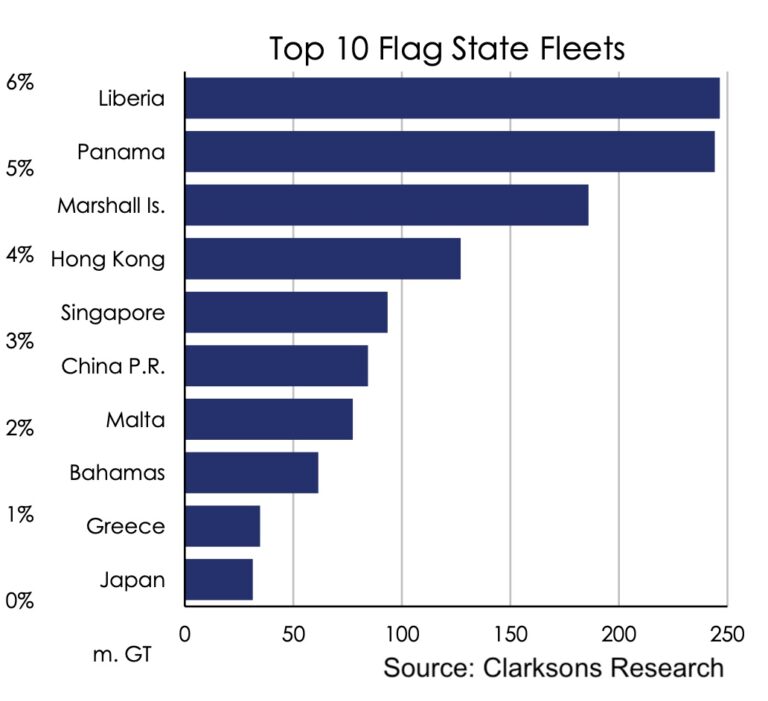
Panama expels 6.5 million gt of ships linked to Iran, North Korea or sanctions

EU ETS at a glance

I found this article very informative. It’s from Bureau Veritas, a classification society based in the EU.

It makes very clear how the EU’s emissions trading system (ETS) will work for the maritime industry. It’s part of the Fit for 55 package that aims to reduce emissions by maritime and other sectors in the EU.

The timeline is very important for shipowners and ship charterers. The rules require payments for emission credits, so there will be a financial impact. It remains to be seen how chartering contracts will divide the costs of the credits between shipowners and charterers, but the financial burden will be there.

Most people agree that the emissions trading credit system is an extremely important motivator for participants in the maritime industry to get serious about reducing emissions. We are seeing activity now to reduce emissions, but the pace has to pick up if the EU goals of a 55% reduction by 2030 are to be met. Investment is needed, and internalizing the cost of emissions through the trading of credits is an important lever to use. It’s a good example of a sensible regulation to impel action. More nations should try it.

The FAQ format of the article makes it easy to see the answers.

One unfortunate issue is the somewhat longer time frame for implementation of the ETS; the first bite starts in January 2024, covering 40% of emissions. This escalates to 70% in 2025 and 100% in 2026. Another critique of the system is that for ships that either enter or exit the EU ports fro outside the EU, they only pay for half the emissions. It’s a compromise that is necessary, since nations outside the EU might have their own emissions trading regimes, or none at all. Having it apply only to EU port visits insures more cooperation.

The basis of the trading is an updated MRV plan, which must be kept updated. There will be an accredited verifier of the plan for each fleet owner. The fleet’s individual greenhouse gas (GHG) emissions must be monitored from January 1 of 2025, and a report submitted by March. Then by September, the emissions will be calculated (surrendered, in the words of the document) and the emissions credits purchased on 40% of it.

Penalties include expulsion orders from EU ports, or a flag detention order until obligations are fulfilled, for EU member state flagged ships.

EU Emissions Trading System Directive | Bureau Veritas M&O

EU Emissions Trading System Directive | Bureau Veritas M&O

When more is less

Drewry’s has an interesting Container Insight feature that clearly shows how container lines can add ships to their fleet and maintain a fixed effective capacity on a route. The essence of it in simplest form is to go more slowly. Consider their example, in Figure 1.

Figure 1: How to hide containership capacity

Note: * Based on a fixed-day-weekly end-to-end westbound Asia to North Europe service with no wayport / intermediate calls; assumes High-Cube capacity reduction of 8.5% and out-of-scope reduction of 1% (differs by trade).

Source: Drewry Maritime Research

Frequency on the route in Figure 1 stays the same, and the average capacity remains constant. The effective capacity of the trade lane stays the same.

So liner companies have quite a bit of flexibility to deploy their ships and manage the supply. In times when the demand is dropping, however, there are limits to what these policies can do. And all the strategies are not equally profitable. In times of financial pressure there would be motives for firms to use the cheapest solution instead of the one best suited to the customers’ needs, the customer being the shippers.

Understanding your shippers’ needs and developing schedules and provisioning of the routes to meet those real needs is the best way for success.

Drewry – Weekly Feature Articles – When more is less (or net neutral)

Drewry – Weekly Feature Articles – When more is less (or net neutral)