Tag Archives: Shipping Industry

Panama Flag tonnage slips

Geopolitics is playing a role in selection of flag states. That includes both US pressure for supply chain control by nations in the Americas against China, and reactions by China. But Panama also wants to cultivate a pristine image as a flag state that supports and enforces international rules.

According to the most recent Clarkson’s Research data, Marshall Islands now ranks ahead of Panama in fleet tonnage registered. Liberia remains first.

Panama’s drop has two causes.

First, Panama has been actively removing shadow fleet and older tonnage from their registry. These are usually ships that run a risk of maintenance problems. Panama now limits tankers and bulkers older than 15 years. This is a sign that Panama wants to be known as a trusted registry, safety-conscious and willing to enforce maritime safety and management rules.

Panama stands out for the age of its fleet. Its average ship is 19.5 years old, the oldest among the top five flags. Liberia averages 12.6 years, the Marshall Islands 12, Singapore 11.3 and Hong Kong 14.9.

Second, Panama and China are crossing swords over the Panama government’s seizure of the CK Hutchison port terminals at each end of the Panama Canal.

This comes after the Hong Kong-based terminal operator, went through a phase of trying to sell the terminals. The original consortium was led by US investment firm BlackRock. However, no agreement could be reached, and the government of China said they would prevent the acquisition.

This seems to be reasonable evidence that China was indeed counting on geopolitical leverage from governance of the two ports.

Accordingly, Panama’s government went to its courts, and Panama’s highest court found that the port management contracts were illegal, and CK Hutchison would be displaced as the terminal operator. Panama is currently bidding the port management contracts and has placed temporary operators in control at the two ports.

Some think that the Panama government was encouraged or asked by the US to get rid of the Chinese influence at its ports, and the seizure by the high court was the result.

Fallout from this seizure has been action by China against Panama-flagged ships at Chinese ports. Chinese leasing companies have subsequently required some owners to reflag away from Panama when arranging newbuilding finance. Heightened Chinese scrutiny of Panama-flagged ships followed Panama’s removal of CK Hutchison-linked operators.

Some shipowners are switching to another flag to be able to access Chinese ports. This could certainly cause a decline in registered tonnage.

Graphs below, courtesy of Splash 24/7, show sizes of the top 10 and top 5 flag states.
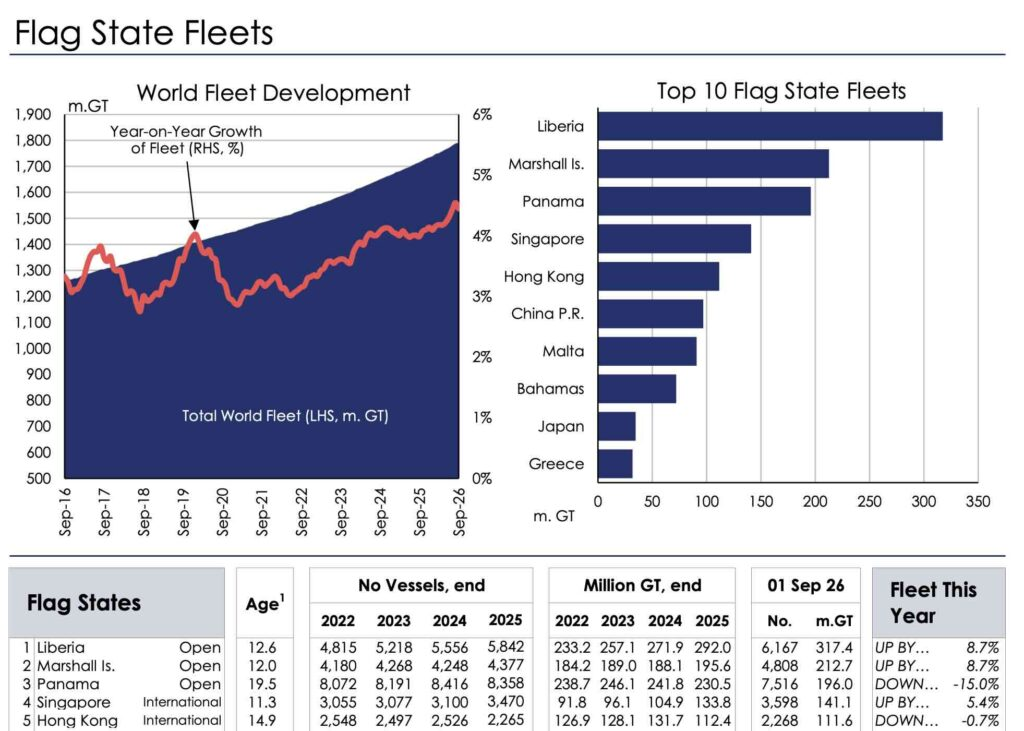
A graph illustrating the development of the world fleet, highlighting year-on-year growth percentages, alongside a bar chart showcasing the top 10 flag state fleets by size in million gross tons (m. GT) for September 2026.

Source: Clarksons Research, via Splash 24/7

Logo of Splash247.com featuring the word 'Splash' in bold black font with a blue underline, followed by '.com'.

Sam Chambers September 25, 2026

https://splash247.com/panama-slips-to-third-in-global-flag-rankings/

Corporate governance in shipping

This article features an interview with Michael Webber, who has been tracking corporate governance in ocean shipping firms since 2016. He produces an annual corporate governance scorecard for shipping, now at his own firm, Michael Webber Research and Advisory.

One significant issue in shipping is the constantly changing mosaic of companies. Firms are constantly merging in companies and creating new spinoff firms, some containing only a single ship. It’s a chore to keep track of it all, let alone try to rate how well the firms are looking after shareholders. The ratings Michael provides are simply to inform readers of the practices the firms engage in. This helps investors and traders to understand whether the firm is practicing good corporate governance or engaging in bad practices.

Webber claims that companies that score low on his rating have trouble raising capital using equity. He thinks investors are becoming more selective. It’s not only affecting stocks on the market; IPOS are failing due to governance issues as well.

There are a lot of related party transactions in shipping. Some benefit public investors and some don’t. Because no one was looking very hard in the past, it can be complicated for an older firm, say from the 2000’s, to unwind old structures that were not examples of good governance. Some firms have been successful doing this, but Webber says shareholders are at an informational disadvantage when these transactions are proposed. His rankings try to shed light on the corporate governance of the actors, for the benefit of the shareholders.

Webber thinks governance is improving overall, and shipping has improved its image on Wall Street. His ratings help public shipping companies find opportunities to conform to best practices in governance, and that improves the image and reality.

The scorecard rankings for 2023 are shown below.

Image of Webber corporate governance ratings
(Source: Chart: Webber Research & Advisory)

The stock symbols of each firm are given. Webber has marked the firms that make no carbon disclosures.

Greg Miller· Thursday, July 27, 2023

Corporate governance in shipping: Who’s been naughty or nice?

Update: The University of Plymouth and the National and Kapodistrian University of Greece have announced a new ESG index to be revealed September 11th. It will be interesting to compare their work against Michael Webber’s.

Sam Chambers July 31, 2023

Maritime gets an ESG index