Tag Archives: shipowners

Dark fleets and Sanctions

We now have two worlds of international commerce, as a result of trade wars and the Ukraine-Russia conflict. As the Western world, principally the EU, UK and related countries and the US look to tighten sanctions on Russian oil exports, some shipowners are finding creative ways to get around the rules set by the West.

One important escape hatch is to flag ships with a Flag State that doesn’t enforce any of the sanctions. While this strategy may not get access to US or EU ports, it allows substandard ships, or those that don’t want to obey rules such as those banning ship-to-ship transfers without proper environmental and safety provisions, to trade with other countries.

Two stories caught my eye this week.

The first article notes that the Cook Islands nation has become a top 30 Flag State, due to the registry of ships that trade Russian, Iranian, or Venezuelan oil, all sanctioned by the Western Powers. Cook Islands is located in Polynesia, and is self-governing, but has an external defense relation with New Zealand. It consists of 15 islands, with a total area of 91 square miles. It has an Exclusive Economic Zone surrounding it, of some 770 thousand square miles. Many of its residents also have New Zealand citizenship. The population is about 15000 as of the 2021 Census. (All figures from Wikipedia, retrieved on July 29, 2024.)

Sam Chambers July 29, 2024

Dark fleet additions see Cook Islands become a top 30 flag

Apparently tankers are the primary ships flagged there; the Russian oil trade needs ships that will carry Russian oil sold at prices exceeding the $60 per barrel cap set by the Western sanctions. Often these are substandard tankers, and since they cannot land at Western ports they may not meet safety, environmental, or ship management standards. A Flag State like Cook Islands will not be in a position to enforce any of the international standards for safe operation.

The article also points out that LNG is also starting to be traded via a shadow gas carrier fleet, largely based in Dubai. Those ships will likely also be registered in Flag States that are unable to enforce international standards.

The second article shows why the shadow fleet is arising. India’s imports of Russian crude oil are skyrocketing to 1.8 million barrels per day compared to just 88,000 bpd in 2022. Part of the reason is logistical constraints, another important part is price. India can buy sanctioned oil at the reduced sanction price from Russia. But they can also buy other Russian oil, possibly at even lower prices, using the shadow trade.

Russian ports are not located where they can conveniently trade with India. But in the dark market, oil can be swapped and traded without incurring sanction restrictions, and more favorable transport obtained. Some movement did occur from the Black Sea through the Suez Canal, but that is now limited because of the Houthi attacks on shipping in the Red Sea. Ships now need to move around the Cape of Good Hope to reach India, adding many miles and days to the voyage. It’s more profitable for a dark fleet tanker, but adds to the full cost of the oil delivered in India.

The article talks about the dangers of using the dark fleet for moving oil. We can expect more oil spills and accidents due to the substandard condition of the ships and the failure of masters to follow international rules.

Seatrade logo

Paul Bartlett | Jul 29, 2024

Indian oil importers’ thirst for Russian crude drives dark fleet demand
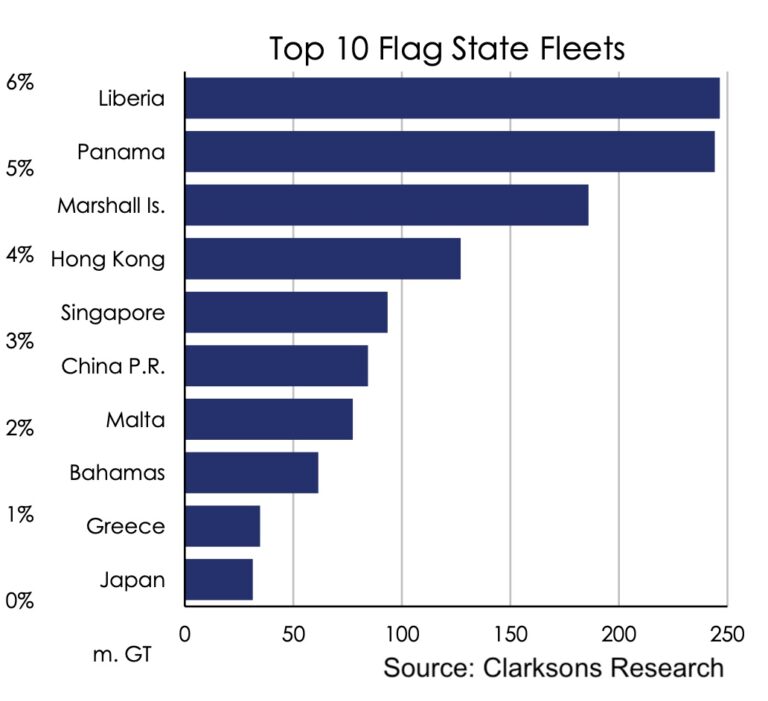
Liberia replaces Panama as the world’s largest flag

Flag state selection by shipowners is becoming influenced to a great degree by geopolitical concerns. A sign of this change is Panama’s loss of the largest flag state title.

One of the factors is certainly Panama’s recent attempt to improve the quality of the shipping registered under its flag. The Panama Registry purged a large amount of substandard tonnage from its rolls. Much of this tonnage was ships engaged in dark or gray trade, skirting Ukraine War sanctions on Russia, making unsafe ship-to-ship transfers, and hiding locations from the AIS system.

This action is coupled with Panama’s alliance with the US Coast Guard standards for shipping safety. Ships registered in Panama will need to comply with the rather strict safety rules the US uses. These are signs that Panama wants to be considered a premier place to register a ship with no substandard tonnage.

I believe the shift to Liberia and other flag states is largely determined by geopolitics. The records reviewed here, compiled by Clarksons, show also that smaller states like Malta and Cyprus, which are right in the line of fire of the Ukraine War’s shipping, have also suffered.

It is really interesting that Germany has risen markedly in the rankings. Perhaps this reflects renewed interest in German shipping. Germany has been spending money on shipping recently, deepening the Rhine to reach Hamburg, and also aiding inland water routes to reduce truck traffic and save fuel for the tonnage of cargo moved.

The nice figure below shows the rankings today of the flag states.

 Sam Chambers July 28, 2023

Liberia replaces Panama as the world’s largest flag

New shipping regulation to combat global warming is under fire

The International Maritime Organization (IMO) has issued their rules for the Carbon Intensity Indicator (CII), which is intended to combat global warming by reducing carbon emissions. It’s been years in the making.

But some of those affected by the regulation think there are flaws in the index which can produce some unintended consequences.

We know that many ships are chartered– they are operated by firms or people who are not their owners. Charter contracts determine how the ship will be operated and how the ship owner will be paid for allowing the use of his ship. But the contracts may allow the charterer to operate the ship in a way that reduces the CII score and causes the ship to fall into a lower class. Perhaps the ship falls into Class E which says the ship should be withdrawn from commerce– sentenced to the shipbreaker.

The Baltic and International Maritime Council (BIMCO), a non-governmental group that offers clauses for contracts addressing numerous international shipping issues, has prepared a contract clause for chartering contracts. This is a useful starting point, because BIMCO contracts and clauses are often used as a starting point for making a charter contract. Use of the BIMCO contracts or clauses is totally voluntary.

The article below explains some of the issues that can arise between charterers and owners, with equations to boot. The essence of the problem is that the index is based on ship capacity, not cargo carried. So sailing empty miles improves your score on the index two ways– first because sailing light burns less fuel, and second because the miles add to the denominator of the measure, reducing it. The examples given show the effect.

Many feel the index should be based on carrying cargo. And some believe the BIMCO clause will not be workable in contracts, and will not use it. But the problem remains of how to divide responsibility between ship owner and charterer for managing the CII score.

I tend to believe any rule is better than nothing. And I think charterers and shipowners will work out how to manage the contract problem. As for empty sailing or sitting in port, I don’t think anyone wants to sail without a paying cargo, or suffer delays even to improve the index. So everyone, owners and charterers, will continue to fill their ships when they can, and sail shorter routes when they can, simply because it’s expensive to operate the ship you’ve chartered; you have to earn a profit at it.

For all the complaining, the CII is still a good thing. We will have to see if it can be tweaked to everyone’s satisfaction.

Greg Miller·Wednesday, December 21, 2022

New shipping regulation to combat global warming is under fire
