Tag Archives: politics

Is a New West Coast Container Port Needed? The Coos Bay Dilemma

Coos Bay, OR, USA is pushing for a new West Coast US container port. It will have rail to the port, so that transloading can take place directly to it.

The port planners see a need for another West Coast port of entry for Asian containers that will reach inland via intermodal rail as far as Chicago. The Oregon International Port of Coos Bay has obtained a $25 million grant for pre-planning and pre-construction. The grant will be matched by $25 million from NorthPoint Development, and will be used for environmental review and preliminary engineering activities.

The map below shows why environmental concerns might be considerable. Coos Bay is a small town that’s long been a Mecca for beachgoers and people who love the coastside style of living. A friend moved there from Santa Rosa, in the Bay Area, for that reason.
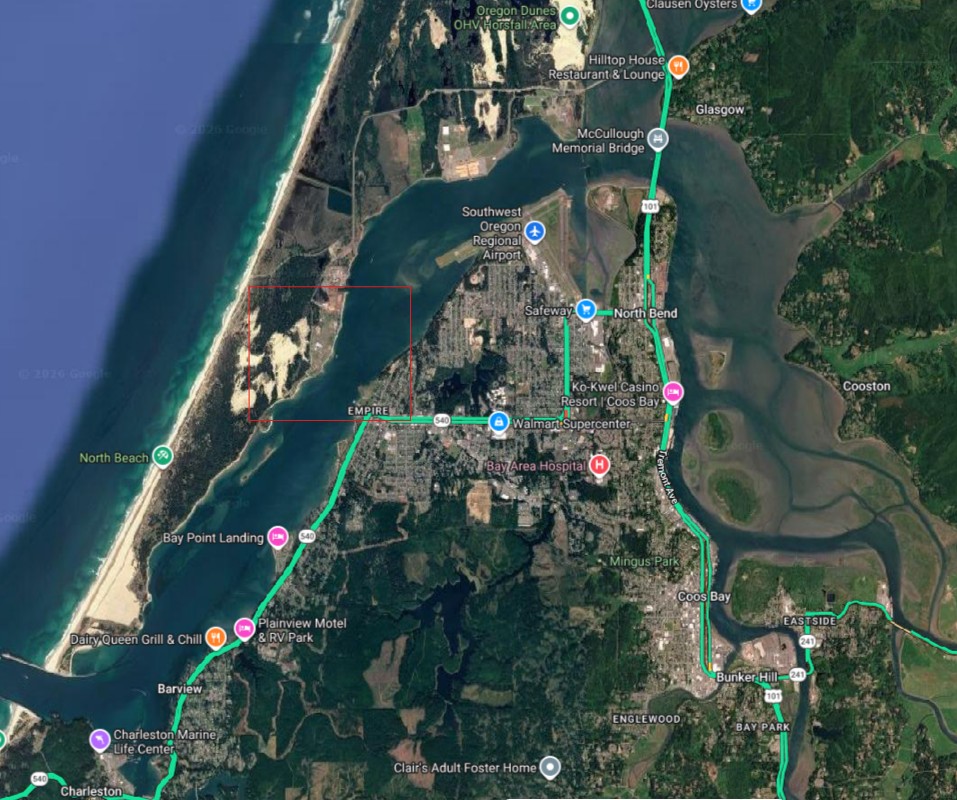
Google Map of Coos Bay, OR. Red square shows the approximate location of the new container port.

You can see on the map that ingress is through a small strait, with a narrow bay running northward to the Coos River. The port will be on the barrier island, just below another industrial site, a sawmill, according to the planning material. Its projected capacity will be 2 million TEU, or one million forty-foot containers per year.

That’s quite a few. It’ s only a bit smaller than the Port of Oakland, in CA, which runs about 2.5 million TEU per year. And it dwarfs the container traffic at the Port of Portland. However, Portland specializes more in automobiles, and grain and minerals bulk. If the port runs at 60% capacity, a reasonable figure for international container ports, that would be 1.2 million TEU per year, or 500,000 forty-foot units.

It’s not a bad idea, geopolitically, to have another West Coast port for containers. It’s a relief valve for the big California ports, which are subject to periodic longshore union strikes and other potential disruptions. Those ports are also major sources of pollution.

The all-rail connection should also make air pollution less of a problem. Perhaps the port can prevent local drayage from causing mammoth traffic and air problems in this pristine area.

Notice Charleston Marine Life Center at the entrance to the strait, a branch of the University of Oregon. Below is a photo of a Dungeness Crab, a local resident; delicious and protected from overfishing. Dredging, which the plan says is necessary, may threaten marine species nearby.

Boxes will move via a short line, Coos Bay Rail Line, owned by the port. It runs north from the peninsula about 137 mi, terminating near Eugene OR at the Union Pacific line. That provides access by rail to all of the central US. And if the UP/NS merger comes to pass, it will provide a single transfer access even to the Northeast US and even Europe. That provides access by rail to all of the central US. And if the UP/NS merger comes to pass, it will provide a single transfer access even to the Northeast US and even Europe.

It’s not clear that more capacity is needed on the West Coast of the US, particularly if interntional maritime trade is resetting and the Asia-US container movements are declining.

Evidently East Coast container traffic is also in decline.

We see a report today of Charleston, on the US East coast, shutting down a 700,000 TEU capacity terminal, Leatherman, because of low demand. It only processed 75,455 containers so far this year. The final capacity of Leathrman Terminal when built out is planned to be 2.4 million TEU. A second berth construction project is being continued. The planned rail yard adjacent to Leatherman, a $690 million project, is being suspended.

freigntwaves logo

Trains.com Staff Wednesday, June 24, 2026

https://www.freightwaves.com/news/oregon-port-oks-federal-rail-grant-agreement-for-multimodal-project

Jun 25, 2026 4:59 PM by The Maritime Executive

https://maritime-executive.com/article/charleston-pauses-operations-at-new-terminal-citing-low-volume-high-costs

Latest Flag State Registries for shadow fleet

The shadow fleet consists of ships that are sanctioned by governments, or who are associated with sanctioned entities, such as shippers or brokers or owners. They’ve needed to be able to show a registration to get insurance or to enter ports.

But they need a flag state that isn’t going to ask very many questions. And that is not going to enforce the nation’s rules on your ship. And that isn’t going to care about how you maintain the ship or take care of the crew, or handle potential pollution problems. Most of the shadow fleet consists of older ships that can be expected to need more frequent maintenance.

Recently some flag states, such as Panama, have tightened their regulations substantially, and are committed to greater oversight. However, others still operate simply as rubber stamps for a fee.

The maritime intelligence firm Windward has reported that Nicaragua and Equatorial Guinea have started taking on shadow vessels in their flag registries.

There are also many cases of false-flag registries, which purport to be associated with a nation, but in fact are simply paper-shuffling offices set up to mislead those who rely on flag identification for activities such as port entry.

Some registries are often seen as “rubber stamps.” While they technically require “proof of insurance” and “non-sanctioned port” letters, the recent case of the tanker Apple (flying the Equatorial Guinea flag) shows that these vessels often ignore reporting requirements and operate under opaque ownership despite these formal rules.

The International Maritime Organization (IMO) recently approved new guidelines aimed at improving transparency in ship registration and cracking down on the growing misuse of flags.

We need to see how much the IMO actions actually affect the picture. But past history is not promising. The effect the IMO can bring to bear is at the nation level.

It’s unrealistic to expect nations to police external private firms that produce false-flagging documents. However, nations can have an effect by announcing their rejection of false-flag firms, by name and location.

Nations can have a substantial effect if they choose, like Panama, to announce and follow up on their enforcement of the rules. That would mean tracking possible use of their flag papers and striking off ships that are not using them legally, or are violating national and IMO rules, such as insurance and crew treatment.

I’m a skeptic that nations will stand up and do this. But recent actions by some flag states are good signs, and some stiffness on the part of the IMO may be rewarded.

Sam Chambers April 22, 2026

https://splash247.com/nicaragua-and-equatorial-guinea-emerge-as-latest-homes-for-sprawling-shadow-fleet/

Atle Staalesen

https://www.arctictoday.com/shadow-tanker-sailed-outside-200-mile-zone-to-avoid-norwegian-scrutiny/

US shipbuilding hard to revive

BRS is a major shipbroker headquartered in Geneva, with offices around the world. The group has issued its Annual Review 2026. One of its features is an assessment of seven major shipbuilding markets. I was interested in its take on the potential for Trump’s plan to revive American shipbuilding.

The BRS study has a very negative view. It views some ‘structural’ issues, to use economic jargon, as serious barriers. One of these barriers is the lack of sufficient labor of the kinds required in shipbuilding. Not enough engineers, not enough pipefitters, welders, and factory workers.

Not only does the US not have these workers; its recent immigration policies are preventing an influx of immigrants who might take these jobs, or allow Americans to take the jobs instead of working service jobs. The birth rate in America is also at an all-time low of 1.62; a factor of 2 is required even to replace the existing population. And surveys indicate that less than 20% of Americans want to take manufacturing jobs rather than service jobs. So where are the workers?

Another factor is manufacturing support infrastructure. Where are American shipyards going to get the supplies and sub-assemblies they need? American manufacturing has, for many years, been ‘hollowed out’ as the American economy shifted to services. Such supplies will need to come from abroad, adding to the cost and the risk. Even today, much US manufacturing is being farmed out to Mexico; closer and safer, and with more secure labor, perhaps, than China, but not nearby most American shipyard locations.

A third factor is capital. One thing the US has is an excellent capital structure, encouraging investment. But where will that capital want to flow? To the industries generating the greatest returns— artificial intelligence, healthcare, consumer services, financial services— not to hard industrial development. Pitchbook already reports something like 50% of capital for startups is going into AI and to data centers supporting AI. How will this rebuild an industrial base?

And investment capital today is facing some serious redemption issues. Investors want to get their money back with profit and are no longer willing to wait for the returns. It is taking longer to build companies. Investors, especially smaller retail investors being courted by venture capital, want their money back on schedule. That’s typically 5 or 7 years, much less time than startups need, especially in the industrial space. Even for software companies, it’s challenging.

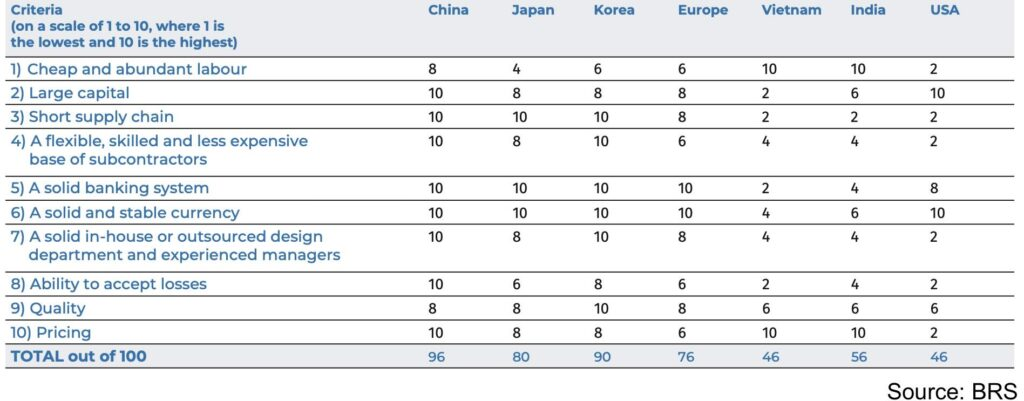
Below, BRS summarizes in a table various countries and their performance on 10 criteria important to shipbuilding. They use a scale of 1 to 10 to evaluate each criterion. It’s enlightening.

I am looking for more information from BRS on how the measurements for the countries are made.

The US has not been a major shipbuilding nation since it ran out of wood. And woodworkers. It’s not likely to come back.

The Annual Review 2026 from BRS is here. You can download it.

Sam Chambers April 1, 2026

https://splash247.com/brs-exposes-the-scale-of-the-challenge-facing-trumps-maritime-ambitions/