Tag Archives: supply chains

State of Logistics 2025 Report

The 2025 State of Logistics Report is out. It’s commissioned by the  Council of Supply Chain Management Professionals (CSCMP) and prepared by global consulting firm Kearney with help from Penske Logistics.

Its title is “Navigating through the Fog”, which captures the confusion and uncertainty of the scene today.

Report highlights include:

  • A notable report statistic, U.S. business logistics costs, is $2.3 trillion, which translates to 8.7% of the national GDP.
  • There are multiple reasons why demand has not yet fully recovered. Chief among them are simultaneous geopolitical conflicts around the world, climate change (which has affected shipping lanes), high inflation, high interest rates, and, apart from the U.S., sluggish demand.
  • As a result of the economic headwinds and geopolitical instability, the continued fragmentation of global trade is complicating supply chain transactions. Since the 2023 report was released, over 1,000 U.S. freight brokers have shuttered their doors.
  • Some of the largest manufacturers and retailers are seeking to monetize their own logistics capabilities while viewing their supply chain successes as a service to market and profit from.

The annual report is well worth reading as a snapshot of what’s going on. But in these volatile times, it’s really hard to make predictions. Hats off to the authors for trying.

Download the report

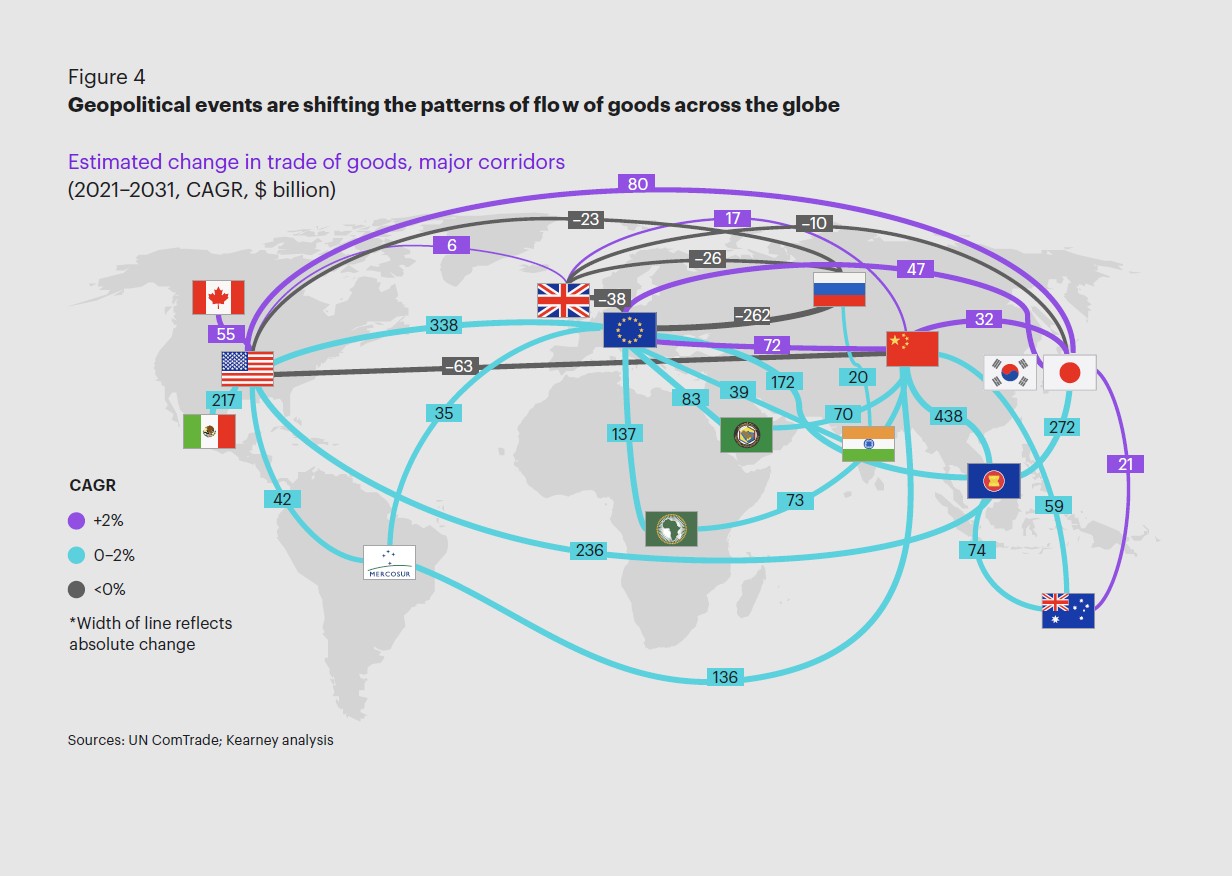
I liked this graphic from the report, which shows predicted changes in international goods flows between 2021 and 2031. With all the geopolitical issues we’re facing, things could change overnight, but one thing we see is a mammoth reduction in US trade with China. And they’re predicting even a bigger reduction in trade between the EU and Russia.

EU’s Black Sea Maritime Safety Hub: A Strategic Initiative

The EU is planning to create a Black Sea Maritime Safety Hub.

It’s important because of the adversarial maritime climate there. The Black Sea is used by Ukraine, Russia, Turkey, and other nations as a port to the world. It’s busy, and there is danger of interference or attacks due to the war in Ukraine.

“The EU is committed to help turn the Black Sea into a mine-free sea basin through enhanced cooperation with its member states, the Black Sea partners, like-minded countries, and partner organizations,” it declares.

The plan does not propose a specific location for the hub but outlines a role in building maritime situational awareness through monitoring efforts. It would include a focus on submarine cables and offshore assets including gas and wind energy infrastructure. It would also focus on the dangers created by the shadow fleet of tankers involved in the Russian oil trade.

These are all useful functions for international trade in the area. Kudos to the EU for stepping up.

Published May 28, 2025 2:03 PM by The Maritime Executive

https://www.maritime-executive.com/article/eu-plans-black-sea-maritime-safety-hub-seeking-to-build-regional-relations

A “radically simplified” solution for SAF

I don’t usually write about air, but in this case I have two connections.

First, Aether Fuels is a new Chicago-based concern with an innovative approach to the Fischer-Tropsch process for making fuel from waste. When I was in Chicago, I participated in some of the planning for the South Chicago airport, which sparked my interest in airport development. If you’ve flown through O’Hare, you have some idea of how jammed-up air transport is in Chicago, and why new venues are needed, especially for freight.

Second, I’m interested in new technologies for sustainable fuels. What caught my eye here is the point at the end. The process can also be used to produce sustainable marine fuel! That really caught my eye.

The company is called Aether; they are well-funded by big corporate names. The article discusses a bit about the process, which is being developed now. A pilot plant is in the offing, maybe in the next couple of years.

One of the advantages of their process is its ability to use carbon-capture output as a feedstock. One of the big problems of carbon capture technologies is what to do with the output. Bury it? Crazy and costly! Another use for CO2 would be useful.

The article mentions that while the company’s goal is SAF fuel for airplanes now, the process could also make fuel for maritime transport. That’s a huge market, with a present-day need. There’s a risk that air carriers might have to compete for sustainable fuels with the maritime transport industry.

We can use all the sustainable fuels production we can get. It’s nice to see a startup that’s not “AI” or software, that can acquire funds to move a worthwhile effort ahead.

Dirk Singer Jun 01, 2025

https://open.substack.com/pub/simpliflying/p/how-aether-fuels-saf-conor-madigan