Author Archives: just2bruce

2021 vessel reliability recorded at its lowest ever

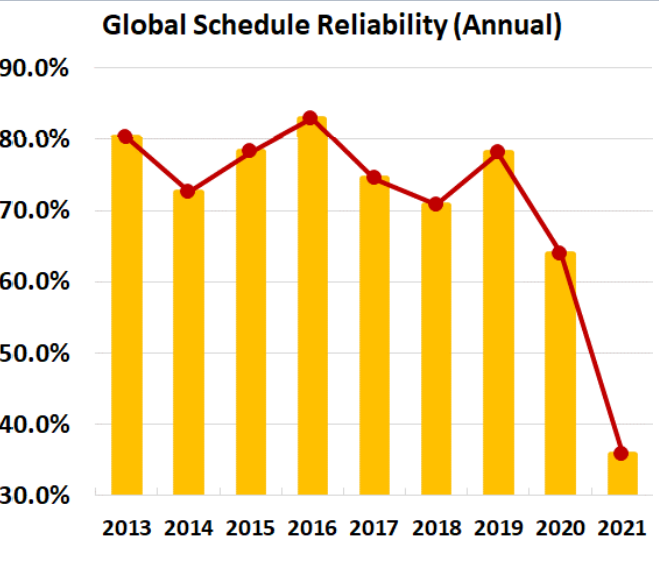
Ocean carriers are running a business in which their reliability of completing voyages planned in advance ranges around 30% to 40%. The highest reported here, by Sea-Intelligence Maritime Analysis, is Maersk at 46%. How can you run a business with these kinds of service levels?

The answer seems to be, VERY profitably. Most ocean carriers reported billions in net income.

I like this graph from the article.

Source: Sea-Intelligence, from article below.

While the trend down coincides with COVID, service levels were not great even before 2019. It’s due to the canceled sailings and skipped stops that are commonplace today. Port congestion has not helped.

But we can see a significant number of firms changing their level of dependency on the scheduled services offered by the major ocean carriers and the alliances,. Large shippers are buying their own ships and containers, usually of smaller size, and choosing when their shipments are scheduled, where they go, and how they get to their warehouses. Even some forwarders and brokers have started doing this. Other firms are looking for brokers who can help them find ways to get their cargo on time.

I think the large carriers have to start looking at how to improve service levels. If it means smaller ships and frequent sailings that don’t get canceled, that’s what it will take.

Perhaps we need feeder ships to allow the ocean carriers to consolidate multiple loads onto their giant ships for long voyages, but offload them near the destination. Years ago Al Baird, an English maritime economist, wrote about offshore container terminals, that could be used with short-range feeders to relieve the wharf pressure on our landside container terminals of today.

New thinking is needed to improve carrier on-time reliability. It won’t come without effort and money. But we can’t keep relying on ‘someone else’ to brainstorm solutions and give them a try. Especially when we’re earning billions.

8 February 2022 Jack Donnelly Ports and Terminals, Shipping Lines

2021 vessel reliability recorded at its lowest ever – Port Technology International

FMC to consider regulating ocean carrier billing practices

Demurrage and Detention are on everyone’s minds in ocean logistics today. The FMC proposes to regularize the information and timing of billing practices.

This could be very helpful in reducing the chaos of D&D billing today. It’s impossible to tell exactly which incidents happened when, and even who should pay. Those kinds of questions must have evidence to settle them, and it’s not being provided in bills. That results in long conversations and debates over the bills. It’s a huge time-waster, and fertile ground for complaints, refusals to pay, and legal action. These add cost while reducing consumer value.

In any principal-agent situation, when the cost of monitoring rises too much, the overall deal can’t be made. D&D charges are part of the cost of monitoring ocean trade. And in principal-agent models, monitoring costs often take the form of data collection and verification.

For years, ocean container traffic flowed fairly smoothly, and the events that triggered D&D charges did not happen very often. In those days, perhaps we could get away with settling claims by email and phone discussion. But with massive congestion worldwide, and only weak motivation to pick up empty containers, those days have changed.

We need accurate information for the parties to be able to resolve the D&D charges, and get the right bills paid by the right party. The FMC has it about right to take this first step, to regularize the bills.

Once that happens, if the D&D problem continues to be big, firms will recognize the value of investing in correct data gathering, and sharing it, and establishing standards for handling it.

John Gallagher, Washington Correspondent Monday, February 7, 2022

FMC to consider regulating ocean carrier billing practices – FreightWaves

Today on the transpacific: continued congestion and more blanked sailings

The headline makes you think that things are worse. However, in one way they’re better. Apparently ocean carriers are making a concerted effort to move empty containers out of LA and Long Beach Ports. And that will make a big difference in yard space at terminals.

Figures show that from late October and January 27, there have been 27 sweeper voyages from LA, carrying 68,000 empty containers to Asia, and 29 from Long Beach, carrying 76,000 empties. It sounds like a lot.

Ocean carriers certainly want to avoid the proposed fees at these two ports for letting empties sit in a yard. At times recently around 45% of the containers in the yards at LA and Long Beach have been empties.

However, when you consider that there are more than 600,000 containers per month coming into LA and Long Beach, the number removed does not seem that high— less than 23,000 per month on average from LA and 24,000 per month from Long Beach. It seems that more work is needed. And more jawboning.

And it’s important to also encourage exports using those containers. We don’t want empties being scarfed up when they could be used for exported products, say agricultural products, which are plentiful in California. The effort to create a port-based empty container filling station for ag products on the West Coast could help, but most ag products sail bulk to the Far East.

But I think more pressure on ocean carriers and others is still necessary.

By Ian Putzger, Americas correspondent 07/02/2022

Today on the transpacific: continued congestion and more blanked sailings – The Loadstar