Category Archives: Managerial Econ

Posts relevant to Managerial Economics.

FMC to consider regulating ocean carrier billing practices

Demurrage and Detention are on everyone’s minds in ocean logistics today. The FMC proposes to regularize the information and timing of billing practices.

This could be very helpful in reducing the chaos of D&D billing today. It’s impossible to tell exactly which incidents happened when, and even who should pay. Those kinds of questions must have evidence to settle them, and it’s not being provided in bills. That results in long conversations and debates over the bills. It’s a huge time-waster, and fertile ground for complaints, refusals to pay, and legal action. These add cost while reducing consumer value.

In any principal-agent situation, when the cost of monitoring rises too much, the overall deal can’t be made. D&D charges are part of the cost of monitoring ocean trade. And in principal-agent models, monitoring costs often take the form of data collection and verification.

For years, ocean container traffic flowed fairly smoothly, and the events that triggered D&D charges did not happen very often. In those days, perhaps we could get away with settling claims by email and phone discussion. But with massive congestion worldwide, and only weak motivation to pick up empty containers, those days have changed.

We need accurate information for the parties to be able to resolve the D&D charges, and get the right bills paid by the right party. The FMC has it about right to take this first step, to regularize the bills.

Once that happens, if the D&D problem continues to be big, firms will recognize the value of investing in correct data gathering, and sharing it, and establishing standards for handling it.

John Gallagher, Washington Correspondent Monday, February 7, 2022

FMC to consider regulating ocean carrier billing practices – FreightWaves
US importers using box ships to store cargo

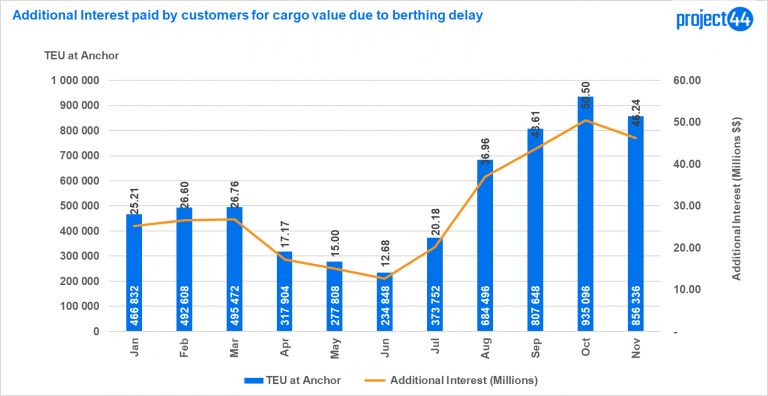
US importers are not so worried about cargo waiting offshore to be unloaded. As long as they have enough for their sales or manufacturing, the cargo can sit on a container ship and the principal cost to the shipper is the interest cost. With interest rates at historic lows, that isn’t much.

The graph below from project44, a Chicago, I- based visibility platform, shows the number of TEUs at anchor by month from January through November 2020, on the left. The rise starting in August is significant. Using data from HSBC, which show a 3.2% annual interest rate, using an average container value of $40,000, they calculate almost $50M per month in new delay costs, and cumulative inventory interest costs over $850 million.

The point is that these costs are a lot lower than inventory costs at warehouses. While the cargo is held at sea under riskier conditions, in the warehouse other costs kick in, not the least of which is space required. Insurance charges on the financed inventory also accumulate. And there’s the work, both labor and mechanical, of shuffling the inventory around; it’s very variable given the specific warehouse layout, but can be significant also.

So shippers are using the offshore jam-up rather than wishing it away. Only when the demand for products ratchets up so that the offshore inventory is needed will the stakes change. While we have significant COVID likelihood today, that isn’t likely to change much.

It’s always interesting to look at the overall question of inventory cost in the supply chain. Advantages to shippers can come from unlikely places.

By Nick Savvides 12/01/2022

US importers using box ships to store cargo – cheaper than warehouses – The Loadstar

Sourcing from Vietnam could shift as costs and restrictions rise

In recent years Vietnam has had its day in the sun, as production of certain items has shifted from China. It’s been cheaper to manufacture in Vietnam, and it’s been a boon to Vietnam’s economy.

But Covid brought a lot of problems to Vietnam, especially at ports. Now firms have to consider whether it’s time to move on, and go to another country.

Instability of supply chains is the new norm. While it’s costly and traumatic to change, sometimes the proper strategy requires it. You can see businesses are thinking hard about it. It’s supply chain strategy playhing out in the real world.

By Sam Whelan 23/09/2021

Sourcing from Vietnam could shift as costs and restrictions rise, warn businesses – The Loadstar