Category Archives: Shipping

Softening spot rates could mean ‘days are numbered’ for ad-hoc carriers

Spot rates for container shipments might be coming down from the stratosphere. There are a few indications, such as Xeneta’s XSI short-term index from Asia to North Europe.

If short-term rates really are coming down, what is going to happen to many new ocean shipping entrants in the trade from Asia? These new firms offer regular shipments with no blanking, faster transits, calling at less congested ports for faster unloads, status monitoring, and good communication.

Most of these firms have a limited number of smaller ships. The conjecture here is that they cannot survive if rates drop back to reasonable levels.

I think this position underestimates the value of on-time and reliable service. Many shippers will pay to get out of the bottleneck system the alliances are running, with large ships calling at large congested ports, and frequent delays of service, including simply canceling voyages if they aren’t full enough. You can’t have a viable business if you’re only on-time 30%-40% of the time. Lots of customers will choose another way.

We have already seen large container shippers such as Amazon, IKEA, and Costco choose dedicated service with captive vessels for some of their cargo. If it works well, that could expand, leaving the major alliances with less cargo to carry.

Interestingly, the large ocean carriers have a new name for what they are doing. Canceling a voyage is not to be called ‘blanking’, but rather ‘sliding’. Whatever you call it, it’s a disruption in service supposedly guaranteed.

By Mike Wackett 11/02/2022

Softening spot rates could mean ‘days are numbered’ for ad-hoc carriers – The Loadstar

Concordia Maritime looks at converting tankers to boxships

The new mantra is ‘anything that can carry containers’. Concordia owns 6 tankers they would like to convert to container ships. Recently it’s been bulk ships of other sorts that have been converted.

Back in the 60s, Malcolm McLean, the founder of container shipping, did just that for his first container ships! I didn’t know that!

Read on to see some of the details of the conversion.

Sam Chambers February 8, 2022

Concordia Maritime looks at converting tankers to boxships – Splash247

https://splash247.com/our-obligation-to-turn-every-stone-to-try-to-create-shareholder-value-concordia-maritime-explains-tanker-conversion-decision/

2021 vessel reliability recorded at its lowest ever

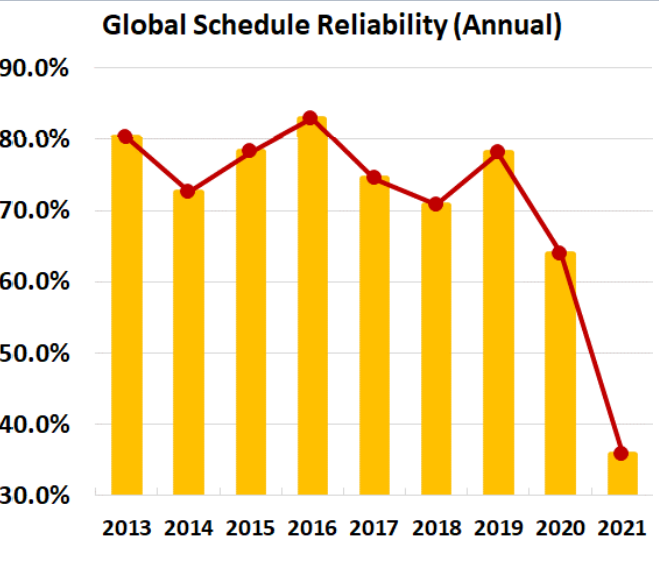
Ocean carriers are running a business in which their reliability of completing voyages planned in advance ranges around 30% to 40%. The highest reported here, by Sea-Intelligence Maritime Analysis, is Maersk at 46%. How can you run a business with these kinds of service levels?

The answer seems to be, VERY profitably. Most ocean carriers reported billions in net income.

I like this graph from the article.

Source: Sea-Intelligence, from article below.

While the trend down coincides with COVID, service levels were not great even before 2019. It’s due to the canceled sailings and skipped stops that are commonplace today. Port congestion has not helped.

But we can see a significant number of firms changing their level of dependency on the scheduled services offered by the major ocean carriers and the alliances,. Large shippers are buying their own ships and containers, usually of smaller size, and choosing when their shipments are scheduled, where they go, and how they get to their warehouses. Even some forwarders and brokers have started doing this. Other firms are looking for brokers who can help them find ways to get their cargo on time.

I think the large carriers have to start looking at how to improve service levels. If it means smaller ships and frequent sailings that don’t get canceled, that’s what it will take.

Perhaps we need feeder ships to allow the ocean carriers to consolidate multiple loads onto their giant ships for long voyages, but offload them near the destination. Years ago Al Baird, an English maritime economist, wrote about offshore container terminals, that could be used with short-range feeders to relieve the wharf pressure on our landside container terminals of today.

New thinking is needed to improve carrier on-time reliability. It won’t come without effort and money. But we can’t keep relying on ‘someone else’ to brainstorm solutions and give them a try. Especially when we’re earning billions.

8 February 2022 Jack Donnelly Ports and Terminals, Shipping Lines

2021 vessel reliability recorded at its lowest ever – Port Technology International