Category Archives: Supply Chains

US tariff fight shifts to Mexico

Mexican-made heavy equipment is being targeted in the latest Section 232 national security probes. These analyses are required before imposition of new tariffs. The claim is that such manufacturing should be performed in the US.

There’s some merit to argue that for national defense the US should have a vibrant heavy equipment manufacturing sector. If you think wars of the future will be fought with tanks, ships, airplanes, and large landing craft, the US should be able to ramp up production fast in case of a war.

Current wars aren’t fought that way. They are waged with missiles, drones, and portable explosives of many different kinds, delivered with high-tech mechanisms. And the Ukraine war and even Iran have shown that conventional forces can be stymied by the high-tech alternatives.

High-tech mechanisms are well within US manufacturing capabilities. There are plenty of jobs available at good wages, if you get the training.

A second argument for the tariffs is based on jobs for workers. High-paying manufacturing jobs are good for those who have them and like the lifestyle. But increasingly, young people are not choosing those jobs, preferring work settings that give them the ability to define their leisure time as they wish. Conventional heavy manufacturing does not fit that mold.

And in the US we have a declining work force, particularly if we choose not to let in immigrants for whom such jobs would be desirable.

So where are the workers going to come from?

We could be better off by cultivating our relations with Mexico and allow them to do the heavy manufacturing of automobile-like components.

Noi Mahoney Wednesday, April 01, 2026

https://www.freightwaves.com/news/us-tariff-fight-shifts-to-heavy-machinery-imported-from-mexico
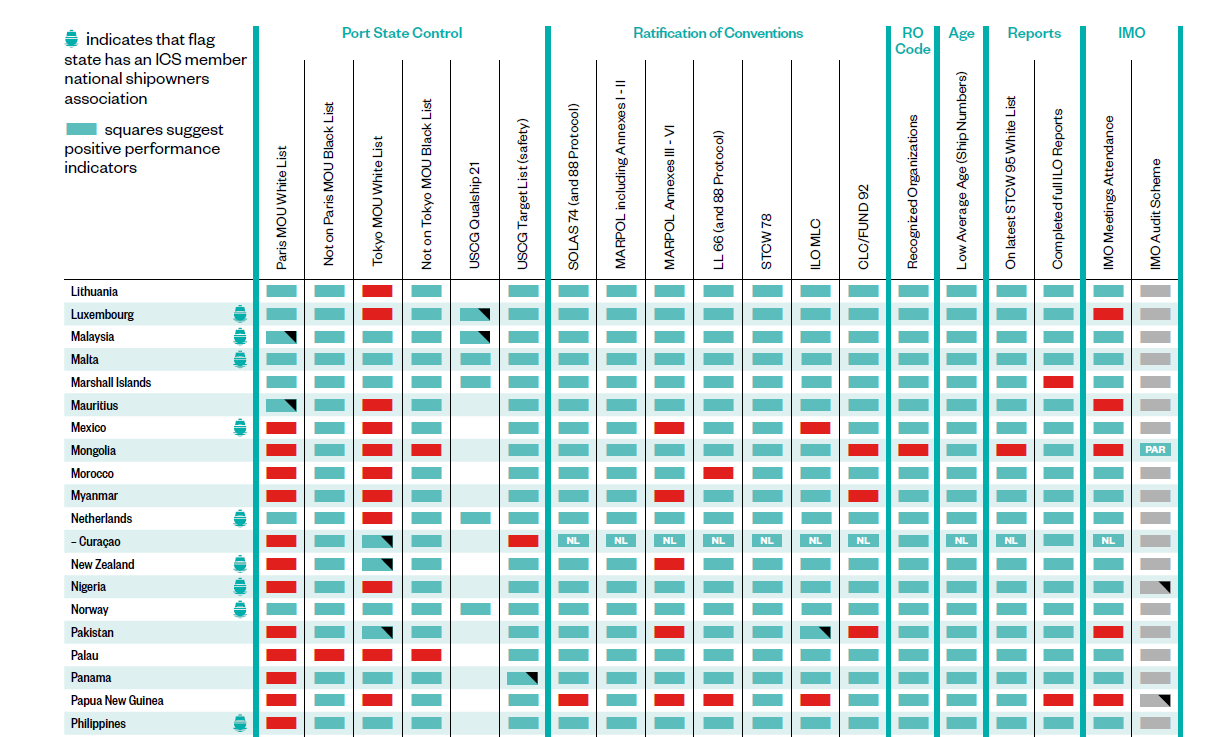
Maritime Flag State Ratings

The International Chamber of Shipping (ICS) has released its latest Shipping Industry Flag State Performance Table for 2025/2026. This report is updated annually. Flag state performance is growing in importance for the shipping industry.

Rounds of sanctions are occurring often, including sanctions of registries. Some ships are changing registries or even using false registries. Shippers, brokers, and carriers need to know the status of the ships they will be using.

The report highlights the criteria used to rate the flag states. Green squares signify positive performance by a flag state. Red squares highlight potentially negative performance. Various shades of grey and some additional markings indicate what the report calls neutral indicators.

Port Shipping Control (PSC) authorities provide most of the data for the ratings. There are three principal agencies and one target list:

  • Paris Memorandum of Understanding (MOU) countries
  • Tokyo MOU countries;
  • United States Coast Guard (USCG) Qualship 21 program
  • Respective blacklists or target lists of the agencies.

To be identified via the Paris and Tokyo MOU white lists, a flag must have undergone at least one inspection in the previous three years. For the Qualship 21 program, a flag must have made at least three distinct arrivals in each of the previous three years. For the Target Lists, flags listed as ‘Medium Risk’ have a neutral indicator.

Ratification of international maritime conventions such as UNCLOS, IMO and ILO also factor in. Some states may have partially ratified or accepted these conventions, or may have legal conflicts preventing ratification. These are also considered in the ratings.

A short section of the table is displayed here:

Source: ICS Shipping Industry Flag State Performance Table 2025/2026

The PDF report is accessible here.

It’s very important to have an independent verification of the performance of flag states regarding the major maritime conventions. These ratings give interested parties information to help them follow up on the standards the ships they hire are meeting. Questions should be raised before booking passage.

Sam Chambers January 28, 2026

https://splash247.com/ics-flag-table-names-and-shames/

Ocean shipping routing changes

Here’s an example of route changes now occurring due to disruptions and freight relocation. Maersk and Hapag-Lloyd are dropping Baltimore from their TA3 transatlantic container service, and adding Philadelphia.

The new rotation is Southampton – Rotterdam – Hamburg – Wilhelmshaven – Newark – Norfolk – Philadelphia – St. John – Southampton. The new schedule kicks off with the sailing of the Maersk Fredericia from Southampton Jan. 4.

The reason offered is the handicapped service at Baltimore due to the collapse of the Francis Scott Key Bridge in 2024, when the Dali ran into an abutment, collapsing the bridge. The rebuilding will take longer than anticipated. The bridge collapse has restricted access to some berths in the port of Baltimore. That has affected throughput at the port.

The article says:

For ocean carriers, calling Baltimore adds several days’ transit time compared to Norfolk, Va., and Philadelphia. Ships have to navigate 150 miles through the Chesapeake Bay, among the longest ship channels in the world, according to a 2019 study by Texas A&M University. The route also requires the services of multiple local pilots to guide vessels in, along with a separate docking pilot at the port.  

Stuart Chirls Tuesday, December 16, 2025

https://www.freightwaves.com/news/maersk-hapag-lloyd-drop-east-coast-city-from-trans-atlantic-services