Tag Archives: maritime logistics

California’s BIG Project: Transforming Rail Logistics

Here’s a project that should have happened 20 years ago.

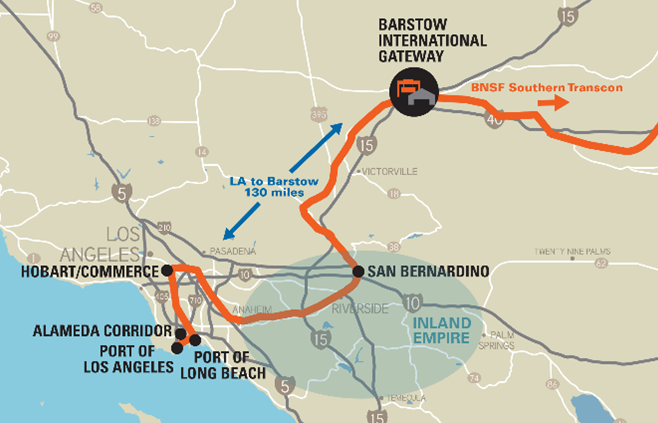
California’s major ports, at Los Angeles and Long Beach, have been desperate for relief from drayage traffic for containers they bring in. It was a struggle to get rail to the ports so that containers could be directly loaded. In 2002 the Alameda Corridor began to move double-stack double-track trains from near (but not on) the ports to the San Bernardino area. But rail service to the bulk of the US was still elusive. Transloading to 53-foot truck containers was the main activity in the Eastern valley. And that led to more truck traffic on the already busy freeways.

Remember that in the earlier days, pre-COVID, the land-bridge was still a preferred route from Asia to Europe. Ship to LA/Long Beach, Rail to New York or another eastern port, and ship again to Europe. It was lower cost and shorter time than any other Asia-North Europe route. And that included the numerous delays in moving goods by rail out of the port areas.

The problem has been urgent because of air pollution from the many drayage trucks traversing the area. California has been trying to address this problem from many directions. One of the first methods was the Clean Trucks program, which banned engines earlier than 2007 carrying to and from ports, and imposed other requirements on NOx and particulate emissions, especially PM2.5, a demonstrated pathogen for breathing problems. Gate reservations came next, as an attempt to articulate delivery and pickup with container movements in the yard.

But many noticed that switching from truck to rail would cut pollution even faster, and perhaps even improve efficiency. Numerous researchers, including my coauthor Chris Clott and me, suggested that moving functions off the port quickly to inland sites, called inland ports, would work. We even suggested, back when the land-bridge was functioning well, that inland ports as far away as Chicago could boost efficiency. The ports were not interested at that time.

Meantime, the ports and private firms have invested in the Alameda Corridor, which took double-stack, double-track trains through a frantically busy melange of LA suburbs, with many overpasses and intersections that had to be rebuilt, and many regulatory challenges.

Now finally, BNSF, a major Class I railroad, one of two serving the West Coast, has committed to a large inland rail intermodal terminal. It’s near Barstow, CA, out in the desert, kind of toward Las Vegas. This large inland port will be able to eliminate over 200 million truck miles by its completion in 2028.

The latest yard technology will be used, including zero-emission cranes, forklifts, and hostlers, electric plug-ins for refrigerated containers, and hybrid rubber-tired gantry cranes. BNSF has also committed to use the cleanest available switching locomotives in the yard.

The project is appropriately nicknamed BIG (for Barstow Intermodal Gateway). The press release says “By relocating container sorting and processing from congested port-adjacent communities to Barstow—a high desert hub with strong transportation infrastructure—the project enables a major mode shift from trucking to cleaner, more efficient rail.”

California and its residents are serious about industry controlling pollution.

Stuart Chirls·Wednesday, June 17, 2026

https://www.freightwaves.com/news/bnsf-wins-local-approval-for-new-4b-california-rail-intermodal-project

Christopher Clott, Bruce C. Hartman, Supply chain integration, landside operations and port accessibility in metropolitan Chicago, Journal of Transport Geography, Volume 51, 2016, Pages 130-139, ISSN 0966-6923,
https://doi.org/10.1016/j.jtrangeo.2015.12.005.

Ocean shipping routing changes

Here’s an example of route changes now occurring due to disruptions and freight relocation. Maersk and Hapag-Lloyd are dropping Baltimore from their TA3 transatlantic container service, and adding Philadelphia.

The new rotation is Southampton – Rotterdam – Hamburg – Wilhelmshaven – Newark – Norfolk – Philadelphia – St. John – Southampton. The new schedule kicks off with the sailing of the Maersk Fredericia from Southampton Jan. 4.

The reason offered is the handicapped service at Baltimore due to the collapse of the Francis Scott Key Bridge in 2024, when the Dali ran into an abutment, collapsing the bridge. The rebuilding will take longer than anticipated. The bridge collapse has restricted access to some berths in the port of Baltimore. That has affected throughput at the port.

The article says:

For ocean carriers, calling Baltimore adds several days’ transit time compared to Norfolk, Va., and Philadelphia. Ships have to navigate 150 miles through the Chesapeake Bay, among the longest ship channels in the world, according to a 2019 study by Texas A&M University. The route also requires the services of multiple local pilots to guide vessels in, along with a separate docking pilot at the port.  

Stuart Chirls Tuesday, December 16, 2025

https://www.freightwaves.com/news/maersk-hapag-lloyd-drop-east-coast-city-from-trans-atlantic-services

Resilience blind spot in shipment routing

Companies have done a lot of work on supply chains in the last year to improve their resilience to geopolitical glitches. It’s been hard work to diversify suppliers to different countries to lessen risk.

But another form of risk is control of the terminals and transfer points on shipping routes. The article here notes that the port of Shanghai in China has grown at over 6% annually, even though the Chinese economy only grew at 3.5%. What’s using all that capacity? The answer is that many shipping routes still move through Shanghai even though the origin and final destination of the cargo is not in China. The routes themselves are subject to disruption if relations with China sour.

It’s also worthwhile to point out that Chinese entities control or have major financial interests in many ports round the world. If a shipper really wants to assure some independence from China, she will have to examine their shipping routes as well as the country of origin.

Is there a way to look at this connectivity? The article suggests an analysis by SKU of the port connectivity involved in the supply. A high-level indicator is provided by UNCTAD’s port connectivity index, available at this link.

To see how the index works, read this: https://unctad.org/news/new-context-calls-changing-how-we-measure-maritime-connectivity The six major components are given here:

  1. Number of direct connections: The more countries can be reached through direct shipping services, i.e. without requiring a transshipment, the faster and less risky is the connection.
  2. Number of weekly calls: The more often ships depart from a port, the lower the waiting time for the shipper.
  3. Number of companies providing services: The more choices shippers have, the less likely they are confronted with potential negative impacts of oligopolistic or monopolistic markets (i.e. higher prices and lower service quality).
  4. A higher number of services is an indicator of shipping options for the importer and exporter. Services may be provided jointly by various carriers, and each carrier may provide several services.
  5. Total deployed carrying capacity: The TEU[i] that can be imported and exported to/ from a country is an indication of the total transport service supply.
  6. Size of the largest ship: Larger container ships are more likely to be deployed in hub ports, providing additional connectivity to importers and exporters from the port thanks to trade between third countries. Also, ports that can accommodate larger ships tend to have better port infrastructure and port services.

The connectivity index is only a rough tool at best for supply chain planners and logistics pros. One needs to investigate the individual routings used for SKUs, and that requires close cooperation and openness with carriers and any third-party firms you use for logistics management.

Furthermore the routing may change even though the carriers involved are the same. So it’s daily attention rather than autopilot. Perhaps this is a job for AI agents. Almost daily checks may need to be made.

Then, what do you do about it? Do you have the power to force a change? Do you want to pay for the change? These are not easy decisions, but they certainly require attention at operational, tactical and strategic levels.

I would not be surprised to see the emergence of startups that can provide dynamic routing visibility and costing, perhaps with AI agents. Such tools can help in the current world scenario. They are most relevant in the fast-changing world political scenario we are in today. That churn is creating costs for supply chains we couldn’t even imagine two years ago.

Some scenarios around the trade lanes are presented by McKinsey. The following graph shows some basic geographical groupings and three scenarios of activity, called Baseline, Diversification, and Fragmentation (the worst), over the period 2022-2035. Compound annual growth rates could range from +6% (China to emerging markets) to -8% (advanced economies to China). The source here is this web page. Such large adjustments over a long period means there’s a risk of stranding investments in infrastructure, including ports.

The people of the world will be much better served by open trade rather than fragmentation.

Splash December 15, 2025

https://splash247.com/shanghais-box-boom-exposes-a-resilience-blind-spot/