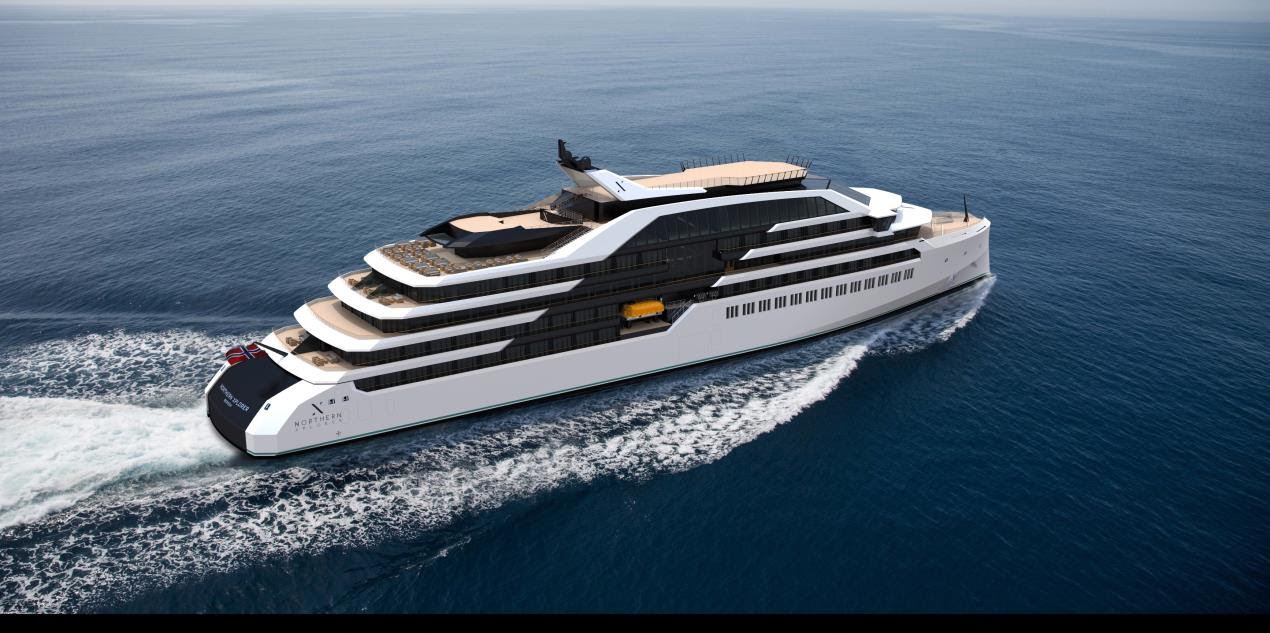
Alternative fuel ships are essential for the Arctic cruise business, since fossil fuel burners will be banned in the Arctic seas starting in 2026. Here’s an innovative approach to develop an entire system, including engines and fuel production, for green hydrogen power of a cruise ship. The ship is expected to be ready for the 2025-2026 cruise season.
Four companies have joined forces to pull this off. I think it’s a great plan; I hope they can carry it out effectively.
Press Release (via Blue-C) January 31, 2023
A multidisciplinary collaboration, for which a Memorandum of Understanding (MOU) was signed last week, has the ambitious goal to develop a complete hydrogen value chain for Northern Xplorer AS (NX) first zero-emission cruise ship featuring fuel cells and electric propulsion, as well as making pollution-free hydrogen available to the wider maritime market at a time of urgent pressure to reduce emissions.
The partners comprise zero-emission cruise venture Northern Xplorer AS, hydrogen provider and owner of infrastructure Norwegian Hydrogen AS, high-capacity hydrogen transfer system supplier HYON AS, ship designers Multi Maritime AS, and hydrogen storage system provider Hexagon Purus Maritime AS.
Preparing for zero-carbon era
NX CEO Rolf A Sandvik says using hydrogen as the energy carrier will enable cruise ships to continue to access vulnerable regions such as Norway’s world heritage fjords, which by government regulation will be closed to ships burning fossil fuels from 2026. Other regions both in Norway and elsewhere will likely follow suit in future.
“This is a very exciting project and a milestone in the development of the clean maritime economy as the green shift takes root. We are delighted to be working with strong partners with deep competence in all the touch points required to develop the infrastructure for hydrogen-powered ships of the future, not only cruise but also commercial shipping,” he added.
“Northern Xplorer has a very exciting concept with a spectacular, sustainable and future-oriented ship design that is truly pleasing to the eye. We are very pleased we have been selected to assist in developing the necessary infrastructure for these ships to run on zero-emission hydrogen when they come into operation,” said Norwegian Hydrogen CEO Jens Berge.
Holistic approach
“We are excited to be part of a consortium consisting of industry leaders within the hydrogen value chain. Together we cover the full value chain, making this an important milestone in establishing hydrogen infrastructure for the maritime sector. Time is of the essence,” added HYON CEO Jørn Kristian Lindtvedt.
“This MOU strengthens our existing relationship with NX and expert partners, and facilitates the alignment of technologies between us. We look forward to seeing the first zero-emission cruise ship running on compressed hydrogen,” said Hexagon Purus Maritime MD Robert Haugen.
“We have been working for three years to create an eye-catching design that will incorporate the latest propulsion technology and vessel systems. It’s great to be part of this ground-breaking project and as a collaboration partner we are eager to bring this vessel and the associated hydrogen infrastructure to reality,” said Multi Maritime CEO Mikael Johansen.
NX signed a Letter of Intent (LoI) with Portuguese shipbuilder West Sea for the construction of its maiden vessel with delivery slated for the start of the 2025/2026 cruise season.
For more information contact:
Rolf A Sandvik, CEO Northern Xplorer
E: hello@northernexplorer.com
M: +47 90 60 48 25
Jens Berge, CEO Norwegian Hydrogen
M: +47 90 55 13 55
Jørn Kristian Lindtvedt, CEO HYON
M: +47 95 27 07 39
Robert Haugen, MD Hexagon Purus Maritime
E: robert.haugen@hexagonpurus.com
Mikael Johansen, MD/CEO Multi Maritime
E: mj@multimaritime.no
M: +47 48 16 78 46