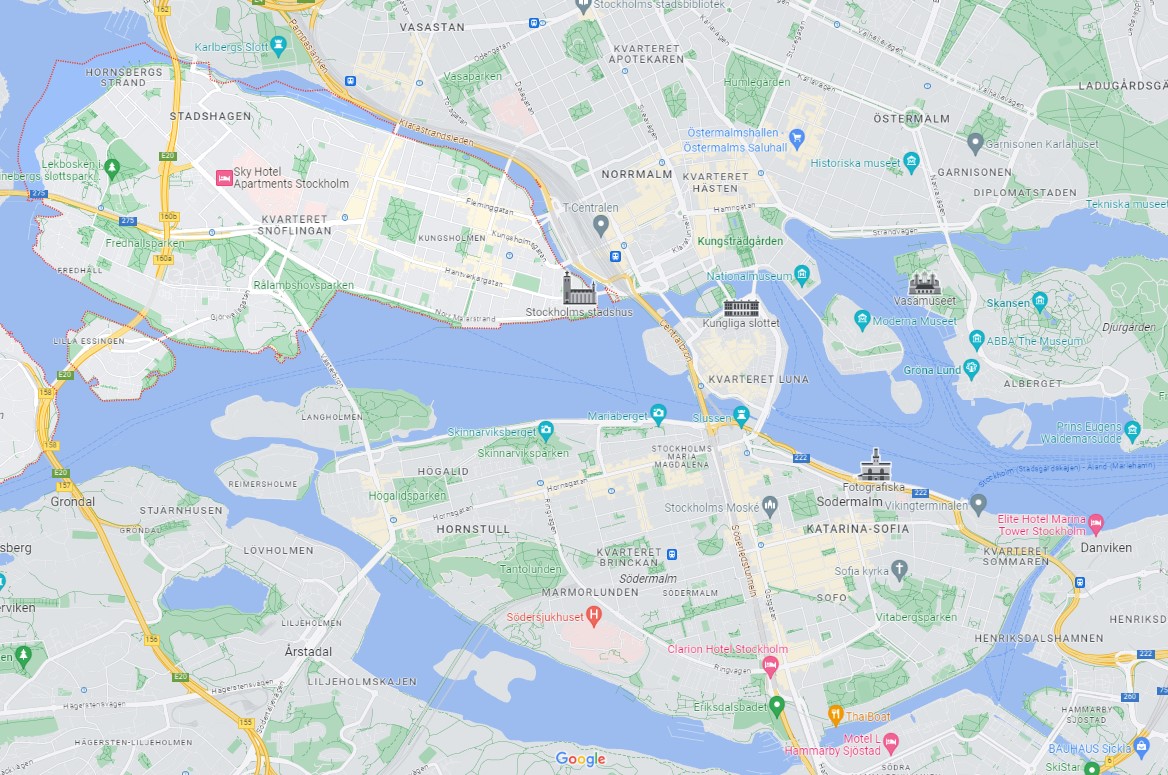
Stockholm will launch the world’s first self-driving passenger ferry, powered entirely by electricity. The ferry will run between the Stockholm islands of Kungsholmen and Sodermalm, starting in June, 2023.
It is owned by Torghatten AS, one of Norway’s important companies in the transportation industry. Torghattan’s annual revenue is approximately NOK 3.7 billion and it has approximately 1250 employees. Its core business is seaborne transportation in Norway (Torghattan website), with over 90 passenger and ferry vessels. Torghattan is owned by the Swedish private equity company EQT.
Ideas for the ferry started at the Norwegian University of Science and Technology (NTNU) in Trondheim, Norway. The goal was to create more sustainable urban mobility. The company Zeabuz was spun off from the autonomous vessel research community at NTNU, who built the first autonomous ferry prototypes, specifically to develop the autonomy system for these ferries.
Stockholm has many islands. Kungsholmen is central to the city, and is where the city hall (Stockholms stadshus) is located. Sodermalm is a neighboring island, just to the south. The distance traversed is not large, but an autonomous ferry will make it convenient to travel between the islands. There are bridges, but the ferry provides a walkable alternative.
It’s not just trucks. The California Air Resources Board (CARB) wants to phase out diesel locomotives as well.
Diesel locomotives could well be a more insidious polluter than diesel trucks. They run through many disadvantaged areas, where the poorest live, and are subjected to particulate and greenhouse gas emissions. And particularly around ports, rail service is frequent and requires diesel locomotives to stand around waiting.
I think some regulation is a long time coming, and badly needed. If the feds won’t step up, let California be a leader.
UMAS is an acronym for University Maritime Advisory Service, a commercial advisory service, or consulting firm, focusing on the maritime segment. It makes use of the University College London shipping team as subject matter experts, and takes on relevant projects for the maritime industry.
Recently they’ve released a report entitled A Strategy for the Transition to Zero-Emission Shipping, which tries to spell out ways that a pathway to a 1.5 degree Centigrade increase could be found. It’s an interesting study because it deals with not only the science-based facts about fuels and propulsion systems, and ship designs, but also with the organizational, regulatory, private investment, and geopolitical aspects of a transformation.
The study outlines three scenarios for a fuel transition away from fossil fuels. These are:
A spread from a strong first-mover country to others
Independent spread from several countries
Global actions (such as the IMO) to drive international spread.
The report goes on to identify levers for change in each scenario, covering three phases of the transition to 1.5 degrees C. The phases are Emergence, Diffusion, and Reconfiguration. They are captured in Figure 19, on page 67 of the report. Here you can see the importance of developing new technologies and investing to expand deployment in the first two phases.
The question they address is how to get all the factors necessary to work for the change in each phase. Especially important are the Energence and Diffusion phases, partly because that’s where we are now, and partly because success there largely determines how we reach the final phase.
The report sees a place for all three scenarios in the effort. It’s quite clear about how companies, governments of states, and international organizations could participate and make the transition easier.
One interesting point is the attention paid to constructing green corridors between different ports, both domestic routes and international ones. The green corridor movement is a powerful driver, and there are now lots of examples starting to appear; they are outlined in the report. The analysis is quite detailed, with actual corridor possibilities outlined, and key national players identified. Experience with the difficulties of establishing them will be important to make the process easier in the future.
The report is also positive about the IMO and its role, while acknowledging some of the difficulties relying on it introduces.
It’s quite an exceptional work, and I recommend reading it. I wish I’d been part of it!