A former VP of Hanjin (currently with K&N) complains quite rightly about two time-wasters in the ocean shipping business– RFQs and bunker surcharges. They overcomplicate the process and add layers of obscurity to straightforward shipping deals. And they confuse customers.
I’ll bet the ocean carriers and shippers and brokers would be better off getting away from these practices.
He also mentions one of my favorite topics– container chassis. His view is that the problem is not going to go away anytime soon. I agree. People will continue to look for ways to eliminate the red tape and confusion they add to supply chain activity.
It’s a breath of fresh air to hear what this guy has to say. Dealing on a handshake is much simpler, but requires honor. It’s been the practice in the oil business for many years. Sure, there are bad guys, but they get ostracized.
This nice essay from Escalation Consultants, delivered on 5/21/2020, shows very large decreases in rail carloads after mid-March of 2020, approaching 30% for most carriers. Only Union Pacific is down by only 18%.
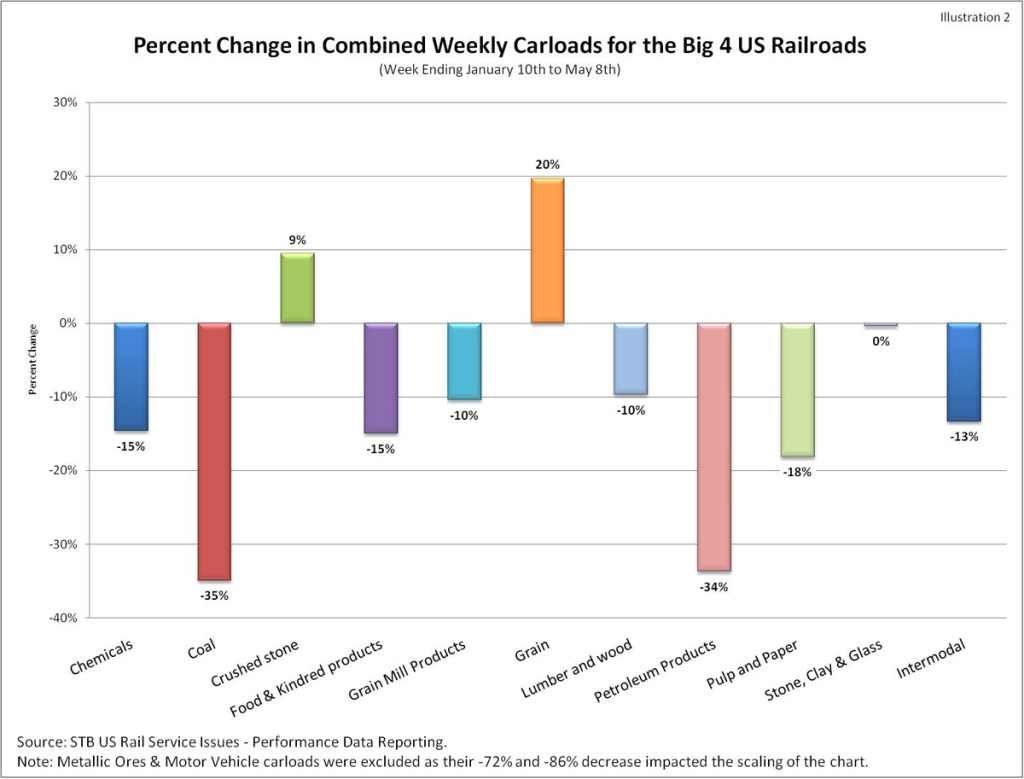
Another graph shows the differences by commodity.
Only grain and crushed stone are up. Coal and petroleum, the profit centers of the railroads, are way down, by more than 30%.
The article claims that one can take advantage of leverage to obtain favorable prices due to these steep declines in the Coronavirus economy.
I think the article bespeaks some hard times ahead for the big rails.
Blanking voyages has turned into unblanking. Ocean carriers try to match supply with demand on a precise basis, to cut losses.
That is a proven technique in industries where you can also vary inventory. But voyages are time-sensitive, and result in lead time losses for shippers. And with large ships, there are a lot more of them.
Even in transportation we see it– I believe it is a similar philosphy to Precision Controlled Railroading made popular by Hunter Harrison at CN and later CSX. But the effect in railroading has been to drive business to trucks, except for large shippers. And we will see the same in ocean container carriage.
It’s COVID-19 time, and we can think about what would happen in public transportation, say a train system, adopted ‘blanked sailings’. You go to the station for the 8:42 and find that because of insufficient demand the train was not running and you’d be late for your work as a cleaner at a hospital. You’d be MAD. You would also think about how else to get there, perhaps a bicycle (probably there is no air!). And if this happened a lot, you might quit using the rail altogether.
Soon Ocean container carriers will serve only a few large customers who can stand the inventory fluctuations of blanked sailings. That is actually what has happened in railroading as well. Where can the small customer get a break?
Enter the forwarders. By doing the ocean carriers’ job, by consolidating shippers, they can buy blocks of movement, and become the large customers for the ocean carriers. but now there will be mismatches at each step. It is a classic bullwhip effect. forwarders over-order to be sure they get their share, then can’t fill their space. Carriers will blank sailings, inconveniencing everyone. And we see supply-denamd variation with huge amplitude, making it impossible to control.
Welcome to transportation life in the 21st century.



 By
By 
 Supply Chain and Logistics