HTA complains: illegal activity during drayage protests

More angst in trucking at Los Angeles and Long Beach.  Are terminals really locking out certain trucking companies who are locked in struggles with employees who are seeking employee and union status?

American Shipper

Source: HTA complains of illegal activity during drayage protests | AS Daily Newsletter | AS Daily | American Shipper

It’s illegal of course, but clearly those drayage firms are not able to offer the same guarantee of service as others who are not experiencing conflict.

The question, from a labor economics standpoint, is whether the terminal actions are somehow putting them in league with the unions.  Remember, earlier when the Clean Trucks program was under discussion, the ports wanted to make everyone a union driver, working for a large company.  That way, the ports thought they could insure the firms would buy new trucks to modernize the fleet– they had sufficient capital, and that would reduce the need for subsidies.    But owner-operators complained bloody murder, the case went to the US Supreme Court, and it was ruled that drivers could not be compelled to be union members or employees.

So terminal operators had better be careful.  It seems to me that the current situation could be interpreted as a sort of tacit collusion with the Teamsters’ union.  Teamsters have a major share of the unionized drivers, and certainly are the biggest labor union player in the debates at these ports.

Conflicts That Cause Companies to Stockpile SKUs

I am posting this article mostly for my students.  It’s about inventory, folks!

Source: Conflicts That Cause Companies to Stockpile SKUs

How you group items makes a big difference in how you set service levels (fill rates or safety stock levels) in the face of variable demand.  When you have so many SKUs in stock, you have to group them or there’s too fragmented data to get good forecasts.  But how you do that grouping is important for the accuracy of forecasts and order quantities and timing.  And the researchers (graduate students, probably only a few years older than you) found that employees tended over time to misclassify SKUs in the groups, causing errors to creep in.

So the issue is the classic operations management or supply chain management dilemma. We know what to do.  Why aren’t we doing it?  At the end the subject is not about figuring the numbers, it’s about convincing people to do what they ought to.

2015 I-NUF Conference

I spent an enjoyable three days at this conference on Urban Freight held in Long Beach, CA.

Source: 2015 I-NUF Overview | METRANS Transportation Center

My colleague Dr Chris Clott (SUNY Maritime) and I presented a paper on supply chain integration at the Chicago freight bottleneck.  Our discussion offered a method of discovering main supply chain corridors to and from the area, discussed some of the attempts to reduce congestion in the light of supply chain integration, and concluded that ports such as LA/Long Beach or New York may need to consider implementing long range corridor integration rather than focusing on improvements inside their region boundaries.

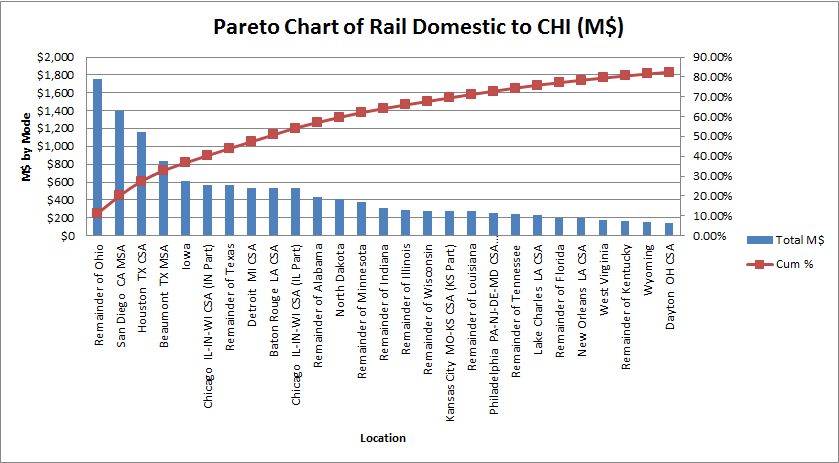
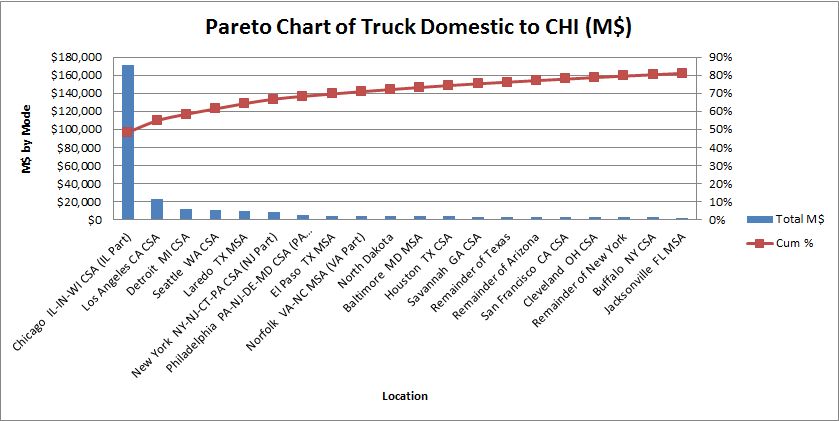
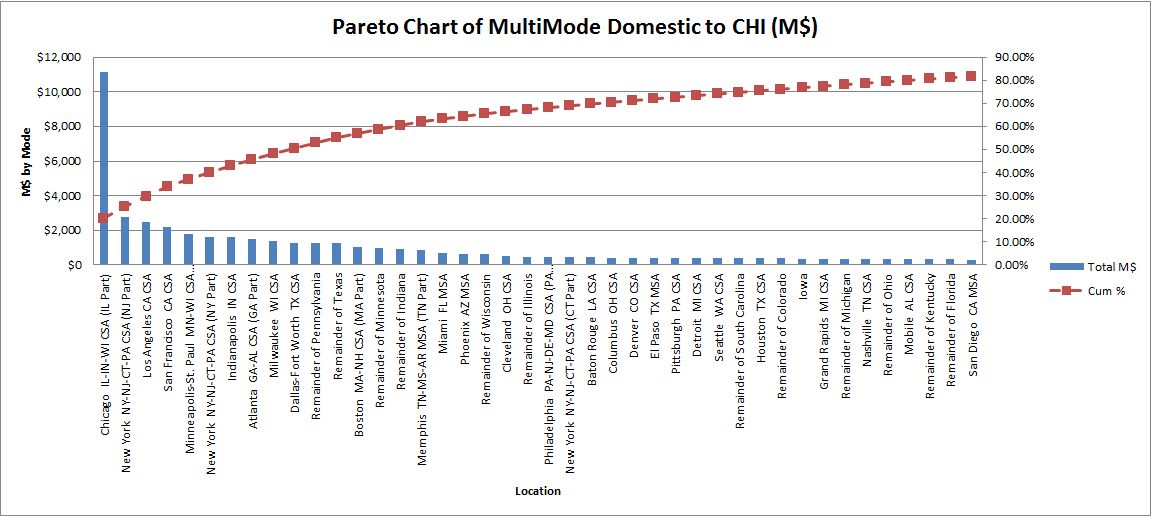
We’ve included some Pareto charts exemplifying our search for important corridors linking Chicago. Truck traffic is super-dominant in terms of dollar value over every other mode.  So why isn’t supply chain integration in the Chicago mega region looking hard at alleviating truck congestion?

Pareto ToCHI Domestic Multi Pareto ToCHI Domestic Rail Pareto ToCHI Domestic Truck