Tag Archives: slow steaming

Port call optimisation reduces greenhouse gas emissions in ports

Drewry is well-known for its expertise in maritime-related matters. In a recent market opinion piece, they suggest that maritime emissions can be reduced rather simply, with port call optimization. They mean to reduce the time ships sit near a port waiting for their berth to open up.

Some ports have been successful with appointment windows. But the Drewry approach includes slow steaming to hit the port berthing window close to the time, instead of standing offshore running engines and emitting pollution. The slow steaming itself is a tested measure for reducing emissions, though it doesn’t eliminate them. The two efforts combined could save a lot of pollution, and now in some places such as the EU, emission charges based on actual fuel use numbers.

Eliminating waste in a system, such as waiting time waste, is a tried and true operations management or lean technique. But in the case of maritime shipping and ports, a lot of coordination is required. Systems need to be in place to provide accurate information about ocean carrier voyage schedules. Sailing times between ports can vary a lot, because of factors such as weather and route adjustments.

But also, both ocean carriers and ports need to share information and cooperate on setting berthing schedules. A late loading in Shanghai, for instance, will affect the projected arrival time in Long Beach. the two ports and the carrier will need to share up-to-the-minute (or hour) information about progress. Will they do it? It will require a level of interaction never before seen.

I think that ultimately, ports and carriers will be driven to this by the gains that can be made. but I think it will be a long time coming.

Update: Port optimization can actually prevent deaths. Hong Kong University of Science and Technology (HKUST) has recently studied the number of deaths that could be prevented by port waiting time improvement.

Sam Chambers June 27, 2024

Port efficiency gains can save 10,000 premature deaths annually

10 Jun 2024
https://www.drewry.co.uk/maritime-research-opinion-browser/maritime-research-opinions/port-call-optimisation-is-key-to-reducing-greenhouse-gas-emissions-in-ports

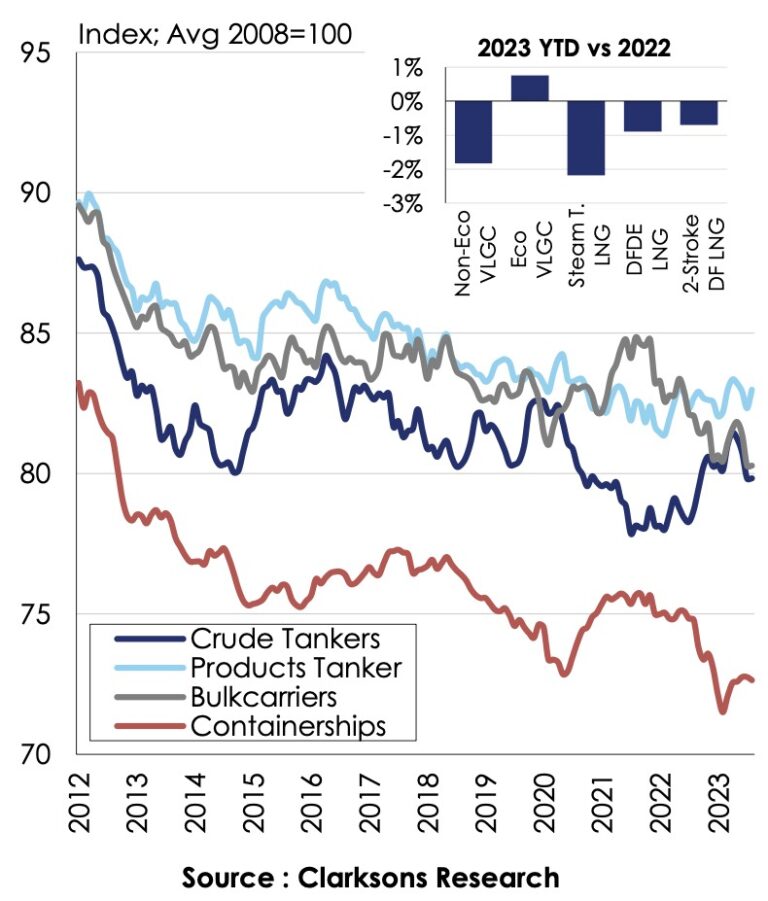
Bulk carriers and containerships moving at slowest speeds

Slow steaming is a good way to save on fuel costs and meet the new IMO requirements. So ships have slowed down. But I was amazed at the graph below, showing a trend for quite a while.

Slowing down is an important way of cutting CO2 emissions from fuel oil. It also implies that more ships are needed to meet planned sailings on a scheduled route. It’s a deliberate reduction of individual ship ‘productivity’, since fewer paid cargo-carrying trips can be made in a year. But it may be a better fit with the demand for shipments right now, and it might result in fuller vessels.

We should remember that slow steaming will not eliminate CO2 emissions problems; it’s a stopgap at best. New types of power with very low or zero emissions through their life cycle well-to-wake must be developed. The investments have to be made.

Sam Chambers October 2, 2023

Bulk carriers and containerships moving at slowest speeds on record this year

Benefits of slow steaming exaggerated?

Studies by Simpson, Spence and Young, a leading global shipbroking firm, seem to indicate that emission benefits of slow-steaming have been exaggerated.

One reason offered is that the ‘cubic law’, which says that fuel consumption rises as the cube of ship speed, is erroneous for many vessels, and is only approximately true at the designed speed of the ship.

Another problem is that slow-steaming effectively reduces capacity, requiring more ships to cover a route with a regular schedule, for instance. Those extra ships produce more emissions even though the per-ship emissions might be smaller.

Capacity is not a problem at present. There’s not enough cargo. But scheduled service may suffer.

There are a lot of moving parts in considering emissions release.

The best way to attack the problem may be to get to zero or low-emission ships as quickly as possible. But in the short run, these considerations in he study are worth thinking about.

By Charlie Bartlett, technology editor 15/05/2023

Benefits of slow-steaming on emissions exaggerated, studies find – The Loadstar