Tag Archives: climate change

Offshore Carbon Capture and Storage

If carbon capture technology is ever to be useful, there have to be places to store the captured carbon. One place is deep in the earth, in abandoned oil wells. We’re seeing somewhat more interest in carbon capture in maritime, and also in manufacturing areas. Maritime is more of an issue, because the captured carbon must be stored onboard, and offloaded periodically.

One option is to sell the compressed cold carbon to industrial users. But there’s not enough demand if most ships were producing captured carbon. Already, onshore carbon capture can supply a good deal of the commercial need for CO2.

Reuse of carbon in this way is simply circular; it does not actually remove carbon from the natural environment, it simply recycles it. And many onshore facilities like power plants and cement processes could rather easily capture their carbon emissions.

All this carbon can’t simply be recycled; there must be a place to put it. It’s odd that there has not been more investment in places to sequester the captured carbon.

That’s why the INEOS announcement in the article below is interesting. INEOS is an international chemical company with headquarters in many countries. (They also co-own and operate Manchester United, a Premier League football club).

They have designed a complete system to sequester the carbon in the North Sea, called Greensand. The full value chain will be established. The captured CO2 will come from Danish biomethane plants.

Once captured, CO2 is liquefied, delivered by truck to a dedicated CO2 terminal at Port Esbjerg, shipped aboard Carbon Destroyer 1, the EU’s first purpose-built CO2 carrier, and injected into the Nini West reservoir in the Danish part of the North Sea, a depleted oil field some 250 km offshore, approximately 1,800 m beneath the seabed.

Currently the project can store 400000 tonnes annually, but plans to expand to between 4 and 8 million tonnes annually.

There are still institutional barriers limiting capture of CO2 at scale — regulations, infrastructure, and investment. Since we’re not going green on energy anytime soon, it’s time to start investing big time in carbon capture — technology and infrastructure.

Logo of Splash247, featuring the word 'Splash' in bold black letters with a blue underline and '247.com' in smaller text.

Bojan Lepic September 18, 2026

https://splash247.com/ineos-opens-eus-first-full-scale-offshore-ccs-project

Green Corridors Hit ‘Realization’ Stage: The Zero-Emission Hurdle

The Getting to Zero Coalition and the Global Maritime Forum have issued a new report At a Crossroads: Annual Progress Report on Green Shipping Corridors 2025. Green shipping corridors are a very impactful way of moving toward zero emissions in the maritime area. They can coordinate many players by providing a specific attainable goal— zero emissions on a specific route for specific ship types. These corridors are independent of efforts by the EU to create incentives and penalties for carbon emissions and reductions, and of efforts by the International Maritime Organization (IMO) to reach a consensus on rules and measures for intrnational ocean shipping. Many times they are organized by specific ports and specific ocean carriers. Often they try to focus efforts on supply chains for specific fuels at those ports.

I think these efforts are extremely important. They can show how to provide reasonably priced fuel supply chains and how to coordinate investors, ocean shipping players, and financial institutions as well as governments. These experiments need to be tried.

The report has been published since 2022, effectively the beginning of the green shipping corridors movement. Steady gains have been made, and today there are 84 initiatives catalogued, with 305 stakeholders. 25 more initiatives have been recorded.

Source: Annual Progress Report on Green Shipping Corridors, 2025.

An interesting section discussed progress at the four corridors that have reached the highest stage in the journey: the Realization stage. Three of them are short-sea routes in Europe. The longest runs bulkers from Australia to China and other Far East ports.

  • Stockholm-Turku ferry, Finland to Sweden, biomethane;
  • Vaasa-Umeå ferry, Finland to Sweden, biomethane;
  • Australia-East Asia bulk carriers, iron ore, ammonia;
  • Oslo-Rotterdam container ships, hydrogen.

I found it interesting that the three short routes fund the difference between green and dirty fuels by entering pooling agreements to sell credits to other shipping lines, under the EU policies. The long ammonia route alone is driven by private firms involved in the trade, to help them meet dramatically lower emissions goals, with fuel costs not funded but expected to drop to a reasonable level as the infrastructure is built out. China, Korea, and Japan all have goals for reduced emissions from shipping which the iron ore route will help with.

Four recommendations emerge from the report’s assessment of the green corridor potential and progress.

  • Pursuing strategies to break the inertia and keep the momentum;
  • Connecting cargo owner willingness to pay to the corridors;
  • Taking an active stance at the IMO;
  • Tapping into or replicating emerging national policy instruments.

Significant issues for now are:

  • Delay of the IMO Net-Zero framework; participants may wait for more clarity.
  • Will the cargo owner be willing to pay for green shipping on the corridor? The evidence so far is not good.
  • Influencing public policies to support investment and regulation.
  • Staying focused on truly green corridors that deploy zero-emission assets rather than fossil fuels, do it early, and iron out the kinks.

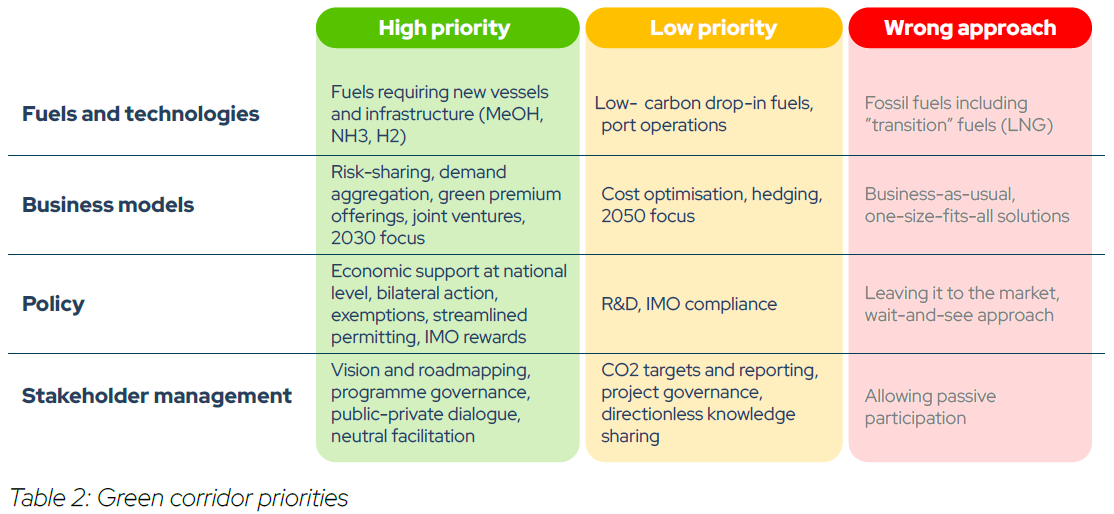
This chart shows the right and wrong approaches:

Source: Annual Progress Report on Green Shipping Corridors, 2025, page 25

The study is available in PDF at this link. It contains an Appendix listing all the current Green Corridors in the portfolio at present.

I was very happy to read this summary of the state of green corridor adoption. Keeping this movement going will play an important part in maritime decarbonization.

Gary Howard, Middle East correspondent November 27, 2025

https://www.seatrade-maritime.com/green-shipping/first-four-green-corridors-hit-realisation-stage

Carbon Capture for ships – current state

Some people think carbon capture onboard is going to be important in meeting emissions goals for ships. There is some entrepreneurship, and some interest by large oil producers and purveyors.

However, many problems remain to be solved. There is essentially no ‘supply chain’ to handle the liquefied carbon product the ships produce onboard from running the carbon capture equipment. Liquid CO2 has a market, but ports are not set up to move it from the ships to storage nor to distribute it into commercial channels.

And it’s not yet clear how much emissions reduction there will be when conventional fuel is burned on ships but the carbon is captured.

Nevertheless, there is activity in this segment. This article explains what’s happening in one case, based on info from classification society DNV.

There are also several links to resources about carbon capture for ship engines.

I’m quite skeptical of carbon capture. It’s nominally a good thing. But the cost of the storage may be large. And how much captured carbon can we reuse?

If the oil companies are back of it, how can it be all good? What are the pitfalls?

Seatrade logo

Barry Parker, New York Freelance Correspondent

September 17, 2024

https://www.seatrade-maritime.com/sustainability/onboard-carbon-capture-and-storage-gaining-ground