Nickel (symbol Ni) is a metal critical in quite a few supply chains. It’s especially important in the production of batteries for electric vehicles and power storage for off-grid applications. Nickel is not mined everywhere. But it can also be obtained by recycling. That’s not uncommon in metal supply chains.
Because geopolitical factors influence the production of this metal, and because innovations happen fast when the supply of a metal is threatened, it makes sense to do a prospective life cycle analysis (pLCA). A pLCA will help us understand how common factors such as water and CO2 emissions will be affected by future actions. Once done, it can be updated as technologies change, and can even serve as a guide to how the production needs to evolve.
I read this interesting paper by Klimt et al (2026), which lays out such an attempt. Of course it’s bound to be wrong— it’s prospective after all— but it put a stake in the ground that allows us to understand how this supply stream might evolve.
A pLCA begins with a block model of the processes involved in Nickel production, including recycling. This diagram shows the complexity of this business. It’s similar to many mining processes. I spent some time in the copper industry, which follows a similar pattern. An ore-bearing rock is mined and then concentrated. It can then be purified by a variety of processes and refined into products suitable for use by the consumers of nickel.
Process flows including scrap and recycling of Ni
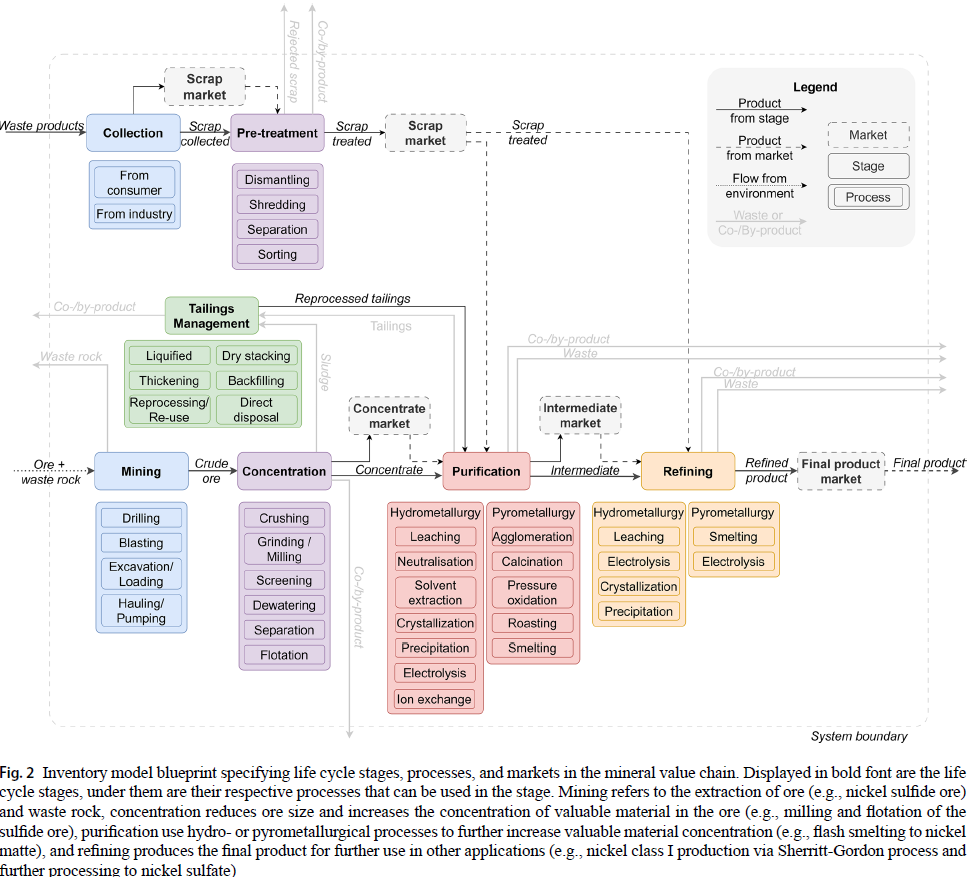
Such hard rock mining processes are complicated by the fact that there are often other products extracted as well, which have completely different concentration, purification, and refining processes, and completely different economics. There’s always a question of how to draw the boundaries of the process you are studying, and what to count as the revenue or profit. Here, the authors focused on the nickel alone.
An important task is to identify the key numerical parameters that can be used in the pLCA. With such a complex process there will be a lot of them. But not all will rise to the level of prime importance. The figure below gives the flavor of the complexity of measuring even this one process performance.
Parameters:
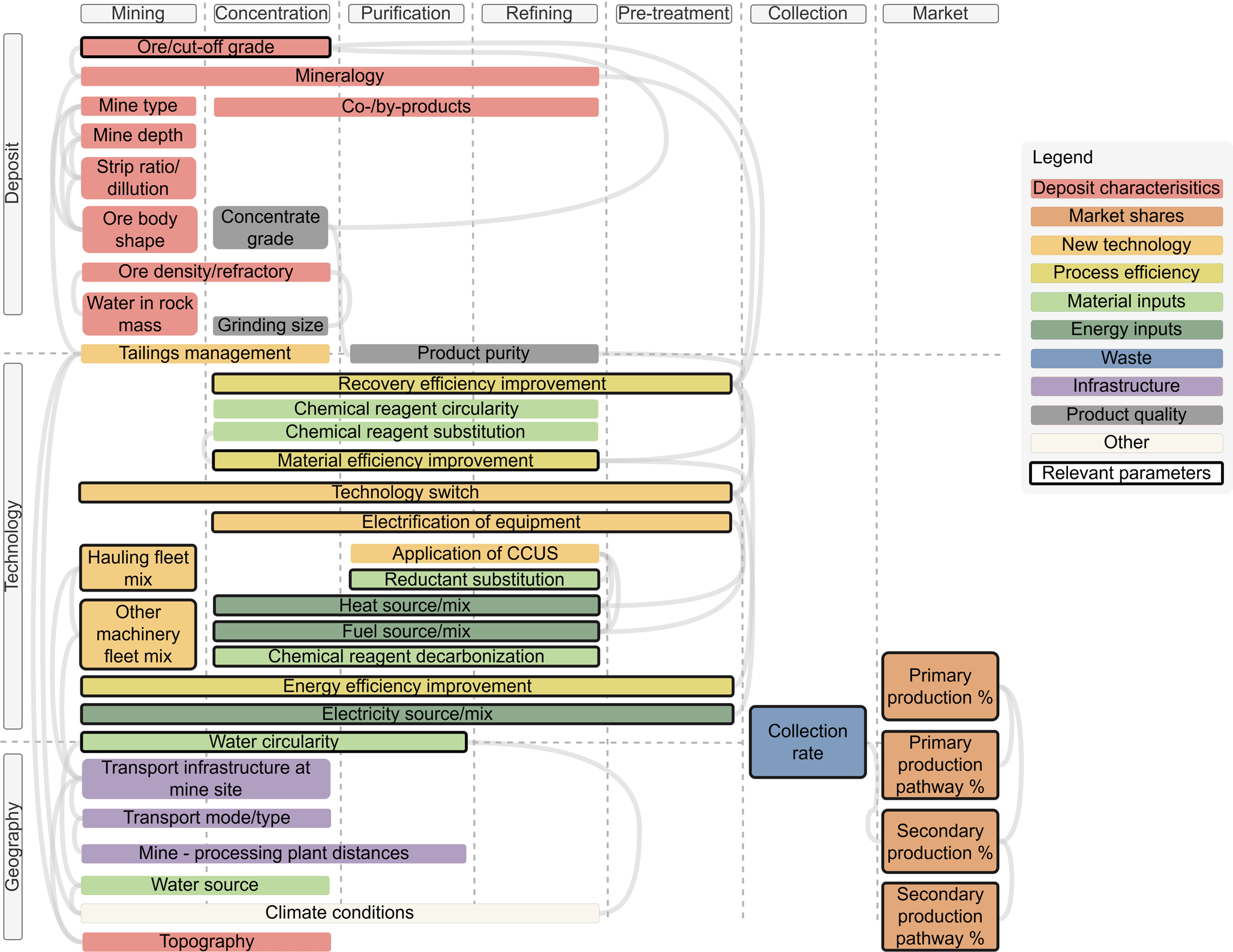
How do these features or parameters interact? The causal loop digram (CLD) is a tool used in systems thinking and modeling to visually map out how different variables or factors within a system interact with and influence one another.
CLD of Factors
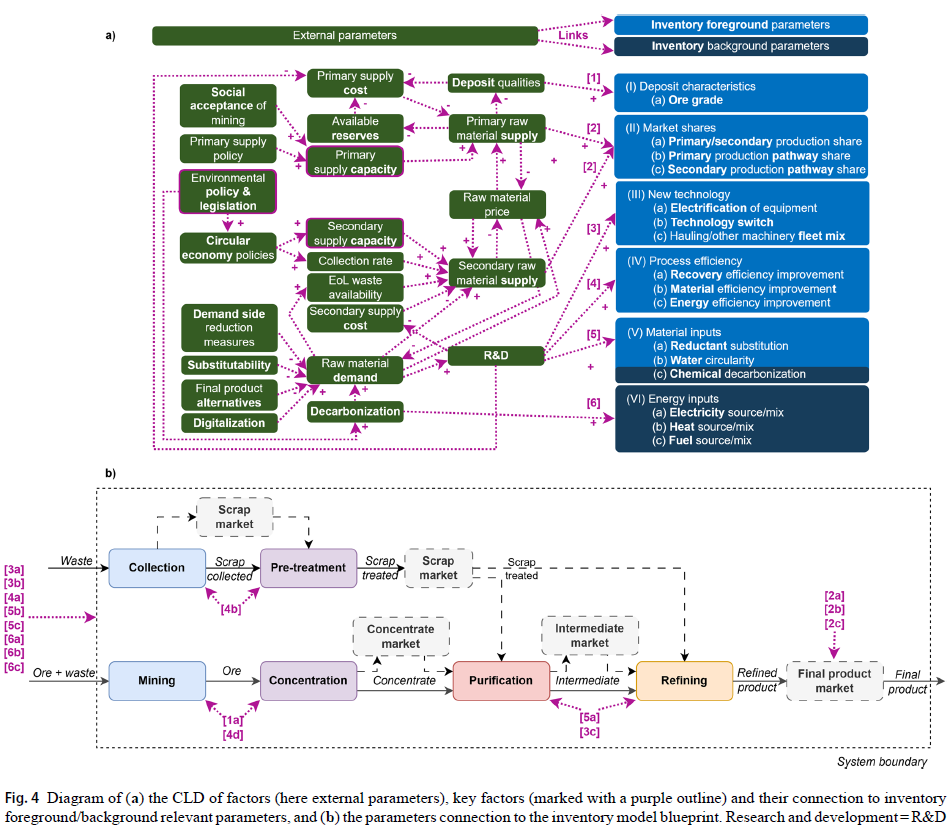
Features are divided into foreground and background, by color (blue, black). They are divided into 6 groups, and mapped to the process diagram. We see that 8 of the parameters influence the initial phase– exploration, collection, and mining. 3 others affect the first step beyond the actual mining. The balance enter much latr in the process, including three at the very end during marketing of the final product.
We have to define a ‘functional unit’ in order to compare items dimensioned in different units. The authors defined a functional unit as 1 kg of battery-grade nickel sulfate hexahydrate, with a nickel metal content of 22%, supplied to the current and 2050 global market.
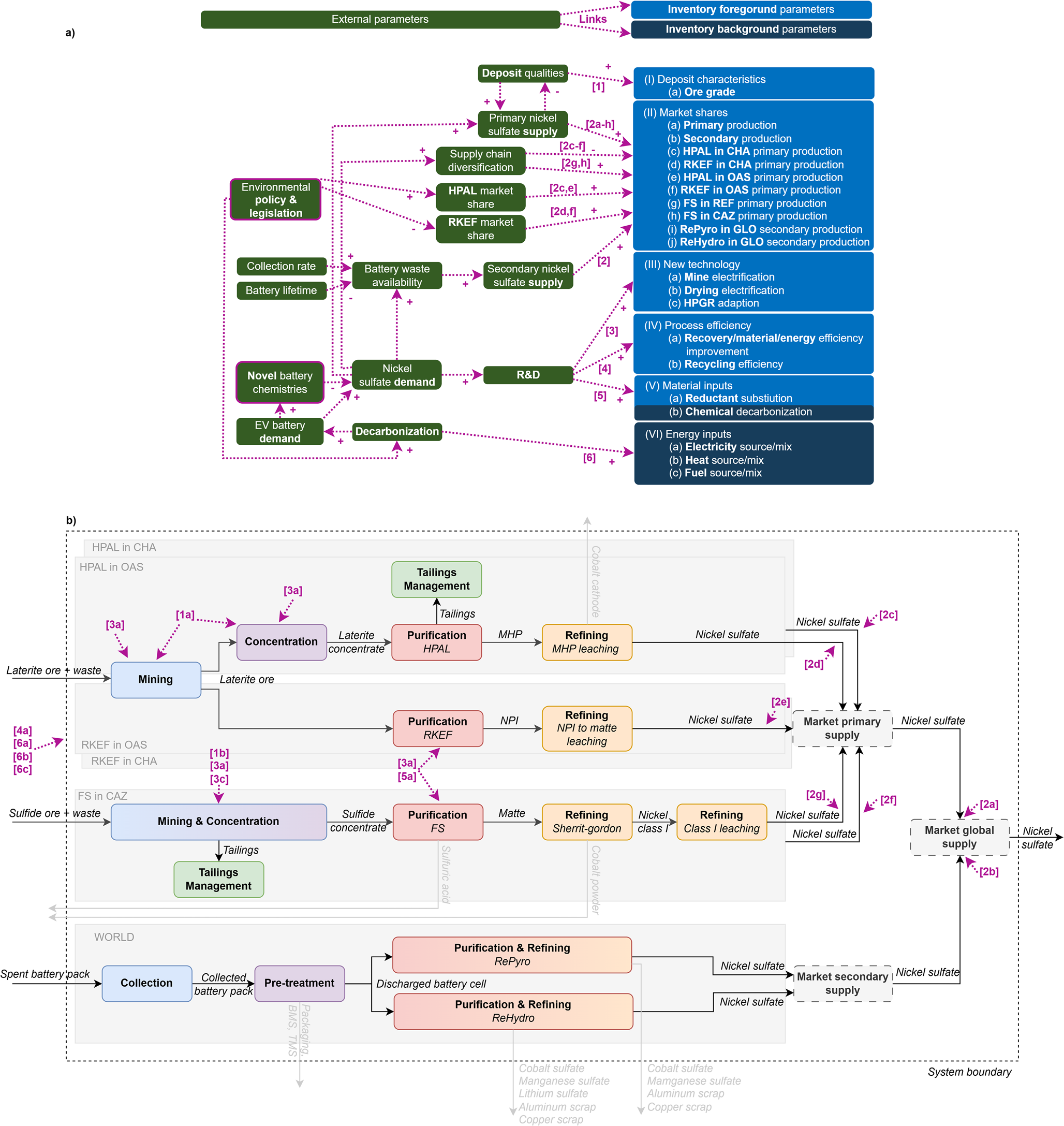
A more detailed CLD appears below with a flow chart for supplying 1 kg of Nickel sulfate.
Fig. 5 (a) CLD of key factors’ connection to selected main parameters. (b) Process flow chart for the supply of 1 kg nickel sulfate for the global market and the connection of relevant parameters to the inventory. Only product in- or outflows from the foreground are illustrated. Waste outflows are not displayed.
Abbreviations: High Pressure Grinding Roll = HPGR, High Pressure Acid Leaching = HPAL, Rotary Kiln Electric
Furnace = RKEF, Flash Smelting = FS, Pyrometallurgical Recycling = RePyro, Hydrometallurgical Recycling = ReHydro.
Geographic regions: China = CHA, Other Asia = OAS, Countries from the Reforming Economies of the Former Soviet Union = REF, Canada, New Zealand, and Australia = CAZ, Global = WORLD
Now we get to the prospective part! We’re going to estimate from 2025 to 2050. So, how does the industry change over this period? Increases in recovery efficiency over time are estimated based on
current efficiencies and a maximum efficiency of 95%, using Wright’s Law to link future improvements to cumulative demand.
What?
In this context, Wright’s Law (often referred to as a learning curve or experience curve) is a mathematical framework used to predict how much a technology or process will improve as its production scales up. Specifically, Wright’s Law states that for every doubling of cumulative production (or demand), the effort or cost required to produce a unit decreases by a constant percentage.
Here the authors use demand rather than production, as it is assumed production will rise to meet demand.
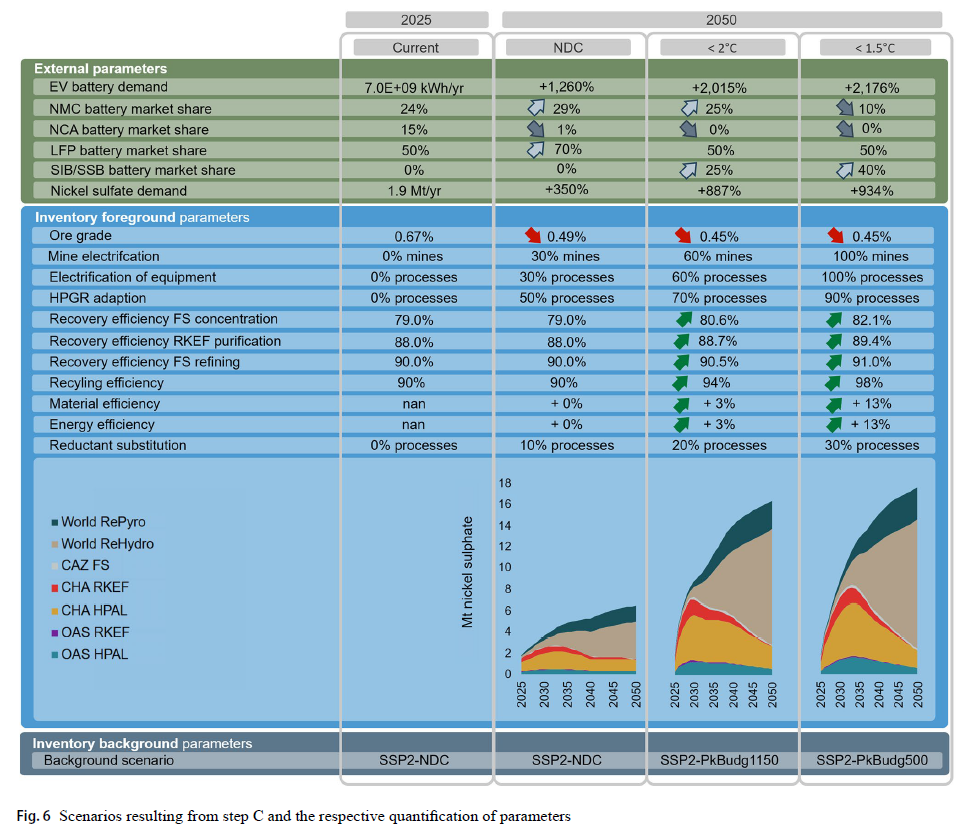
Three scenarios are chosen for 2050: an NDC base case based on current nationally determined climate parameters, and two more aggressive scenarios, targeting 2-degree and 2.5-degree global temperature increases by 2050. The current situation is modeled also.
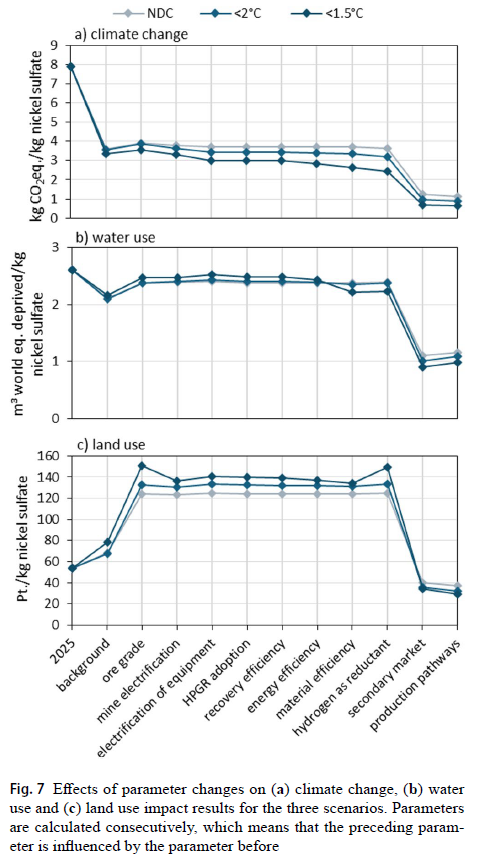
Now to some results. What are the effects of Ni production on CO2 equivalent, water use, and land use. The figure shows there is not much difference in the effects for the three scenarios.
Bottom line:
- Ni production can cut CO2 by half, from 8 to under 4 kg CO2 per kg Ni, over current levels just in the background. The process steps themselves hold roughly level no matter which scenario. But using the secondary market (recycling) better can pare the emissions from 3 to 1.
- Water use for production of mined Ni won’t be changed much regardless of scenario, until we also consider the secondary market. But in that stage, water use can be reduced, from over 2 cubic meters per kg of Ni sulfate, to less than 1. That’s half as much water use.
Instead of measuring land use purely in physical area (like square meters), a point system weights the land use by its potential damage to ecosystems or biodiversity. This allows researchers to easily compare different types of environmental burdens on a single scale. In life cycle assessments (LCA), “Points” (often derived from methodologies like Eco-indicator 99 or ReCiPe) are a standardized unit used to measure total environmental impact. So, Pt./kg nickel sulfate represents the aggregated environmental impact “points” scored in the land use category per kilogram of battery-grade nickel sulfate produced.
- Every scenario increases land use a lot just through the background, due to opening new facilities. However, making better use of the secondary market through recycling Ni would bring the land use down to below the original levels.
It’s not clear in the paper what methods were used to get the points for land use measurement. The ReCiPe system for impact assessment and Eco-indicator 99 were both created in the Netherlands, and would be likely candidates for use. I suspect the latter system was an important influence, since it includes species diversity among its metrics for land use.
The paper mentions several limitations.
Although an extensive list of parameters relevant for prospective modelling was identified, not all of these parameters are equally ready for implementation into inventory modelling. For example, efficiency improvements can be relatively easily incorporated into life cycle analysis, whereas parameters such as reductant and reactant substitution require more detailed process-specific knowledge and potentially additional inventory flows.
The list of parameters is biased towards a focus on parameters affecting GHG emissions. More broadly, pLCA relies on scenario data mostly from integrated assessment models (IAMs) with a focus on climate change impacts, which leads to other environmental issues such as toxicity or water scarcity being largely neglected.
There’s lots of room to improve and refine such a model. That’s why it’s important to get a stake in the ground by publishing a substantive try that can be refined as more knowledge surfaces.
I learned a lot about LCA and especially the prospective part. Understanding what might happen in the future is very hard. But the analysis based on a current perspective may motivate inventors and entrepreneurs to go after specific process improvements now, to improve the performance on the industry later on. If that happens, maybe the damage from more Nickel mining will be less than predicted.
References:
Klimt, J., Istrate, R., Barbarossa, V. et al. Scenario-based inventory modelling for prospective life cycle assessment of mineral raw materials supply (SIMPL-Minerals). Int J Life Cycle Assess 31, 88 (2026). https://doi.org/10.1007/s11367-026-02641-0
https://link.springer.com/article/10.1007/s11367-026-02641-0
PDF: Klimt etal 2026 Scenario Based LCA Nickel supply chains -026-02641-0 (1).pdf