Tag Archives: supply chains

Forwarders fear ‘shut-out’ as other major lines emulate Maersk strategy

This complaint from freight forwarders is starting to resonate. It appears the major container carriers are gradually refusing to sell bulk space on container ships to brokers and forwarders, instead making them buy on the spot market.

One of the issues is to determine whether the liner companies are favoring large brokers and forwarders with discounted contracts, to the disadvantage of smaller brokers. Are there sweetheart deals? I am betting that for sure there will be space available from large brokers to smaller brokers. Price discipline is notoriously hard to enforce.

Is it anti-competitive to offer spot prices? No, I think not. Is it anti-competitive to offer different prices to different groups? Quite possibly. It’s worth a review by government agencies and regulators.

In competitive economics, fairness is not a principle; however, in political life it could be seen as unfair to drive out of business a group of substantial size who provide customized services of a very precise nature in a niche, to some shippers. Those skills may have value to society as a whole that are not captured in prices. That’s where regulation comes in.

By Alex Lennane and Ian Putzger 20/01/2022

Forwarders fear ‘shut-out’ as other major lines emulate Maersk strategy – The Loadstar
US importers using box ships to store cargo

US importers are not so worried about cargo waiting offshore to be unloaded. As long as they have enough for their sales or manufacturing, the cargo can sit on a container ship and the principal cost to the shipper is the interest cost. With interest rates at historic lows, that isn’t much.

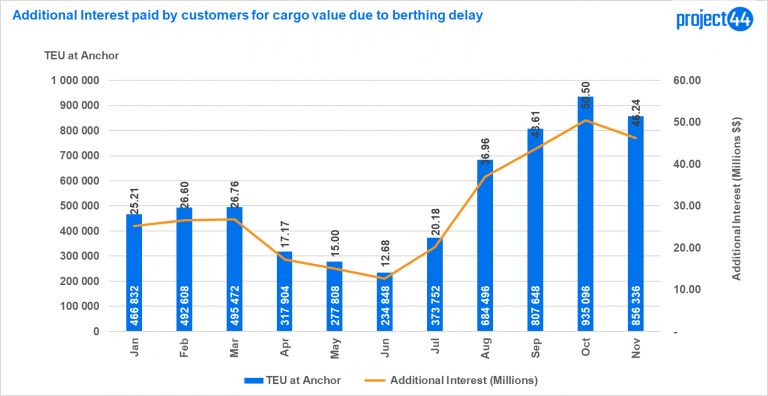
The graph below from project44, a Chicago, I- based visibility platform, shows the number of TEUs at anchor by month from January through November 2020, on the left. The rise starting in August is significant. Using data from HSBC, which show a 3.2% annual interest rate, using an average container value of $40,000, they calculate almost $50M per month in new delay costs, and cumulative inventory interest costs over $850 million.

The point is that these costs are a lot lower than inventory costs at warehouses. While the cargo is held at sea under riskier conditions, in the warehouse other costs kick in, not the least of which is space required. Insurance charges on the financed inventory also accumulate. And there’s the work, both labor and mechanical, of shuffling the inventory around; it’s very variable given the specific warehouse layout, but can be significant also.

So shippers are using the offshore jam-up rather than wishing it away. Only when the demand for products ratchets up so that the offshore inventory is needed will the stakes change. While we have significant COVID likelihood today, that isn’t likely to change much.

It’s always interesting to look at the overall question of inventory cost in the supply chain. Advantages to shippers can come from unlikely places.

By Nick Savvides 12/01/2022

US importers using box ships to store cargo – cheaper than warehouses – The Loadstar

It’ll be ‘quality not quantity’ on China-Europe rail services as subsidies fade

The Chinese government and several states have been subsidizing rail service from China to Europe. A phase-out is planned for 2023 now. Subsidies were supposed to end in 2022 but an extension was made for COVID.

There are various claims of inflating the amount of traffic.

Rates from Europe to China, the return trip, have been low, so that empty containers get returned to China. In fact, they are set at less than cost; around $100 per container, while the real cost is around $3000 to move an empty container.

But with container rates sky-high now and so many blank sailings from Asia by container liners, the rail service rates have been very high to Europe. Perhaps a subsidy is no longer needed. We’ll see.

Quality of service will be the main determinant of the success of this route in the long run. And we will see if the various countries on the route can figure out how to cooperate over the long run to get total rail shipment times down.

By Sam Whelan 20/12/2021

It’ll be ‘quality not quantity’ on China-Europe rail services as subsidies fade – The Loadstar