Tag Archives: trucking

Real cause of UK driver shortage is an obscure UK tax law

The author of this piece contends that a UK tax law called IR35 is responsible for at least part of the driver shortage.

In the past, UK drivers were allowed to choose whether to be classified as contractors or employees. But with the change in April of 2021, employers now must decide whether drivers they use are contractors or employees.

According to the author, since April, many trucking firms have chosen to classify the drivers they hire as employees, due to the tax law. This has resulted in lower take-home pay for drivers. Naturally, drivers are upset about that. They can easily decide to quit driving and choose another form of work.

I don’t know whether there is statistical evidence for this phenomenon in the UK.

In the US, drivers themselves choose how they are classified. And they can be chosen to drive by any firm. Some firms, through union arrangements, or by choice, may decide not to hire contractors. However, a firm may also hire a mix of employees and contractors. In the US, employers are required to pay benefits, which include health insurance, unemployment insurance, and other services. According to the ATRI white paper An Analysis of the Operational Costs of Trucking: 2020 Update, benefits represent 10% of total average marginal cost, and wages represent 32%. This is a large amount.

But they do not need to pay those benefits to contractors. In the US, rates received by driver contractors are piece rates, and often the drivers come out worse than they would as employees, because they must buy their own benefits.

Also, contractor drivers must pay the costs of their vehicle, including fuel costs and lease payments. According to the ATRI study, in 2019, fuel costs were 24% of total average marginal cost and lease payments were 16%. These costs would be assumed by trucking firms hiring employees rather than contractors.

But in the US a major concern for drivers are the specific requirements associated with loads, such as picking up and returning chassis and containers, a shortage of parking to meet hours-of-service rules, and delays loading and unloading at warehouses and port terminals. These working conditions can be changed at will by trucking firms, on a trip-by-trip basis, and cause loss of income and waste of time for drivers.

I believe that in the US, this ‘supply chain adaptation’ is making many drivers look for other work. It’s hard for a contractor to avoid these work conditions, and employees, though they may be compensated for some of the time, may find it unsatisfactory for lifestyle reasons. They’d be very tempted to try some other line of work. Anecdotally, construction work is an important alternative.

While the contractor-employee distinction is equally important in both countries, the reasons offered seem to be different. Unions in the US trumpet the value of making drivers unionized employees, and it often does result in greater benefits for drivers, as well as the right to grievance arbitration. But it also means the driver does not get to choose which load to accept. Drivers choose to be contractors because they can choose who they work for and which load they take, in an atmosphere of changing and disadvantageous handling requirements that are often imposed. Regularize that, and drivers would be happier to work.

By Richard Clutterbuck 29/10/2021

The real cause of the driver shortage crisis is an obscure tax law called IR35 – The Loadstar
Trucking key issues in 2021

One of my favorite sources for information about trucking and truck drivers is ATRI, the American Transportation Research Institute. It’s a nonprofit with board members from every aspect of the trucking industry.

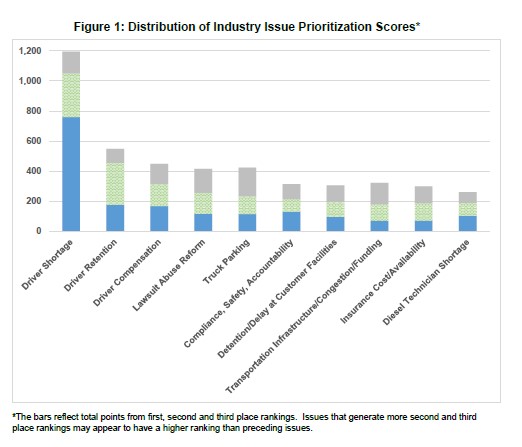
Each year they publish a report on the top industry issues for the year. It’s based on surveys. You can get it here. https://truckingresearch.org/atri-research/top-industry-issues/

It is always interesting reading. This year issues related to driver retention rose to the top of the list. We can see that at a glance by inspecting Figure 1, from page 4 of the report. The top 3 deal with the driver crisis in trucking.

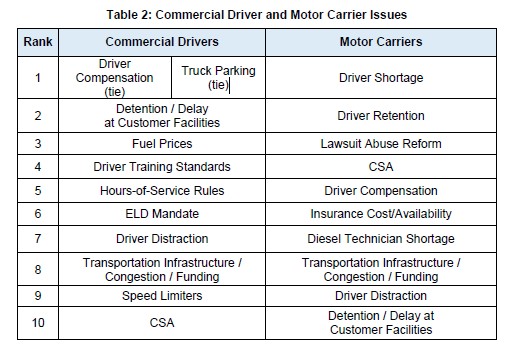
One of the most interesting aspects of the report is a comparison between the attitudes of commercial drivers and those of motor carriers. The two groups have very different concerns, which are telling. The gap in concerns may represent why drivers are leaving the trucking workforce. I’m including Table 2 from the report below, which clearly portrays those different views.

Drivers are very concerned about compensation, truck parking, and delays at customer facilities, all of which affect their bottom line directly. Motor Carriers are concerned about the driver shortage and retention; I have heard that about 90% of drivers leave their current job within the first two years.

It seems to me that motor carriers ought to think about how they might have an impact on the truck parking problem nationally, and the detention or delay problems. Those factors are influencing drivers to choose to leave the profession or to switch to a company that can offer something that improves those dimensions. Money isn’t the whole story, though there is certainly a need for truck driver compensation to improve; both sides understand that.

One important dimension of trucking that cannot be overlooked in the US is the division between Owner-Operators and Company Drivers. There are different factors at work for these two very different classes of drivers. The ATRI Survey brings that out clearly in Table 3 of the report.

Both groups rate Truck Parking high, because it affects scheduling breaks and their ability to earn by moving goods. A search for a parking spot is time not spent transporting the goods.

But as one would expect, Owner-Operators are concerned about fuel prices, because they pay that themselves out of their piece-work fee for carrying the load. Company drivers do not have to pay for fuel themselves; it’s a company expense, and not money directly out of their pocket.

Compensation, whether by wages or by per-load fees, is a major issue for both groups.

I want to give a shout-out to ATRI for their diligence in producing this study each year. It’s a valuable resource for understanding the state of the trucking industry and gives us info that can drive our thinking about how its individual participants need to change.

Trucking costs rise as US freight traffic grows – but the momentum is slowing

Recent data show that trucking costs are still rising, but not as fast as before.

One interesting fact is the decline in Midwest trucking volume. Auto makers have cut production by 30%, and the Midwest is struggling economically. This means less demand for trucking services.

But overall, truckload shipment volumes were still up slightly, continuing the trend.

This article has some nice numbers which define the trend. It would be nice to see a graph of the history of some of the numbers, like the average fuel charges. These are surcharges for fuel that trucking companies add to freight invoices because diesel fuel is elevated in price beyond some ‘norm’ they have decided they ought to pay.

By Ian Putzger in Toronto 21/10/2021

Trucking costs rise as US freight traffic grows – but the momentum is slowing – The Loadstar