Tag Archives: West Coast Ports

Is a New West Coast Container Port Needed? The Coos Bay Dilemma

Coos Bay, OR, USA is pushing for a new West Coast US container port. It will have rail to the port, so that transloading can take place directly to it.

The port planners see a need for another West Coast port of entry for Asian containers that will reach inland via intermodal rail as far as Chicago. The Oregon International Port of Coos Bay has obtained a $25 million grant for pre-planning and pre-construction. The grant will be matched by $25 million from NorthPoint Development, and will be used for environmental review and preliminary engineering activities.

The map below shows why environmental concerns might be considerable. Coos Bay is a small town that’s long been a Mecca for beachgoers and people who love the coastside style of living. A friend moved there from Santa Rosa, in the Bay Area, for that reason.
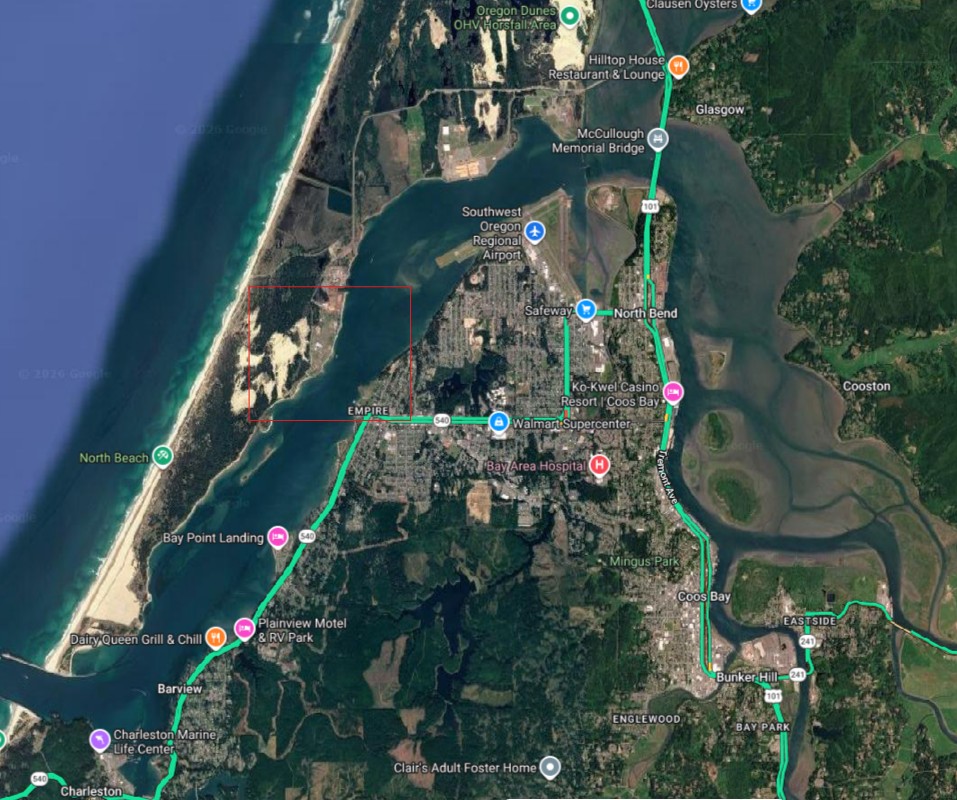
Google Map of Coos Bay, OR. Red square shows the approximate location of the new container port.

You can see on the map that ingress is through a small strait, with a narrow bay running northward to the Coos River. The port will be on the barrier island, just below another industrial site, a sawmill, according to the planning material. Its projected capacity will be 2 million TEU, or one million forty-foot containers per year.

That’s quite a few. It’ s only a bit smaller than the Port of Oakland, in CA, which runs about 2.5 million TEU per year. And it dwarfs the container traffic at the Port of Portland. However, Portland specializes more in automobiles, and grain and minerals bulk. If the port runs at 60% capacity, a reasonable figure for international container ports, that would be 1.2 million TEU per year, or 500,000 forty-foot units.

It’s not a bad idea, geopolitically, to have another West Coast port for containers. It’s a relief valve for the big California ports, which are subject to periodic longshore union strikes and other potential disruptions. Those ports are also major sources of pollution.

The all-rail connection should also make air pollution less of a problem. Perhaps the port can prevent local drayage from causing mammoth traffic and air problems in this pristine area.

Notice Charleston Marine Life Center at the entrance to the strait, a branch of the University of Oregon. Below is a photo of a Dungeness Crab, a local resident; delicious and protected from overfishing. Dredging, which the plan says is necessary, may threaten marine species nearby.

Boxes will move via a short line, Coos Bay Rail Line, owned by the port. It runs north from the peninsula about 137 mi, terminating near Eugene OR at the Union Pacific line. That provides access by rail to all of the central US. And if the UP/NS merger comes to pass, it will provide a single transfer access even to the Northeast US and even Europe. That provides access by rail to all of the central US. And if the UP/NS merger comes to pass, it will provide a single transfer access even to the Northeast US and even Europe.

It’s not clear that more capacity is needed on the West Coast of the US, particularly if interntional maritime trade is resetting and the Asia-US container movements are declining.

Evidently East Coast container traffic is also in decline.

We see a report today of Charleston, on the US East coast, shutting down a 700,000 TEU capacity terminal, Leatherman, because of low demand. It only processed 75,455 containers so far this year. The final capacity of Leathrman Terminal when built out is planned to be 2.4 million TEU. A second berth construction project is being continued. The planned rail yard adjacent to Leatherman, a $690 million project, is being suspended.

freigntwaves logo

Trains.com Staff Wednesday, June 24, 2026

https://www.freightwaves.com/news/oregon-port-oks-federal-rail-grant-agreement-for-multimodal-project

Jun 25, 2026 4:59 PM by The Maritime Executive

https://maritime-executive.com/article/charleston-pauses-operations-at-new-terminal-citing-low-volume-high-costs

West Coast container ports hit by labor actions

Apparently the negotiations between the Pacific Maritime Association (PMA) and the International Longshore Workers Union (ILWU) are not going well over wages.

Some peripheral issues have been settled, but union workers want a share of the massive profits generated by the container carriers during the COVID time. PMA represents ocean carriers and terminal operators in the negotiations, and some terminals are controlled or dominated by a carrier or a group of them.

I think that is appropriate. Anyone’s analysis of the labor economics of unions will indicate that unions only have occasional times when they have any leverage over their terms of employment. This is one of them.

They should be expected to bargain hard for wage increases because they have not had a new contract since 2015. A lot of water has gone under the bridge, including massive profits for ocean liner firms. Longshoremen played a large part in the successful import and export of all those containers.

The PMA has not had a good record of conducting these negotiations, sometimes playing hardball when their sponsors would have liked a little softer approach. It’s true that the ILWU is known for its intransigence also.

But now the PMA should make a realistic offer. Inflation is high, there’s no prospect of it moderating very much very soon, and there are all those past years to make up for. Longshoremen deserve to be paid fairly for their work in the light of present, and possibly future, economic conditions.

These incidental stoppages for short times are just warnings. Neither side should want a general strike, because the new increases in West Coast shipping, after a long decline, are just emerging. It’s true some traffic has left for the East Coast, but the facts are that West Coast ports that operate well are still the fastest and most reliable way to ship to America from the Far East. If they are seen as reliable, traffic will return.

Time to step up and make an offer longshoremen are likely to accept.

Greg Miller Sunday, June 04, 2023

West Coast container ports hit as labor talks take ominous turn

Work resumes at LA/LB ports, but contract settlement stays out of reach

There’s no labor agreement in sight for West Coast ports. And recently there have been short unannounced work stoppages by the unions.

I’m thinking these work stoppages are trial balloons. The major union at the ports, the International Longshore and Warehouse Union (ILWU), may be trying to gauge the impact of a stoppage on the ports. We all know that the ocean shipping market is weak, and in addition quite a bit of container traffic has moved away from the West Coast ports, to the East Coast. So volumes are down at the West Coast ports.

It’s possible that cargo volumes are so light that a full strike will jeopardize the ports’ business. A sizeable reduction in container traffic would reduce the demand for longshoremen and union workers. They don’t want to kill the golden goose. A mini-trial would tell them whether the ports would be severely hurt by a strike. Otherwise the ports might say “Go ahead and strike!”

I think that is why the US government is loath to intervene yet. Continuing to negotiate might be the best way to get an outcome everyone can live with.

Ian Putzger, Americas Correspondent 11/04/2023

Work resumes at LA/LB ports, but contract settlement stays out of reach – The Loadstar