It turns out that major shareholders of Freightos are also large logistics companies— FedEx, Qatar Airways, and IAG Cargo. Thre are others, such as Singapore Exchange, who participated in Freightos’s Series C round of financing. There has been a policy of keeping major shareholders hidden.
Is this bad? Not necessarily, but there could be conflicts of interest. Some customers won’t care, but others might if their interests are not being addressed.
Freightos operates an online international freight marketplace [Wikipedia]. It also sells multimodal freight, and booking automation for carriers and freight forwarders. The Wikipedia article does a good job of explaining what they do and what acquisitions they have made. They’re a freight broker and carrier, with a software platform, though they started out as a software company.
Complicated ownership structures are not uncommon in business. Whether they influence how they do business in the small is a different question. At present we don’t hear of any customer issues.
Partners’ business relations should always include checking on whether ownership affects the partner’s way of doing business with you.
The excess estimated in this article is mostly in dry containers. Reefers are still much in demand. The problem is, what’s going to happen to them? Resales are down, and there aren’t enough container houses being built to use them up.
It’s time to think about scrapping them, just like ships. If the Chinese factories can continue to produce them at low cost so that it doesn’t pay to ship them back, we have to get rid of them somehow.
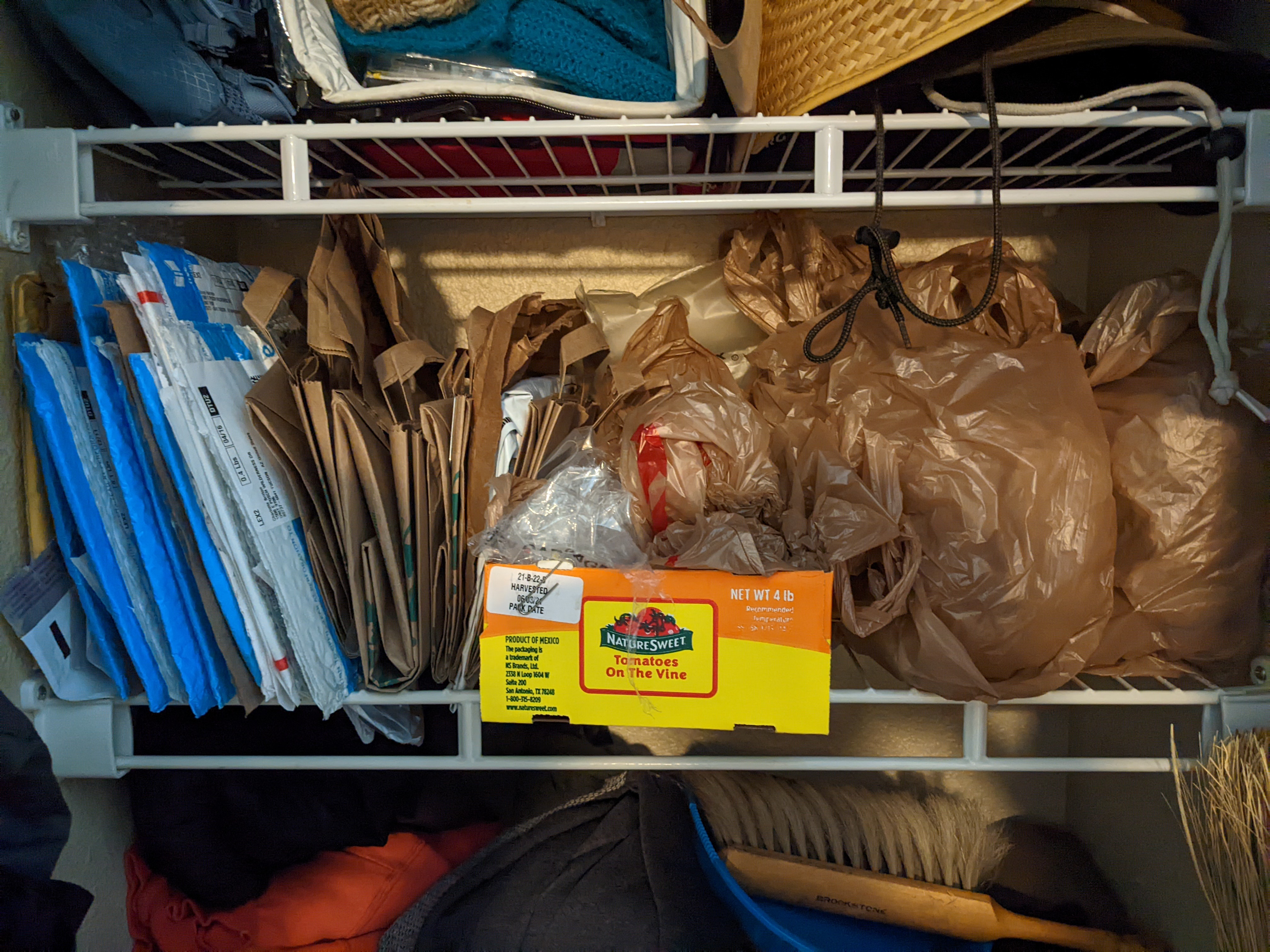
In freight transport, backhauls are always a problem. They are basically unpaid miles and tons. Their cost must be recovered in the head haul freight cost. It’s like the packaging when you buy something online. We either have to find something to do with it, or throw it away, or take up valuable space storing it for reuse. Here’s an entire shelf in my coat closet, stuffed with packaging.
We have worked out various systems for recycling packaging. In the US most locations have some recycling capability, and customers are urged to separate trash. The usual destination is a recycling facility, or perhaps a landfill. The landfill is very undesirable, because of contamination leakage from the dumps, which can be hard to control. Landfill space is also at a premium in the US in most places. Who wants a landfill next door?
Over time, however, the rules have changed. It used to be we could export our trash waste to other countries. China took a large amount of paper waste in the past. They did not have clean sources of paper waste for papermaking in China. But in the last few years they have refused to take the waste, since they created domestic sources.
Similarly, plastic waste used to be exported. It’s a usable feedstock for certain plastic manufacture, and has a few other uses. But more recently countries have recognized the problem and are refusing to take it.
Containers fall into the same category. They are packaging. They are recyclable, though it takes some work. The steel scrap has a value in future steelmaking, but it isn’t large. And they cube up the world, taking up both area space and height when stored in yards. In California during the recent congestion crisis at the ports, additional empty container yards were created at considerable expense off the port properties, to provide storage space off the port terminal yard where empties were clogging up the movement lanes.
We’re going to be faced with an increasing problem as long as the US is an importing nation.
There have been various schemes for modifying containers floated. Foldable containers would be quite a bit less costly to ship back, and take up less space at the cost of some labor to fold them and then unfold them. One design I saw allowed five forty-foot containers to fit in the space of one forty-foot unit for storage and shipping. But they are a lot more expensive than standard units, and reefers would be hard to handle this way.
As long as current export-import patterns continue, it would be worthwhile for entrepreneurs to spend time on the empty container problem. Other industries have improved the recyclable aspects of their packaging, and ocean carriers and shippers should start addressing the issue.
The baby formula shortage is deplorable. And it’s nice that the government is trying to figure out how to help get more product into the supply chain. And it’s good to rethink restrictions on imports and get them moving.
But let’s not forget the real cause of the problem. It’s the fact that Abbott Labs would not agree to implement process changes required to reopen the plant that was shut down by the FDA for failing to meet standards for production.
So this is a case when industry and business failed to look out for the welfare of babies.
They failed to monitor the production properly to prevent contamination. And then they argued about how to fix it rather than jumping in to do the job fast. Was he cost the reason?
There are some times when firms just have to step up, admit a problem, and fix it fast. That did not happen here.
We should be glaring at Abbott for failing to prevent this mess we have to fix for them.
And I’m sure there are many other cases in other fields, most not so inconvenient and harmful as a shortage of baby formula.



 Supply Chain and Logistics