Author Archives: just2bruce

US importers using box ships to store cargo

US importers are not so worried about cargo waiting offshore to be unloaded. As long as they have enough for their sales or manufacturing, the cargo can sit on a container ship and the principal cost to the shipper is the interest cost. With interest rates at historic lows, that isn’t much.

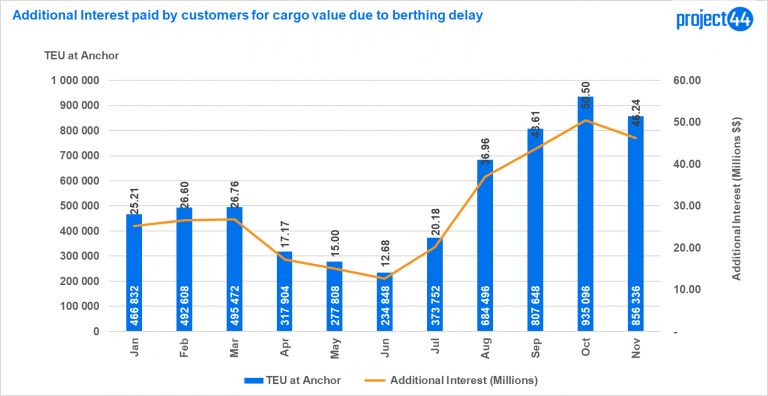
The graph below from project44, a Chicago, I- based visibility platform, shows the number of TEUs at anchor by month from January through November 2020, on the left. The rise starting in August is significant. Using data from HSBC, which show a 3.2% annual interest rate, using an average container value of $40,000, they calculate almost $50M per month in new delay costs, and cumulative inventory interest costs over $850 million.

The point is that these costs are a lot lower than inventory costs at warehouses. While the cargo is held at sea under riskier conditions, in the warehouse other costs kick in, not the least of which is space required. Insurance charges on the financed inventory also accumulate. And there’s the work, both labor and mechanical, of shuffling the inventory around; it’s very variable given the specific warehouse layout, but can be significant also.

So shippers are using the offshore jam-up rather than wishing it away. Only when the demand for products ratchets up so that the offshore inventory is needed will the stakes change. While we have significant COVID likelihood today, that isn’t likely to change much.

It’s always interesting to look at the overall question of inventory cost in the supply chain. Advantages to shippers can come from unlikely places.

By Nick Savvides 12/01/2022

US importers using box ships to store cargo – cheaper than warehouses – The Loadstar

FMC probe into D&D claim against Hapag-Lloyd could set industry precedent – The Loadstar

This Detention and Demurrage claim filed by a carrier against Hapag-Lloyd could be interesting to watch. All this activity takes place at the Port of Long Beach and nearby.

For one thing, the claim involves reefer containers, usually overweight, which require special triple-axle chassis to handle. It also involves breaking down the containers and restuffing them into domestic-style reefers for inland transit. The drayage firm, OAE, finds that they are often charged detention even if they can return the empties within 2 days.

From a supply chain perspective, OAE is clearly providing an important service; they are moving containers from the yard, and are quickly returning them to the carrier for reuse. Both of these are aids to reduce congestion. They also are aids to the shippers, getting cargo further along its route. And there is a recognized need for reefer containers, perhaps even more than for general merchandise containers.

So it would seem that Hapag-Lloyd might be prepared to look the other way regarding D&D charges, except when something goes wrong, such as a lost container or something. Other issues that can occur include a lack of gate appointments for return. With the congestion at Long Beach we see now, gate appointments could be in short supply. To what extent is that the fault of Hapag-Lloyd? Do they have an obligation to use a terminal that can accept the containers they are sending through it?

By Nick Savvides 10/01/2022

FMC probe into D&D claim against Hapag-Lloyd could set industry precedent – The Loadstar

Port of Long Beach receives $52 million for rail project

It’s about time that Long Beach is able to provide on-dock container rail handling. Drayage trucks have been a massive source of pollution in the area since the 1990s. Even the Clean Trucks initiative, helpful though it was, can’t keep the particulates and other noxious elements of diesel exhaust down. The proper solution is on-dock rail.

Though this won’t touch the total cost of the project, it’s enough to get it going. It can certainly fund studies and preliminary work.

The time frame isn’t till 2025 for the first trains, though.

23 December 2021 Port Technology International Team

Port of Long Beach receives $52 million for rail project – Port Technology International