
One of my favorite sources for information about trucking and truck drivers is ATRI, the American Transportation Research Institute. It’s a nonprofit with board members from every aspect of the trucking industry.
Each year they publish a report on the top industry issues for the year. It’s based on surveys. You can get it here. https://truckingresearch.org/atri-research/top-industry-issues/
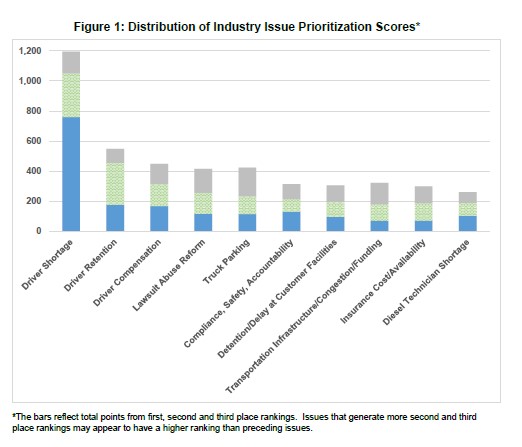
It is always interesting reading. This year issues related to driver retention rose to the top of the list. We can see that at a glance by inspecting Figure 1, from page 4 of the report. The top 3 deal with the driver crisis in trucking.
One of the most interesting aspects of the report is a comparison between the attitudes of commercial drivers and those of motor carriers. The two groups have very different concerns, which are telling. The gap in concerns may represent why drivers are leaving the trucking workforce. I’m including Table 2 from the report below, which clearly portrays those different views.
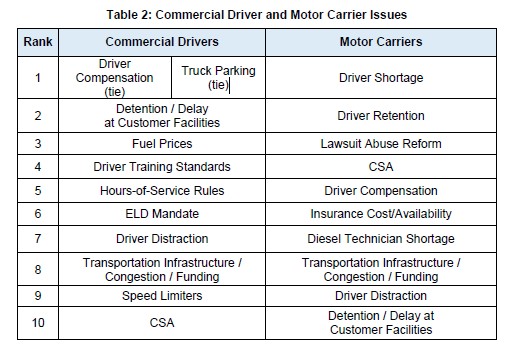
Drivers are very concerned about compensation, truck parking, and delays at customer facilities, all of which affect their bottom line directly. Motor Carriers are concerned about the driver shortage and retention; I have heard that about 90% of drivers leave their current job within the first two years.
It seems to me that motor carriers ought to think about how they might have an impact on the truck parking problem nationally, and the detention or delay problems. Those factors are influencing drivers to choose to leave the profession or to switch to a company that can offer something that improves those dimensions. Money isn’t the whole story, though there is certainly a need for truck driver compensation to improve; both sides understand that.
One important dimension of trucking that cannot be overlooked in the US is the division between Owner-Operators and Company Drivers. There are different factors at work for these two very different classes of drivers. The ATRI Survey brings that out clearly in Table 3 of the report.

Both groups rate Truck Parking high, because it affects scheduling breaks and their ability to earn by moving goods. A search for a parking spot is time not spent transporting the goods.
But as one would expect, Owner-Operators are concerned about fuel prices, because they pay that themselves out of their piece-work fee for carrying the load. Company drivers do not have to pay for fuel themselves; it’s a company expense, and not money directly out of their pocket.
Compensation, whether by wages or by per-load fees, is a major issue for both groups.
I want to give a shout-out to ATRI for their diligence in producing this study each year. It’s a valuable resource for understanding the state of the trucking industry and gives us info that can drive our thinking about how its individual participants need to change.



 Supply Chain and Logistics