Category Archives: Ports

ILA stops negotiations with USMX

The labor deal between US East and Gulf Coast ports and the International Longshoreman’s Association (ILA) may be unraveling. The current agreement expires at the end of September. It was a six-year deal.

The major issue at present is an Auto Gate system Maersk and APM Terminals are using that processes trucks autonomously, with no ILA labor. The union claims this directly contradicts what was agreed in the last union contract.

Automation and protection of ILA jobs have for years now been a bone of contention between the union and the alliance of container carriers, direct employers, and port associations that serve US ports, which is called the United States Maritime Alliance (USMX). The same was true on the West Coast, when the recent strike was averted by a new contract with the Pacific Maritime Association.

There’s no easy way to find resolution. Automation reduces jobs for longshoremen, though it creates support jobs, for which most union longshoremen are not qualified. And retraining these longshoremen may be difficult, even if some way could be found to fund it. Each side thinks the other ought to pay for the retraining. And in the short run, there will still be a workforce reduction.

The September 30, 2024 expiration date looks like it may not be met; however both sides have usually agreed to continue work as usual while still negotiating. However, openly violating terms of the contract, especially without full discussion with the union, is a good way to get their dander up, and prolong the negotiations.

Best to practice transparency and full disclosure.

Logistics Management logo

By Jeff Berman June 10, 2024

https://www.logisticsmgmt.com/article/ila_stops_negotiations_with_usmx_with_deal_set_to_expire_at_the_end_of_september

Cars-in-containers innovation boosts capacity

There is a shortage of ro-ro (roll on roll off) capacity for moving vehicles by sea. One possibility to move the cars is to put them into containers and ship them on container ships. But you can only get so many into a container – two per (twenty-foot equivalent unit) TEU or four in a forty-foot container.

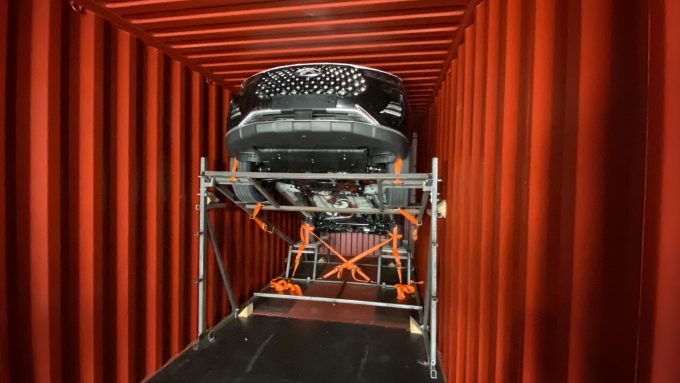
One solution would be to find a way to pack them tighter. And that’s what DP World, the large port operator, has done for voyages from China to Turkey. They can now get three Chery vehicles in a container.

Chery Automotive is a major Chinese car manufacturer, with a portfolio of ICE, hybrid, and all-electric vehicles. In July, they imported 10,000 SUVs into Turkey from China using this method.

Turkey is a big market for Chinese cars, but it’s also a gateway to Europe. Cars brought to Turkey could be sold on into European countries.

Packing of containers has always been a way to avoid shipping ‘air’ (empty space). But one issue is the incidence of fires on ships from lithium battery explosions. These explosions have become quite frequent. It’s due to the heat and close packing. So far, ro-ro ships have suffered most, though there have been lithium battery fires on container ships, due to shipments of other battery-powered equipment. Adding large numbers of cars will make the risk greater.

A TT Club risk management director noted that automakers are simply trying to get more energy into batteries, not investing in how to reduce the danger from shipment. They need to focus more on the risk in their designs.

Here’s a picture of the stacking. It’s not very clear, but you can see the rack.

By Charlie Bartlett 03/10/2023

Cars-in-containers innovation boosts ro-ro capacity for DP World

How China Uses Shipping for Surveillance and Control

Beijing’s global maritime operations double as intelligence-gathering outposts.

I was not aware that Chinese interests have installed operating software at quite a few ports around the world. Coupled with the Chinese Government’s mandate to share all information with the Chinese Government, we have an ideal spying network. Port traffic is a clear indication of material movements, and could give insights useful for military action.

The article in Foreign Policy, clearly labeled ‘argument’, suggests that the US government examine the risks and take actions to thwart the use of port information. It’s not unlike the US Government stance on Huawei components for cell phones. That fear led to a ban on Huawei selling components in the US.

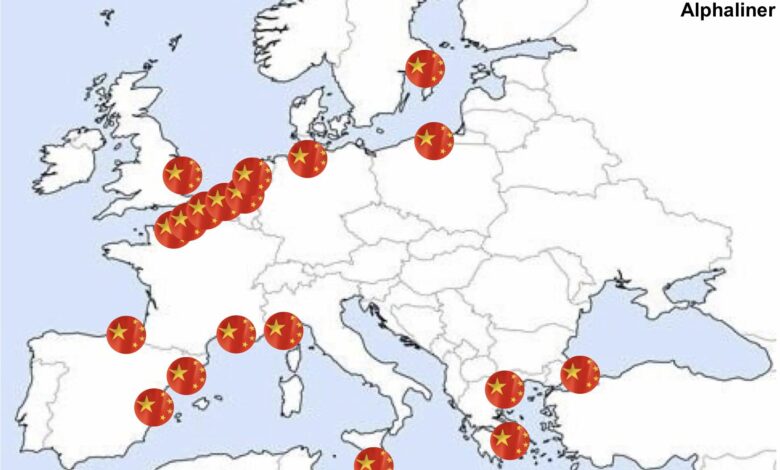
Europe has a problem too. This map from Alphaliner shows which ports in Europe have Chinese interests.

Of course, they aren’t controlling except at Piraeus in Greece and Zeebrugge in the Netherlands. And 23 of them arise from state-owned Chinese interests, China Overseas Shipping Company (COSCO) and Terminal Link, a joint venture with liner company CMA CGM.

The EU adopted new rules last December that call for monitoring of potential threats posed by Foreign Direct Investment (FDI) in European assets.

By Elaine Dezenski, a senior director and the head of the Center on Economic and Financial Power at the Foundation for Defense of Democracies, and David Rader, a senior fellow at the Foundation for Defense of Democracies. SEPTEMBER 20, 2023, 4:46 AM

How China Uses Shipping for Surveillance and Control

By Gavin van Marle 21/09/2023

Are China’s ports and shipping companies being used to spy on the world?

Sam Chambers September 20, 2023

China’s European port interests mapped