This story indicates that 3PLs will provide the supply chain wisdom the ocean carriers and port operators refuse to take on. Look for more and more profitable intermediaries, rather than fewer, in ocean supply chains. They are not likely to be supplanted by blockchain systems.
Here’s a great idea: why don’t we simply buy a 3PL? It is a lot easier than developing all that wretched software ourselves! Seriously, why isn’t consolidation of 3PLs and maritime firms a good way to extend services beyond the port and put them under the control of someone we can trust to (more or less) handle the movements the way we want? It is a time-honored way to gain capabilities we do not have without doing the work of creating a new business. Sure there can be some coordination issues, but are they as bad as Maersk has coordinating with IBM on their blockchain system?
Remember that providing coordination and visibility of information is mostly what blockchain accomplishes, and the jury is out on whether it can be made competitive with existing types of databases (which may also need improvement, to be sure). And any of these systems is “permissioned” in blockchain lingo– there is a governor who is empowered to make decisions about who is allowed to use it. None of them is truly decentralized for governance, as the Bitcoin advocates would have you believe; in that world, the miners (of whom there are now about 6 with a 75% share of all blocks mined) can exercise control whenever they want.
It comes down to trust. Who do we trust? Central banks, or a bunch of miners? Or are we happy enough trusting Maersk, or CMA-CGM and Ceva, or some other 3PL with our cargo, and prefer to argue with them over damaged or misplaced cargoes, rather than debate with some Ethereum sites about these issues?
I’m not sure how it will come out, but I don’t think it will be all one way or the other.
Turkey has announced a new canal parallel to the Bosporus, to connect the Black Sea and the Sea of Marmara. It’s an expensive project for Turkey, and the government appears to want a PPP model for at least some of the route. Here’s a map, from the article.
Several universities participated in the research needed to get the project off the ground. Work is planned to start soon, and be completed by 2023.

 via Bigger ships and bigger ports an opening for 3PLs to revolutionise supply chains – The Loadstar
 via
via  via
via  via
via 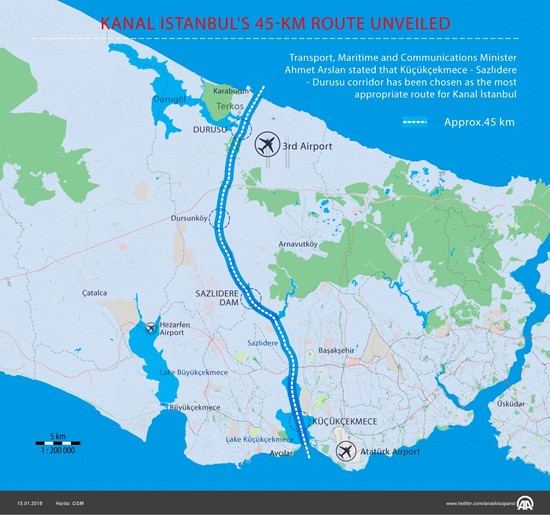


 Supply Chain and Logistics