Category Archives: Strategy

Liners get a preview of alternative fuel costs

A new technical and commercial comparison of alternative fuels for ocean carriers compares expected bunker costs for different size and differently equipped ships. Alphaliner, a consultancy for ocean carriers, has reviewed that comparison.

Alphaliner’s review shows the ship owner and operator what they can expect in economy over the next few years. The results indicate that as the new regulations for CO2 emissions kick in, fuel costs will become a much larger percentage of total ship operating costs, perhaps double, or even more.

For instance, the graph they publish shows fuel costs for differently equipped Megamax-24 (MGX-24) ships. A megamax-24 ship is typically 400 meters long and 61 meters wide, with a depth of about 33.2 meters. It should carry around 23,500 twenty-foot equivalent (TEU) containers (Alphaliner newsletter).

The graph compares use of fossil fuels, bio fuels, and power-to-fuel (PtX) fuels (read about them). The PtX fuels convert renewable sources such as wind, sun, hydro, and geothermal, to fuel products such as hydrogen, ammonia, or products containing carbon, such as syn-crude. If carbon is used in the PtX process it should be from non-fossil sources or unavoidable industrial carbon emissions capture and reuse.
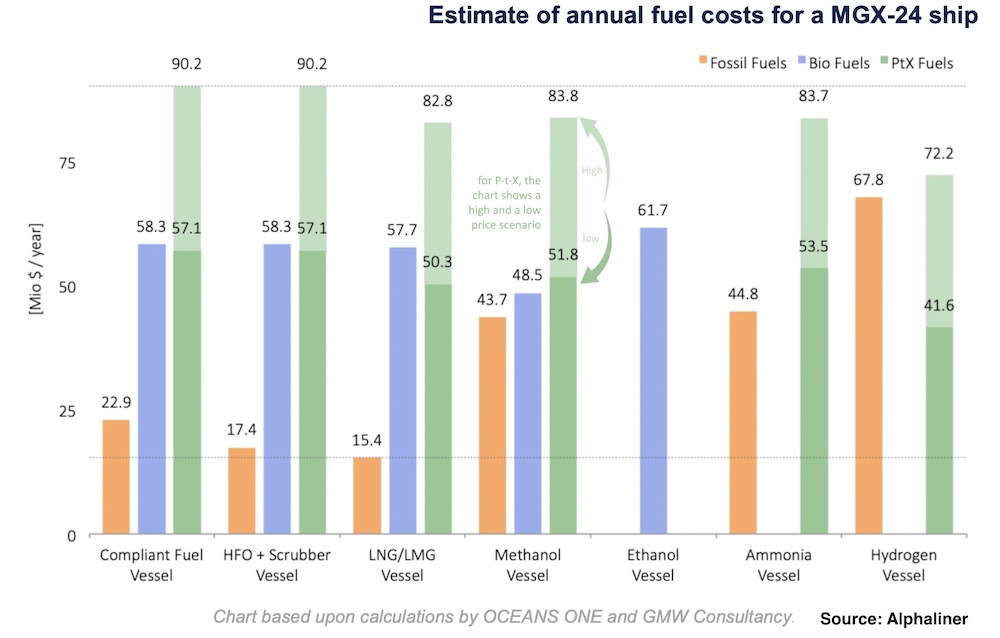
Source: Splash247 article.

Even bio-fuels cost a lot more than conventional fuels when all the upstream supply chain emissions are considered, for these very large ships.

The graph seems to imply that scrubbers are still a very important technology in the fight to clear the air. And LNG has a role to play, though it might be temporary. At their best, the PtX technologies such as electric-powered ships are comparable to or better than bio-fueled vessels.

There’s clearly a long way to go for ocean shipping to go where it needs to in the race to clean up global emissions.

However, some of these non-fossil technologies will adapt over the next few years, and costs will come down. It’s hard to do much more with the fossil fuel technology.

The argument Alphaliner makes is that soon fixed costs will be a smaller part of the total cost of a large ship than fuel operating costs. As these proportions change, emphasis will come more on building ships with desirable emissions control power systems, since the availability and price of fuel will be driving overall costs.

That’s an interesting point. We will see the extent to which it influences the next generation or two of ship orders.

Sam Chambers July 27, 2022

Liners get a preview of alternative fuel costs – Splash247

Freightos’ shareholders unveiled: does transparency really matter?

It turns out that major shareholders of Freightos are also large logistics companies— FedEx, Qatar Airways, and IAG Cargo. Thre are others, such as Singapore Exchange, who participated in Freightos’s Series C round of financing. There has been a policy of keeping major shareholders hidden.

Is this bad? Not necessarily, but there could be conflicts of interest. Some customers won’t care, but others might if their interests are not being addressed.

Freightos operates an online international freight marketplace [Wikipedia]. It also sells multimodal freight, and booking automation for carriers and freight forwarders. The Wikipedia article does a good job of explaining what they do and what acquisitions they have made. They’re a freight broker and carrier, with a software platform, though they started out as a software company.

Complicated ownership structures are not uncommon in business. Whether they influence how they do business in the small is a different question. At present we don’t hear of any customer issues.

Partners’ business relations should always include checking on whether ownership affects the partner’s way of doing business with you.

By Alex Lennane 27/05/2022

Freightos’ shareholders unveiled: does transparency really matter? – The Loadstar

Synchronisation across maritime value chains can ease inflation

This interesting article suggests that slot management across supply chain entities could help ease the current supply chain congestion woes. It’s an attempt to define this concept that could induce more cooperation between firms and supply chain entities such as ports, terminals, and hauliers.

There’s no question that today’s world of maritime logistics and supply chains is dominated by decision-making for the benefit of each individual participant. The flow of goods overall could be improved by introducing a discipline that would make decisions for the common good look better.

The article leaves open the question of how to induce the players to participate.

We already see signs that some large shippers have already decided not to play on the same terms. Firms like Home Depot, Walmart, Amazon, and IKEA are trying out chartering their own ships and selecting their own ports, terminals, and inland transport to make their specific supply chains work better. This individual management could bring gains especially for them, and there’s a chance that if enough of it happens, some of the major bottleneck ports such as Shanghai, LA/Long Beach, and Rotterdam could see a reduction of traffic enough to lower backlogs and congestion. And the smaller ports these individual shippers might use, such as Seattle/Tacoma, Norfolk, and Savannah, will see increasing traffic and congestion. If they have the capacity that’s ok, but if not the woes will continue.

These are just examples of how not to participate.

I agree with the authors that just allowing market principles to work won’t create the gains in throughput we need to see. The markets don’t work fast enough to prevent hardship and business and personal failure.

A suggestion made earlier was for a system to ‘label’ each container (in the paperwork, and perhaps physically on it, like the priority mail labels in the US mail) with a service level standard required for this container. Those handling the container would know its priority and could adjust their individual workflows to meet the standard delivery time. Even if there were bottlenecks, the standard would help those in a position to relieve one to see which containers needed to be handled or placed first, second, and so on.

I submit that introduction of a world-wide slot system for maritime container transport needs to be accompanied by a system to reallocate the benefits and costs of the system. There need to be charges or inducements at ports and terminals to get players to fit their needs and actions in with the slot optimization system.

In fact, any system that would operate throughout whole maritime value chains needs to have the incentives designed along with the tracking or resource allocation system.

A worthwhile start would be a model of a realistic slot allocation system and its effects on, say the current congestion worldwide at ports and in hinterland supply chains. Not an easy study to conduct, but it would show where inducements need to be given, and where penalties need to be put, to prevent or reduce gaming the supply chain. Experiments with inducements could be made to gauge their effect and help choose the right ones.

By Mikael Lind et al 01/02/2022

Synchronisation across maritime value chains can ease inflation – The Loadstar