Category Archives: Supply Chains

America’s freight railroads are incredibly chaotic right now

Right now there’s a big railroad strike looming. There’s also a potential strike coming up among West Coast dock workers. And there is labor unrest elsewhere in the supply chain area, including warehouse workers and independent contractor drivers.

It’s obvious that when things are difficult for employers, that’s the time to stage a strike if you’re a union. The circumstances offer the opportunity to generate maximum impact on the firms.

But the railroads have many other problems that coalesce into a serious decline in service. Rails were all excited about PSR, or precision scheduled railroading, an effort to apply some lean principles to the management of rail traffic. The trouble with lean, however, is always in the interpretation. It’s easy for managers to get carried away and cut too deeply, whether it be equipment, labor, or other resources. It makes the bottom line look good instantly, but reduced flexibility to deal with change. And it may even reduce customer service, if that isn’t measured in a sound fashion, that takes the customer interest into account. I’m afraid some of the rails did not perform their lean transformation that well.

The Covid epidemic didn’t help, either. It created a temporary decline in demand, and it was easy to ride that trend downward and reduce inputs too much. That’s what happened here. The rails simply cut staff too deep. And now that demand for rail has increased, it’s really hard to catch up.

The Great Resignation or Relocation is also amplifying the problem. People don’t want to keep jobs that make them work hours they don’t want, or force them into a difficult lifestyle. So even if union contracts are signed, there’s no guarantee that workers will become available for the rails. They may decide to choose other jobs and lifestyles. Make the job too hard, and no one will want it.

I feel that rails took their eye off the ball— customer service. Customers depend on rail for reliable on-time delivery, within the requirements for their use of the products. That means the trains have to run on time. There can’t be shortages of equipment or labor. When those are cut too deeply, it’s hard to bring them back quickly.

And the financial implications, to stock prices, and now high inflation, also work against the executives making difficult decisions to not cut so deep. Inflation makes capital items harder to replace. And the labor shortage means that higher wages will hurt the bottom line, since the raises ought to be offered to everyone, not just new workers— that’s the basic law of monopsony.

So the chaos in dispatching and routing for rails today is not entirely due to labor in my opinion. It’s also due to the big rails not continuing to invest in infrastructure improvements, in switching yards and equipment that would support their goals of reducing future congestion and costs. And they will need to cooperate as well. Allowing customers to cross-connect would help. Improving switching yards, or humps, to make switching cars and trains faster, would help. In a few places, double-track and double-stack would help. And better port-to-rail connectivity would help.

Rails also can’t ignore the agriculture supply chains which rely on them for both exports and domestic deliveries. Those chains aren’t as profitable as some others but have to be served. We allowed the rails to abandon passenger transportation years ago. But we can’t allow them to abandon other business sectors that depend on them.

Rachel Premack Thursday, July 14, 2022

America’s freight railroads are incredibly chaotic right now – FreightWaves

Joanna Marsh Wednesday, July 13, 2022

Rail union members could go on strike Monday amid contract impasse – FreightWaves
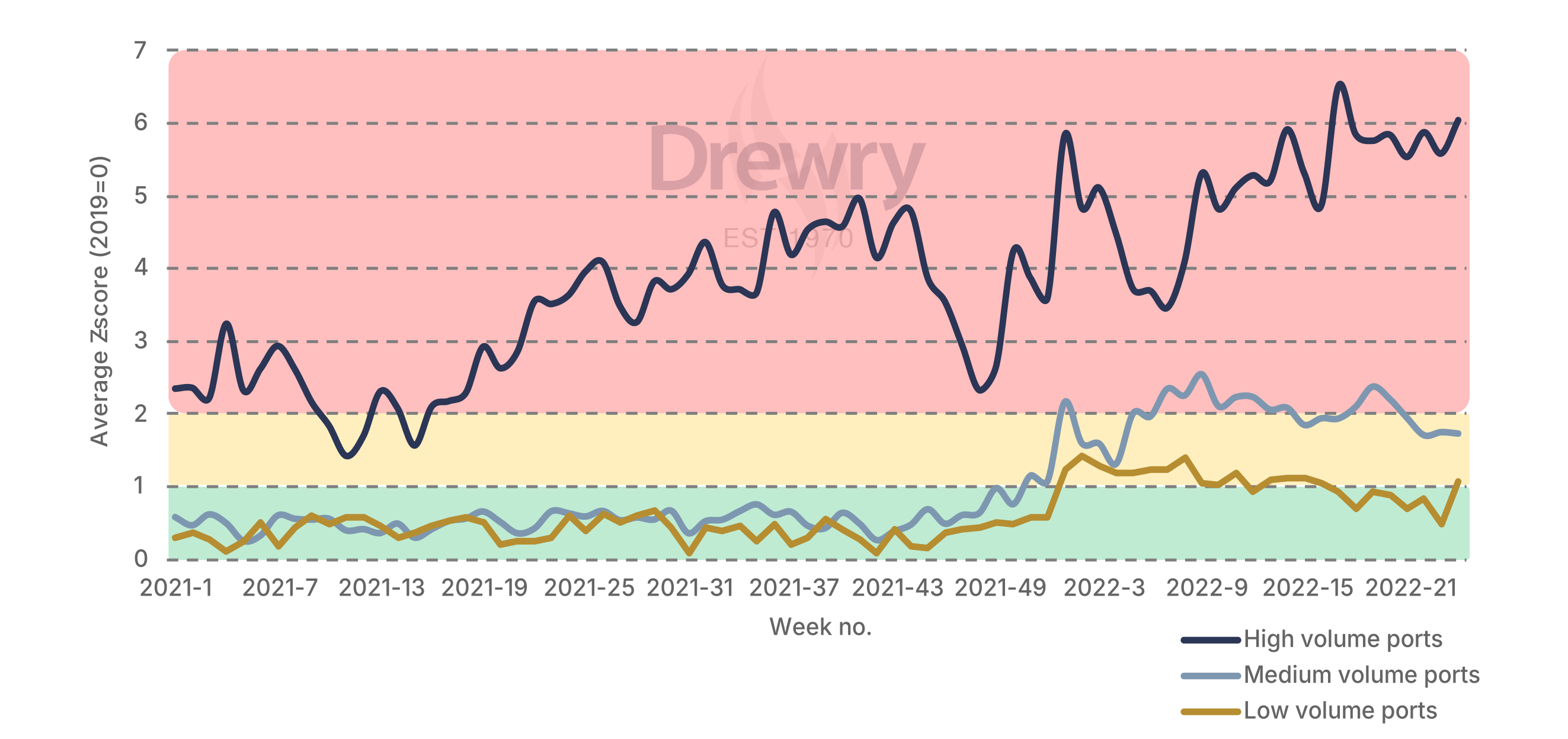
Beginning of the end for carriers’ bull run

Drewry’s Weekly Feature Articles are usually full of good information, though at an aggregate level. This week’s issue is notable for its information on when the congestion and high ocean prices will end.

This graph shows that high volume ports are still seriously congested, while medium and low volume ports are far better off. The Z-scores are based on the 2019 average, so they represent the difference from that baseline level of congestion.

Source: Drewry Maritime Research
Note: Based on the z-score deviation from 2019 averages of the number of ships waiting outside selected ports. Only considers waiting events longer than 4 hours to avoid capturing ships passing through port waiting zones.

The current Drewry customer surveys show that most customers think the congestion in North America won’t dissipate until 2023, perhaps the first half; or maybe even the second half. The reasons given seem to be that there has not been much change in the supply chains that serve the ports, especially the large ports. It’s clear that US supply chain participants such as rail lines, truckers, warehouses, and equipment suppliers such as chassis yards and suppliers, are having trouble cooperating to get goods to move faster and empties returned and refilled in timely ways. There’s little confidence that that will change.

The threat of a longshoremans’ strike at LA/Long Beach, where negotiations have begun, is another factor. I, for one, think that the negotiations will be successful, though not done on time. I think both sides have too much political capital to lose by failing to agree. It would be catastrophic for both the Pacific Maritime Association (PMA) who negotiates for the management side, and the International Longshore Workers Union (ILWU), representing labor, if they can’t forge a position. We can’t predict whether the major issue, how to implement automation without eliminating longshore union jobs, will be settled to allow a lot more automation this time. But they don’t have to completely settle this right now; it can come up again in a later round, and the ports on the West Coast can meet quite good throughput goals without changing much in the automation activity right now.

Unfortunately, the PMA has a history of being sticky in negotiations. It’s sad, because some of my former students at Cal State Maritime work for the PMA, and others are with the terminals at the ports. But I’m no expert on PMA dynamics. I just hope everyone is adopting a reasonable attitude.

The expectations for easing in Europe and Asia are similar, with customers of Drewry’s believing the congestion problems will continue into 2023. There are different issues there, though including China’s COVID shutdown policies.

Most of the survey participants believe that ocean carriers will continue ‘capacity discipline’ far into next year. This can be translated as blanked sailings. So there is little hope of reliability turning around for the foreseeable future. Private or dedicated fleets could continue to be a good idea for very large importers to the US.

Theo Notteboom and Pierre Cariou have just written a paper contrasting Walmart and Nike’s dedicated fleets with the standard ocean liner trade to West Coast North America, in the light of COVID disruptions. You can find the paper here. It indicates that quite different strategies combining choice of origin and destination and hinterland inventory locations are possible for dedicated fleets. They offer these larger shippers good opportunities to increase reliability and reduce costs. It’s done by thinking about the entire supply chain rather than just the maritime link. Perhaps 3PLs can help other shippers s well, by offering different packages with dedicated portions. Flexport has done some of that with air shipments in past years, with their own airfreight contracts.

But in general, it’s very hard to get supply chain participants to think in a cooperative manner. We see this every day in the complaints being made when any proposal for coordination is brought forward. With dedicated service there’s only one decision point.

Cooperation is going to take massive effort on the part of supply chain participants. Visibility is nice but will only go so far. Coordination schemes have to be found to keep congestion at bay.

Reading Drewry’s is a good way to stay in touch with the bigger picture.

Drewry – Weekly Feature Articles – Beginning of the end for carriers’ bull run

Drewry – Weekly Feature Articles – Beginning of the end for carriers’ bull run

A potential economic recession and the supply chain bullwhip are colliding

Freightwaves’s SONAR app has a lot of excellent data that it makes readily available. This post by the CEO shows some clear trends in freight, particularly ocean freight.

One of the interesting graphs shows that recently the number of containers per shipment has dropped a lot. It’s based on the number of bills of lading, and the container volumes in twenty-foot units (TEU) in green.

The most obvious fact predicting this number is that order size for containers is dropping. Perhaps the shippers need less stuff.

Or perhaps they are finding other ways to get them. Walmart and Home Depot, for instance, are running their own liner services, so perhaps shipments moved on them are not showing up. Or perhaps they are ordering domestically.

The service on the container lines and alliances has been so horrible that supply chain managers who really need reliability are becoming squeamish about using them.

I think we can look for these ratios to stay similar till the container lines and alliances start regularizing their schedules and improving their on-time delivery rates.

SONAR is a good place to look for an overview. Now there needs to be some analysis. Visibility is only so valuable. It needs analytics to determine causes and relationships.

Craig Fuller, CEO at FreightWaves Follow on TwitterTuesday, June 21, 2022

A potential economic recession and the supply chain bullwhip are colliding – FreightWaves