Category Archives: Uncategorized

Xeneta green scheme names and shames box line heroes and villains

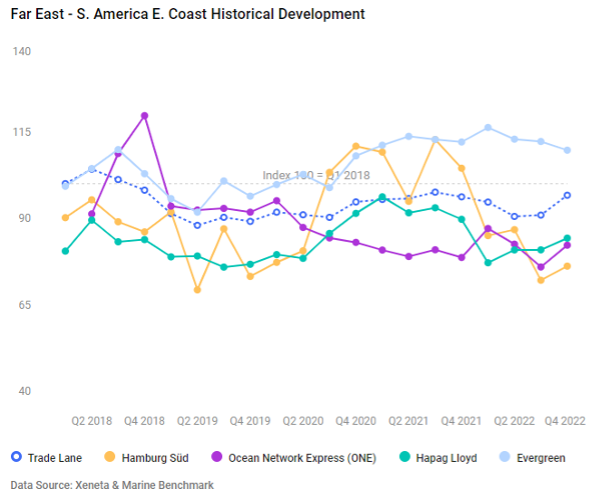
Xeneta has developed a new index to describe the CO2 emissions by major container shipping companies on specific trade lanes. The index names Hamburg Sud as a hero and Evergreen as a villain currently.

Unlike the IMO’s CII the index estimates CO emissions per unit of cargo, which may be a better measure for carriers to work on. It also lets Xeneta make a statement on how the line got their result.

For instance, Hamburg Sud got their good result mainly by slow steaming.

Here’s what Xeneta had to say about how the index is calculated:

“The CEI methodology, she explained, is based on data from Marine Benchmark and calculated based on AIS data, including speed, combined with modelled factors, such as weather data, loading.”

Source: article linked below.

We’ll want to follow this CEI index over time. Over time Xeneta gives us a graphical picture of several entities on the America East Coast trade. Here we see how various carriers and consortia are able to manage CO2 emissions via the CEI.
By Charlie Bartlett, technology editor 09/02/2023

Xeneta green scheme names and shames box line heroes and villains – The Loadstar

Monopolist gatekeepers keeping warehouse power in the shade

In the UK, using warehouse roofs for solar power could produce over 13 trillion watt-hours of energy. Even one-third of this would fulfill the UK’s commitment for 2030.

The issue: regulators have handed power over who and how to connect to the national grid to the District Network Operators, who get to decide the cost and access.

Rooftop solar for warehouses would need dozens of requests for access from DNO’s and they would be in a position to set the cost at a level where it would be impractical.

Gavin van Marle proposes that control be given to the state regulator Ofgem. That would break up DNO control and allow a fair price to be set. And it could make a big difference in solar power generation.

The alternative is trying to install solar on vacant farmland, which has its own set of regulatory hurdles and protests. Few would care if solar were on top of warehouses.

It’s an interesting conundrum, and one we hope the UK acts on soon. We could do more of the same in the US.

By Gavin van Marle 08/09/2022

Monopolist gatekeepers keeping warehouse power in the shade – The Loadstar

Klaipeda looks to position itself as the Blue Economy capital of the Baltics

Klaipeda is in Lithuania, the only substantial port in that country. Geographically it is well-positioned for the maritime industry of the Baltic Sea. A map is instructive.

Lithuania is close to Russia on the east, and Sweden on the west, and also on routes to Finland, Denmark, Germany, Poland, and Norway. There are many opportunities for trade over the sea here.

The conference planned by Klaipeda is connected with Norway, one of the most important locations for maritime innovation.

I’m planning to attend online. I will be listening especially for green innovations and plans to meet European sustainability and ESG goals for the maritime industry.

The Baltic States area has become more important due to the war in the Crimea. Lithuania blocks access to the Russian port of Kaliningrad, which is in an island of Russian territory separated from the main body of Russia. Recently permission was granted to allow transport across Lithuania to Russia, despite the sanctions on Russian shipping. Lithuania is an EU country.

Press Release.

Klaipeda looks to position itself as the Blue Economy capital of the Baltics – bruce@ahartman.net – ahartman.net Mail