Tag Archives: container shipping

Ocean shipping routing changes

Here’s an example of route changes now occurring due to disruptions and freight relocation. Maersk and Hapag-Lloyd are dropping Baltimore from their TA3 transatlantic container service, and adding Philadelphia.

The new rotation is Southampton – Rotterdam – Hamburg – Wilhelmshaven – Newark – Norfolk – Philadelphia – St. John – Southampton. The new schedule kicks off with the sailing of the Maersk Fredericia from Southampton Jan. 4.

The reason offered is the handicapped service at Baltimore due to the collapse of the Francis Scott Key Bridge in 2024, when the Dali ran into an abutment, collapsing the bridge. The rebuilding will take longer than anticipated. The bridge collapse has restricted access to some berths in the port of Baltimore. That has affected throughput at the port.

The article says:

For ocean carriers, calling Baltimore adds several days’ transit time compared to Norfolk, Va., and Philadelphia. Ships have to navigate 150 miles through the Chesapeake Bay, among the longest ship channels in the world, according to a 2019 study by Texas A&M University. The route also requires the services of multiple local pilots to guide vessels in, along with a separate docking pilot at the port.  

Stuart Chirls Tuesday, December 16, 2025

https://www.freightwaves.com/news/maersk-hapag-lloyd-drop-east-coast-city-from-trans-atlantic-services

Beijing sets port fees and restrictive policies

Retribution for the US port fees for Chinese-owned and Chinese-built ships is already here, even before the fees come into effect. The main effect seems to be a restructuring of shipping services, rather than any actual fees being collected. Operators of liner routes are simply taking the Chinese-related ships off their US runs. Several liner carriers have announced that they propose no surcharges.

I think the most important effect of the Chinese declaration is going to be the loss of data and information about Chinese ports. Most large carriers call at Chinese ports on their loops. No data means a loss of accuracy on arrival times and dwell times at the ports. This will affect all shippers and supply chain partners, making predictions more difficult.

I’m afraid geopolitics will make ocean shipping, and perhaps all kinds of carriage, into a game in which advance knowledge is impossible. We already see some effects in the loss of information from AIS due to spoofing and turning off transmission because of sanctions.


Stuart Chirls
Tuesday, September 30, 2025

https://www.freightwaves.com/news/china-could-bar-u-s-service-ships-in-new-maritime-dispute-volley

How Ultra-Large Container Ships are Transforming West Africa

Ultra-large container vessels are coming to West Africa. There is pent-up demand for goods in West Africa and throughout the continent. That’s because African economies are slowly improving, creating more consumers and businesses with money to spend.

Infrastructure to handle the ULCVs has been in short supply, but after considerable investment over the past few years, the giants can now land in numerous African ports.

With the impending container charges imposed by the US on containers arriving at its shores, more carriers and shippers are looking for ways to avoid landing in the US. Increasing West African trade is a natural way to use that capacity.

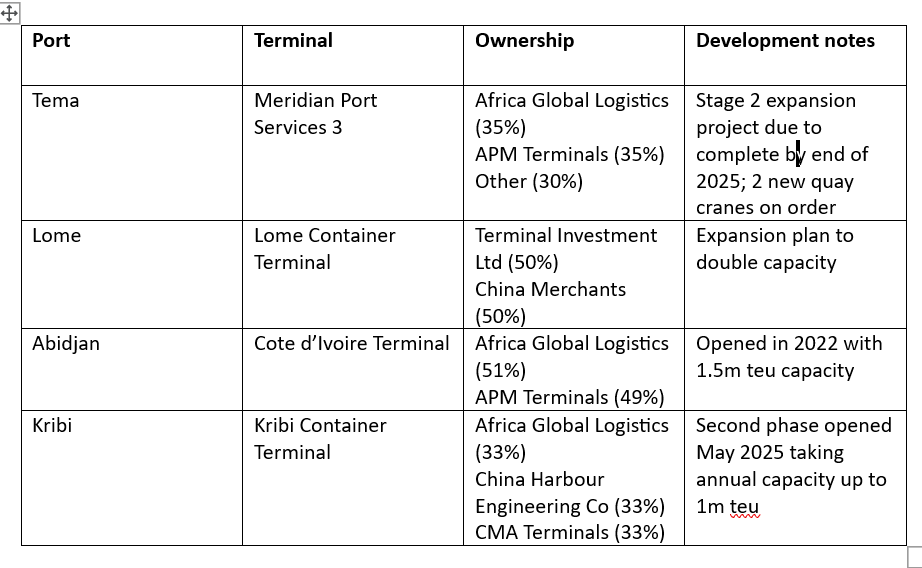
MSC is a major player in this trade. Their situation is helped by the fact that MSC has partial interests in port terminals in key West African locations, as the table below from the article shows. Tema is located in Ghana, Lome in Nigeria, Abidjan in Cote d’Ivoire, and Kribi in Cameroon. MSC has investments in Africa Global Logistics, which operates terminals at three of these ports; and a share in TIL, which has a terminal in Lome.

It’s good to see West Africa getting better access to the world’s goods. Trade improves the lives of both partners, exporter and importer.

Gavin van Marle  04/06/2025

https://theloadstar.com/asia-west-africa-ulcv-deployment-opens-new-markets-for-carriers