Tag Archives: container shipping

Is Ammonia cheapest long-term for IMO carbon rules?

University College London has published a new study considering in detail how shipowners can comply with the IMO rules for carbon emission compliance. It’s very detailed and takes into account not only the different technologies available, such as methanol and LNG, but also the timing of implementing the various regulations. One has to consider all these factors over the 25 or so years of the lifetime of a ship.

Granted, new technologies and availability of different fuel choices can change from what we can see now, but this impartial study favors ammonia-powered ships over the longer time frame. They suggest dual-fuel ammonia ships might be the best bet for investors in new shipping.

“Although there are significant complexities and uncertainties in what was agreed [at IMO MEPC 83] in April, even conservative projections of how remaining policy details will be finalised results in a ‘no brainer’ choice for shipowners in dual fuel ammonia,” said Dr. Tristan Smith, Professor of Energy and Transport at the UCL Energy Institute. 
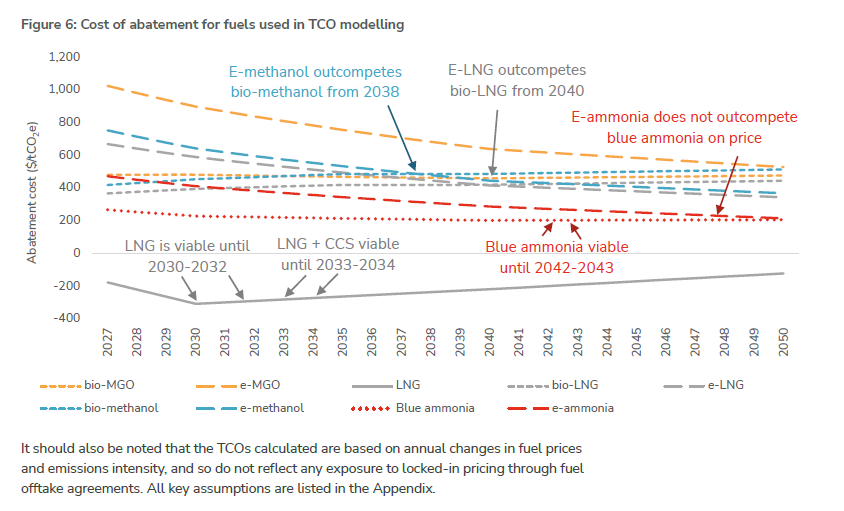
The report is available here.

This figure from the report indicates when different fuel choices become cheapest in terms of abatement cost. It seems that e-ammonia never outcompetes blue ammonia before 2050. And LNG remains viable for quite a while, especially with integrated carbon capture.

There are a lot of assumptions in any such study, and the IMO could change the rules in the meantime. But shipowners should be thinking hard about ammonia, and so should international bunker fuel providers.

Published May 29, 2025 9:08 PM by The Maritime Executive

https://www.maritime-executive.com/article/ucl-ammonia-is-the-cheapest-compliance-option-for-new-imo-carbon-rules

Update 6/5/2025: Fortescue is jumping on the dual-fuel ammonia bandwagon, and has some not-so-polite comments about others in shipping sticking with LNG.

Sam Chambers June 5, 2025

https://splash247.com/fortescues-mission-to-champion-ammonia-goes-global/

Detention and Demurrage claims are rolling in

Samsung Electronics of America (SEA) is a major user of container shipping. They have decided to fight back against excessive and frequently undocumented Detention and Demurrage (D&D) bills from carriers. This article spells out the claims.

Overall, Samsung thinks ocean carriers were selling door-to-door service and couldn’t deliver it. So they started billing customers to recover their costs.

The Federal Maritime Commission (FMC) has recently established rules about billing for such services, making the billing more transparent and requiring documentation for each charge. This will help shoppers, who are frequently baffled by the charges.

It’s essential to close down the practice of billing without thorough documentation. Seagate should have lots of winning arguments in these cases. There were so many temporary closures, changing windows for pickup and delivery, and other delays not caused by the shipper during the COVID era and after, that most D&D charges were probably due to slipups out of the shipper’s control, and perhaps even the carrier’s control. Carriers should not be entitled to profit from these.

Seatrade logo

Nick Savvides | Jun 17, 2024

Samsung Electronics America fires D&D claims at carriers

Port call optimisation reduces greenhouse gas emissions in ports

Drewry is well-known for its expertise in maritime-related matters. In a recent market opinion piece, they suggest that maritime emissions can be reduced rather simply, with port call optimization. They mean to reduce the time ships sit near a port waiting for their berth to open up.

Some ports have been successful with appointment windows. But the Drewry approach includes slow steaming to hit the port berthing window close to the time, instead of standing offshore running engines and emitting pollution. The slow steaming itself is a tested measure for reducing emissions, though it doesn’t eliminate them. The two efforts combined could save a lot of pollution, and now in some places such as the EU, emission charges based on actual fuel use numbers.

Eliminating waste in a system, such as waiting time waste, is a tried and true operations management or lean technique. But in the case of maritime shipping and ports, a lot of coordination is required. Systems need to be in place to provide accurate information about ocean carrier voyage schedules. Sailing times between ports can vary a lot, because of factors such as weather and route adjustments.

But also, both ocean carriers and ports need to share information and cooperate on setting berthing schedules. A late loading in Shanghai, for instance, will affect the projected arrival time in Long Beach. the two ports and the carrier will need to share up-to-the-minute (or hour) information about progress. Will they do it? It will require a level of interaction never before seen.

I think that ultimately, ports and carriers will be driven to this by the gains that can be made. but I think it will be a long time coming.

Update: Port optimization can actually prevent deaths. Hong Kong University of Science and Technology (HKUST) has recently studied the number of deaths that could be prevented by port waiting time improvement.

Sam Chambers June 27, 2024

Port efficiency gains can save 10,000 premature deaths annually

10 Jun 2024

https://www.drewry.co.uk/maritime-research-opinion-browser/maritime-research-opinions/port-call-optimisation-is-key-to-reducing-greenhouse-gas-emissions-in-ports