Tag Archives: emissions

Liners get a preview of alternative fuel costs

A new technical and commercial comparison of alternative fuels for ocean carriers compares expected bunker costs for different size and differently equipped ships. Alphaliner, a consultancy for ocean carriers, has reviewed that comparison.

Alphaliner’s review shows the ship owner and operator what they can expect in economy over the next few years. The results indicate that as the new regulations for CO2 emissions kick in, fuel costs will become a much larger percentage of total ship operating costs, perhaps double, or even more.

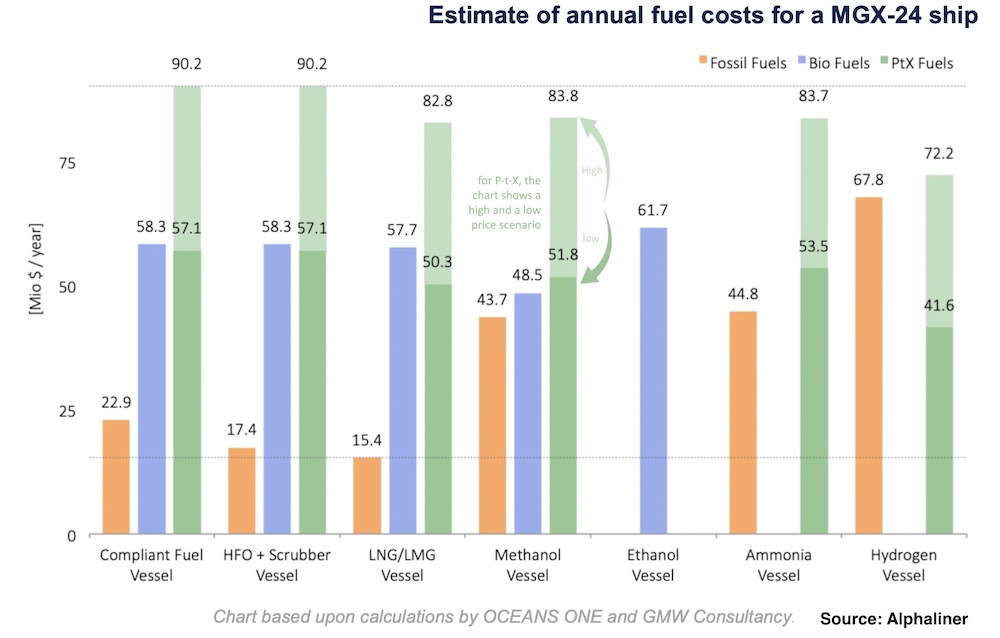
For instance, the graph they publish shows fuel costs for differently equipped Megamax-24 (MGX-24) ships. A megamax-24 ship is typically 400 meters long and 61 meters wide, with a depth of about 33.2 meters. It should carry around 23,500 twenty-foot equivalent (TEU) containers (Alphaliner newsletter).

The graph compares use of fossil fuels, bio fuels, and power-to-fuel (PtX) fuels (read about them). The PtX fuels convert renewable sources such as wind, sun, hydro, and geothermal, to fuel products such as hydrogen, ammonia, or products containing carbon, such as syn-crude. If carbon is used in the PtX process it should be from non-fossil sources or unavoidable industrial carbon emissions capture and reuse.
Source: Splash247 article.

Even bio-fuels cost a lot more than conventional fuels when all the upstream supply chain emissions are considered, for these very large ships.

The graph seems to imply that scrubbers are still a very important technology in the fight to clear the air. And LNG has a role to play, though it might be temporary. At their best, the PtX technologies such as electric-powered ships are comparable to or better than bio-fueled vessels.

There’s clearly a long way to go for ocean shipping to go where it needs to in the race to clean up global emissions.

However, some of these non-fossil technologies will adapt over the next few years, and costs will come down. It’s hard to do much more with the fossil fuel technology.

The argument Alphaliner makes is that soon fixed costs will be a smaller part of the total cost of a large ship than fuel operating costs. As these proportions change, emphasis will come more on building ships with desirable emissions control power systems, since the availability and price of fuel will be driving overall costs.

That’s an interesting point. We will see the extent to which it influences the next generation or two of ship orders.

Sam Chambers July 27, 2022

Liners get a preview of alternative fuel costs – Splash247

Trucking industry concerned about SEC’s proposed climate rules

This article is interesting because of the dilemma of small trucking firms. The SEC will soon require disclosure of climate impact by companies, which will include how they ship their goods. There are scope 1, scope 2 and scope 3 emissions. Scope 3 emissions come from the partners used in supply chains. That would mean documenting the emissions from trucking and other cargo movements. It would include also outbound logistics, such as Amazon Prime. Shipper firms would require their suppliers to provide the required information about their emissions. Smaller firms might be at a disadvantage, having to invest in the equipment and people to monitor those emissions and make improvements. Small truck lines think that would offer an unfair advantage to large carriers, because customers would require this information to participate in bidding.

According to the first article by Alyssa Sporrer, large trucking firms support the SEC disclosure rules. That’s because they are already serious about their sustainability efforts, especially environmentally, and it will give them a chance to showcase their efforts.

Sustainability is also in the news in California. CARB, a state agency, has $125 million available for funding for clean off-road equipment, such as that used in ports and freight yards. The program is administered by Calstart, a clean transportation nonprofit. The equipment must be zero-emission, which means electric for the most part. Most of the equipment will be for terminal tractors, on and off-road, refrigeration units, cargo handling equipment, railcar movers and switchers, and airport ground support equipment.

The nice thing about this program is that it does not require firms to retire existing equipment.

The Calstart program prides itself on putting money to work for reduced emissions in places like port communities where excess emissions have caused health problems in the past.

Alyssa Sporrer Thursday, July 14, 2022

Trucking industry concerned about SEC’s proposed climate rules – FreightWaves

Alyssa Sporrer Monday, July 18, 2022

California offers up to $500,000 for purchases of zero-emissions equipment – FreightWaves

Convoy survey: Trucking divided on sustainability, climate change

Small and mid-size trucking operators have mixed views on sustainability, especially on the viability of electric vehicles (EVs). There seems to be some split between younger operators and older ones, with the younger ones much more attuned to an acceptance of sustainable requirements.

Convoy, the surveying organization, operates a load matching service, which helps truckers reduce deadhead or empty runs, and therefore makes a contribution to sustainable operation. , as well as earning more for truckers.

It’s no surprise that the initial cost of new EVs is a serious problem for these smaller truckers. Even with lower maintenance and operating costs, the shortage of charging stations and repair facilities means buying a new EV truck is not an option most of these folks are considering.

However, they are concerned about operational cost savings, and the factors preventing EV use should decline in significance as more of them hit the road. When petroleum fuels are so high-priced, the electric alternative looks more practical.

It will be a few years before the number of charging stations will be large enough for many truckers. However, fleets with shorter day-long routes, roughly 250-300 miles or less, which return to a base station, are natural candidates for EV trucks. If manufacturing can get going, we will see these operations choosing new EVs, since the y can control the needed infrastructure.

It will take longer to satisfy the owner-operator crowd that there are enough charging stations. I have not seen a significant study of the density of charging stations or their placement to support general truck movements, say based on the Convoy to-from waybills. Knowing where charging is needed would go a long way toward defining how to proceed.

Alyssa Sporrer Thursday, September 2, 2021

Convoy survey: Trucking divided on sustainability, climate change – FreightWaves