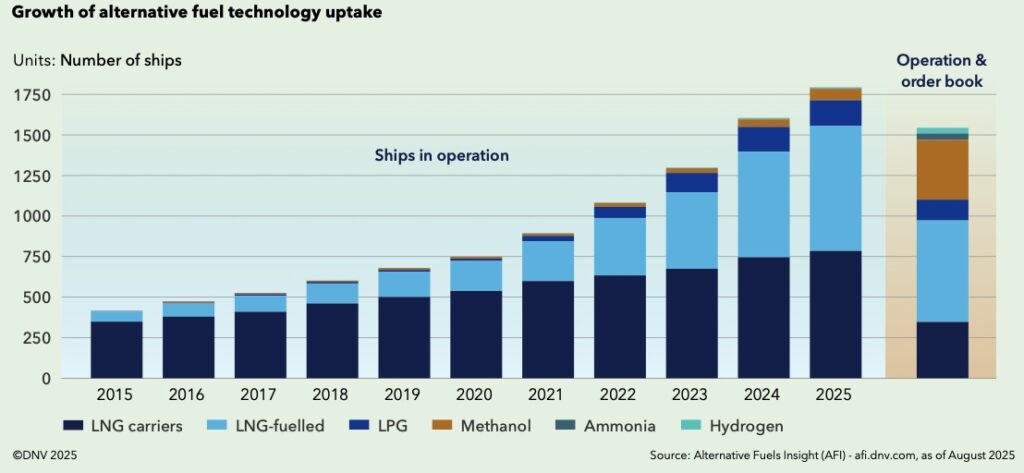
DNV, a major classification service for the maritime industry (it stands for Det Norske Veritas), is reporting that accounting for newbuilds that can burn alternate green(er) fuels, the bottleneck will be the supply of these fuels for maritime use.
It calls the phenomenon a “fuel transition tipping point”. It’s a strong demand signal for fuel producers. The graph shows the exponentially rising number of alternative fuel ships in the fleet, and adds the order book for the future. Methanol seems to be increasing quickly.
The infrastructure just isn’t there yet, and bunker operators and fuel producers need to step up their investments.
Green corridors are one approach that is gaining traction. In this scenario, several partners join forces with ports, fuel producers and bunker operators to make sure the infrastructure is there for fueling with green fuels on the route, usually point-to-point. Maersk has been a leader in this effort. Others are getting on board.
You can read the DNV maritime forecast to 2050 report here.
It seems that there is enough extra capacity in container shipping carriers’ fleets so that Chinese-built or Chinese owned ships need not be used on Asia-Pacific routes. Carriers have already announced plans to redeploy Chinese-built ships to other routes. So these shipping lines won’t be paying the US port access fees Trump put into place.
Will anyone be paying them? That’s the question now. The Trump administration’s estimates of the revenue these charges will bring in are way too high. No big money for US shipping improvements.
It’s another example of international ocean carriers and shippers’ immense innovativeness when a barrier to trade is erected. These entrepreneurs will always find a way around the barrier. One example here is ships calling at Canadian ports like Prince Rupert or Mexican ports like Ensenada instead of their US counterparts, avoiding the fees, but still able to provide good service via rail into US customers.
Something similar will happen with US tariffs. Enterprises will find a way around the rules.
That’s been happening since the dawn of navigational history, if not before. The American Revolution was in part about avoidance of requirements imposed by England on the shipment of goods between England and its colonies. The American cargo fleet, run by entrepreneurial sea captains and shipping firms, was an end-around the British shipment rules. Imposing those rules made the Americans mad, and added to the furor about independence.
With the Trump tariffs, too, international commerce will find a way. The result will be much lower tariff fee collections than Trump’s ridiculous projections. It won’t pay for much of anything, let alone trillions. We’re only seeing big numbers now because shippers get caught in the uncertainty; thinking the tariffs are off, they ship the goods, but by the time the goods arrive there’s a tariff again. But once burned, twice shy!
We haven’t seen big declines in Asia-West Coast trade yet, even though container unloadings at the West coast ports are down somewhat. But they are coming. Once firms get serious about minimizing landed cost, shipments could drop another 30% or more. And firms will make sure what they do have to ship is paying lower rates, even if they need to shift the source to another country.
The long-term lesson of history is that Tariffs are a weak tool for boosting a nation’s interests. Most often they wind up just making folks in trade mad, and making them less likely to support the tariffing nation’s interests in any way.
Unfortunately in the US the government is walking back any disclosure regulations for greenhouse gas emissions. But many companies operate multinationally, and procurement procedures are so complex that it becomes very difficult to know what suppliers are actually doing about greenhouse gas and other emissions.
That’s why ways to collect and validate the required supplier data, as well as your own, are important. A well-designed system can make the task remarkably easier.
Enter Danish climate specialist ReFlow and Procureship, an e-procurement platform supplier. Their partnership has created as system called EmissionPassport, a structured way to collect product-level Scope 3 emissions data from suppliers as well as your own vessel-level activities. The makers say that the climate data is not used to make procurement decisions in the system, but does insure that the measurable climate impact numbers are available for reporting.




 Supply Chain and Logistics