Tag Archives: Port Infrastructure

China-France Green Corridors: A New Blueprint for Maritime Decarbonization

Green corridors are a meaningful approach to emissions reduction for shipping. They coordinate the various factors required to make emissions reductions possible. Designating a green corridor will ensure that emissions-reducing fuels will be available in sufficient quantity for the ships calling, and the infrastructure for production and delivery is there. On-shore power will also be available for ships, so they do not need to operate engines just to provide power for the ship support. And in the port, cargo handling equipment can also be designed with cleaner emissions. Properly done, drayage functions will also operate with cleaner power.

It’s great to see a new green corridor connecting China and France. The ports involved are both important stops. And we can anticipate more trade between the EU and
China because of the American tariff hoopla.

Michele Labrut,Americas Correspondent

February 6, 2026
https://www.seatrade-maritime.com/ports-logistics/first-green-shipping-corridor-between-france-and-china

When more is less

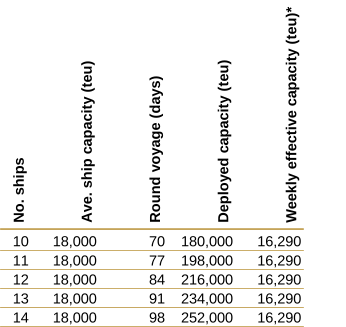
Drewry’s has an interesting Container Insight feature that clearly shows how container lines can add ships to their fleet and maintain a fixed effective capacity on a route. The essence of it in simplest form is to go more slowly. Consider their example, in Figure 1.

Figure 1: How to hide containership capacity

Note: * Based on a fixed-day-weekly end-to-end westbound Asia to North Europe service with no wayport / intermediate calls; assumes High-Cube capacity reduction of 8.5% and out-of-scope reduction of 1% (differs by trade).

Source: Drewry Maritime Research

Frequency on the route in Figure 1 stays the same, and the average capacity remains constant. The effective capacity of the trade lane stays the same.

So liner companies have quite a bit of flexibility to deploy their ships and manage the supply. In times when the demand is dropping, however, there are limits to what these policies can do. And all the strategies are not equally profitable. In times of financial pressure there would be motives for firms to use the cheapest solution instead of the one best suited to the customers’ needs, the customer being the shippers.

Understanding your shippers’ needs and developing schedules and provisioning of the routes to meet those real needs is the best way for success.

Drewry – Weekly Feature Articles – When more is less (or net neutral)

Drewry – Weekly Feature Articles – When more is less (or net neutral)