The EU’s Wind Assisted Ship Propulsion (WASP) project has ended. So far we seem to have favorable findings concerning the viability of retrofitting ships with wind propulsion units in addition to conventional power.
Estimates seem to be coming in at up to 10% savings. This is in the North Sea, where the winds blow heavy. However, 10% is not to be sneezed at. It’s a significant reduction in both energy and GHG emissions.
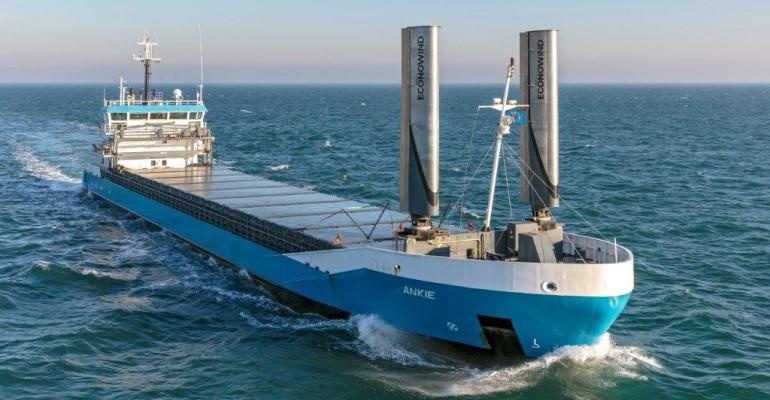
The picture of a bulker fitted with the sails shows one way to add the wind power.
Cooperation between shipowners and technology developers as well as university researchers is key. The list of partners is impressive.
This statement is from their website:
“The project brings together universities, wind-assist technology providers with ship owners to research, trial and validate the operational performance of a selection of wind propulsion solutions on five vessels thus enabling wind propulsion technology market penetration and contributing to a greener North Sea transport system through harvesting the region’s abundant wind potential.”
WASP has published their last newsletter, and also other publications. It’s interesting reading. There is also a final webinar.
Since I sailed as a kid, I’ve been interested in commercial applications of wind power. It’s exciting to see new engineering marvels tailored for the maritime world. Let’s hope the WASP research will lead to more and better wind power for ships.
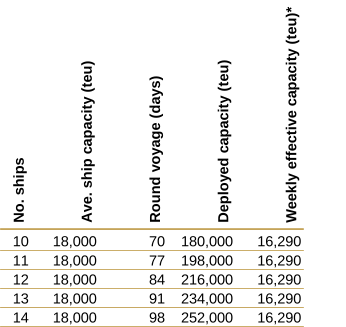
Drewry’s has an interesting Container Insight feature that clearly shows how container lines can add ships to their fleet and maintain a fixed effective capacity on a route. The essence of it in simplest form is to go more slowly. Consider their example, in Figure 1.
Figure 1: How to hide containership capacity
Note: * Based on a fixed-day-weekly end-to-end westbound Asia to North Europe service with no wayport / intermediate calls; assumes High-Cube capacity reduction of 8.5% and out-of-scope reduction of 1% (differs by trade).
Frequency on the route in Figure 1 stays the same, and the average capacity remains constant. The effective capacity of the trade lane stays the same.
So liner companies have quite a bit of flexibility to deploy their ships and manage the supply. In times when the demand is dropping, however, there are limits to what these policies can do. And all the strategies are not equally profitable. In times of financial pressure there would be motives for firms to use the cheapest solution instead of the one best suited to the customers’ needs, the customer being the shippers.
Understanding your shippers’ needs and developing schedules and provisioning of the routes to meet those real needs is the best way for success.
Drewry – Weekly Feature Articles – When more is less (or net neutral)
With all the talk of breaking up the alliances, this decision by Maersk and MSC is smart. Each line now has a ready answer for regulators, both in the EU and the US.
The decision is reminiscent of what happened with IBM and ATT. In those cases, the US regulators sued these two giant companies on antitrust grounds. At the time, IBM was dominant in computers, and ATT was dominant in telephones, and there were concerns of price fixing with both companies. In each of these cases, the government had to take legal action against the firms. But the lawsuits dragged on and on; giant companies can easily afford large legal entourages that can string out a proceeding forever.
One of my good friends and former bosses led the IBM antitrust management team.
Somewhere in the proceedings, while imagining life after the breakup, each of these firms came to the conclusion they would be better off broken up. So each of them proposed a split-up. The proposal itself was enough to defuse the lawsuit’s consequences, and reduce concerns the regulators had.
For a short while, I worked for Lucent, which was one of the spinoffs of ATT; it was the Western Electric manufacturing division, and included Bell Labs and other electronics manufacturers. Other ATT spinoffs were the ‘baby Bells’, the regional telephone companies. Now, 40 years later, they are all gone too. So is local phone service, replaced by cell phones, so a monopoly in local landline service is not a concern. Lucent is also gone, merged into Alcatel, a large European concern with partial Chinese ownership, and is called Alcatel-Lucent. It’s a private concern.
IBM spun off its printer and PC division into Lenovo, also a Chinese company, and while they still support mainframe computing today, are now more of a software company.
I think it’s a smart move to defuse regulatory concern about alliances. The political atmosphere right now would definitely support breaking them up. Huge profits in times just past, and terrible service for customers in the past and right now make the alliances an easy political target. But saying it’s going to end anyway should buy Maersk and MSC some negotiating room with the regulators. The only issues then will be how they preserve service; these are easily dealt with by making some kind of plans that man or may not ever be implemented.
I think the big question for Maersk and MSC will be the effect on their capital expenses and on their service guarantees. The rationale for alliances was that more regular service could be offered on an alliance route because the carriers covering it would share the job of providing regular ship sailings. That would reduce the need of each firm for more ships. That’s much lower capital expense.
Alliances are a great example of business collaboration to reduce costs, here capital costs (since the voyage operating costs are ‘covered’ by the cargo). Capital is expensive; no one can buy enough ships without borrowing, or using up cash on hand, or asking for more investment.
But in recent times, carriers are blanking sailings when they don’t have full ships. Service, even on alliance routes, has deteriorated to an awful level for container shipping.
It’s hard to see how Maersk, for instance, can cover a 2M alliance route adequately for a large customer, who may require weekly shipments. Some of the business will have to go to another carrier. And then the scheduling will not be straightforward. Throw blanked sailings into the mix, and customers will suffer.
But the regulators will be appeased; they can’t regulate as much when the alliance is gone.
I think the big problem of long-term success for ocean container carriers is customer service. They have to figure out how to set delivery expectations for customers and then deliver to them reliably. Hopefully at a profit.
Another take from Drewry is posted below.\, via Nick Savvides and Loadstar.
Update 1/27/2023: another thoughtful article from Greg Miller·Wednesday, January 25, 2023 in American Shipper.







 Supply Chain and Logistics