The World Shipping Council wants the maritime industry to use a ‘well-to-wake’ measure for ships’ emissions, rather than a simple CO2 measure at the stack. It’s a good point.
Ocean shipping firms will do only as much as is required. And the current picture based on the International Maritime Organization (IMO)’s CII regulations, doesn’t require taking account of emission sources in the supply chain of fuels, or the greenhouse effect of process emissions such as methane leaks.
IMO’s own study shows that LNG may reduce smokestack emissions, but total greenhouse emissions are even greater than conventional fuel oil.
It is interesting to hear about changes in regional supply chains. The Ukraine war provides a chance to see what disruption occurred and how it is impacting routes to move cargo in the area of the Black Sea. This article covers the effects of the blockade of Ukranian ports.
Naturally costs have changed, and so have equipment imbalances.
Finally, the markets for freight into and out of the area have changed a lot. Many shippers and carriers have been actively looking for alternatives, and have needed to create some new ones.
And sanctions imposed by the EU and US have forced other changes.
By Daniil Melnychenko data analyst at Informall BG 26/07/2022
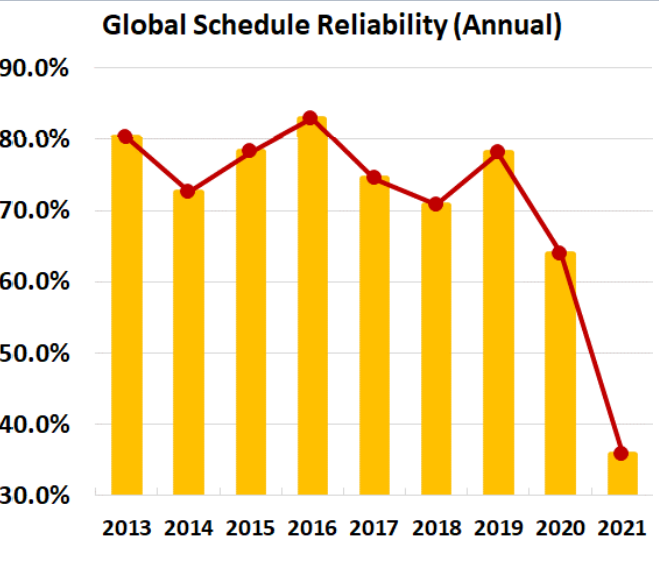
Ocean carriers are running a business in which their reliability of completing voyages planned in advance ranges around 30% to 40%. The highest reported here, by Sea-Intelligence Maritime Analysis, is Maersk at 46%. How can you run a business with these kinds of service levels?
The answer seems to be, VERY profitably. Most ocean carriers reported billions in net income.
I like this graph from the article.
Source: Sea-Intelligence, from article below.
While the trend down coincides with COVID, service levels were not great even before 2019. It’s due to the canceled sailings and skipped stops that are commonplace today. Port congestion has not helped.
But we can see a significant number of firms changing their level of dependency on the scheduled services offered by the major ocean carriers and the alliances,. Large shippers are buying their own ships and containers, usually of smaller size, and choosing when their shipments are scheduled, where they go, and how they get to their warehouses. Even some forwarders and brokers have started doing this. Other firms are looking for brokers who can help them find ways to get their cargo on time.
I think the large carriers have to start looking at how to improve service levels. If it means smaller ships and frequent sailings that don’t get canceled, that’s what it will take.
Perhaps we need feeder ships to allow the ocean carriers to consolidate multiple loads onto their giant ships for long voyages, but offload them near the destination. Years ago Al Baird, an English maritime economist, wrote about offshore container terminals, that could be used with short-range feeders to relieve the wharf pressure on our landside container terminals of today.
New thinking is needed to improve carrier on-time reliability. It won’t come without effort and money. But we can’t keep relying on ‘someone else’ to brainstorm solutions and give them a try. Especially when we’re earning billions.
8 February 2022
Jack Donnelly
Ports and Terminals, Shipping Lines




 Supply Chain and Logistics