Tag Archives: soybeans

Brazil’s May soybean exports jump 33% in month

Ever since we wrote a paper about exporting soybeans, I’ve been following the contretemps between Brazil and the US regarding soybean exports. China is the largest importer of soybeans from these two countries. Since one is Northern and one is Southern Hemisphere, their harvest seasons differ. So in the past the prices switched back and forth as the harvest supplies soared in one country or another, and China bought around the same from each source. The US has areas where yields are large, is a bit closer, and the inland transport for the soybeans is good. Brazil has lots of land planted, overland transport to ports is challenged a bit, and the distance to China is greater.

But now we have ‘exogenous factors’ as the economists like to say. China is in a trade war with the US. So as the second article indicates, China’s government-owned processors are buying some American beans, whereas the private Chinese enterprises are buying more Brazilian beans. The result is that more beans are going to China from Brazil right now. The trade war’s uncertain vicissitudes may mean that Brazil’s sales will become significantly bigger, and China will only buy what it thinks it has to from the US. Geopolitically, it makes sense for China to support Brazil, a developing country with lots of financing needs and less influence in the world. Support might mean good opportunities for Chinese investment and influence on Brazil’s policies internationally.

The outlook is really unclear. We need to keep watching developments in soybean trade.

https://www.spglobal.com/platts/en/market-insights/latest-news/agriculture/052620-brazils-may-to-date-soybean-exports-jump-33-on-month-to-1224-mil-mt

https://www.spglobal.com/platts/en/market-insights/latest-news/agriculture/052520-china-buys-bulk-of-brazilian-soybeans-in-april-despite-us-china-trade-deal

Author Asim Anand

Quote

Swine fever set to reduce China’s soybean imports further: USDA

Asim Anand writes in Platts agriculture report that China is suffering from substantial losses in their pig population due to African swine fever (ASF).  The pig herd has declined by 20%, and that translates to less need for soybeans.   Estimates run to 22 million mt less.

I’ve been watching the world soybean flows since 2014 when my colleague Cris Clott and I, working with Althea and Libby Ogard, and with help from Scott Sigman, wrote an article about the soybean flows and the possibilities for containerization of soybeans as opposed to bulk transport.

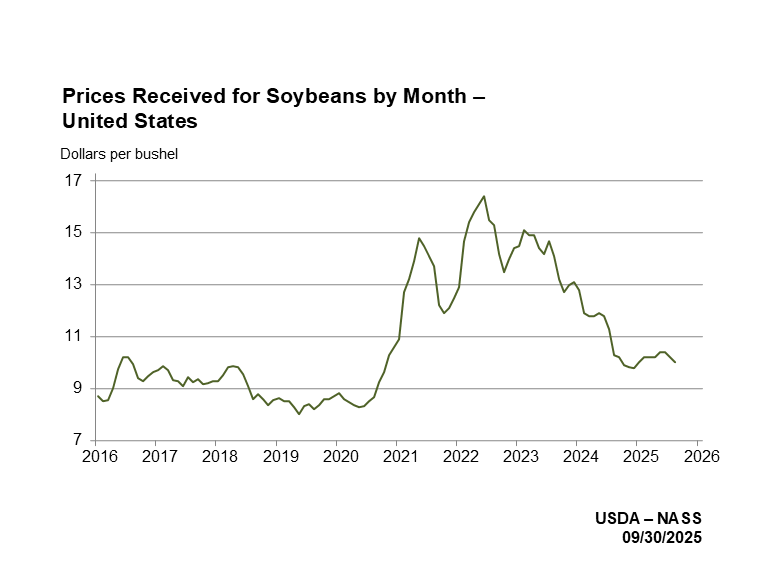
US soybean exports to China have fallen by 85% due to the imposition of a tariff of 25% on US products by China.   So world wide there is a glut of soybeans and prices are dropping fast. Prices of US soybeans are under $9 per bushel, the lowest since 2016. (See graph from USDA-NASS).

Prices Received: Soybean Prices Received by Month, US

Graph from https://www.nass.usda.gov/Charts_and_Maps/Agricultural_Prices/pricesb.php retrieved 2019-05-14.

We can expect this trend to continue, and as the trade war with China escalates, US soybeans will cease to be exported to China at all.  Exports represent about half of the US production each year, and China is the largest customer.  We can hope for a change, but I’m guessing this market is virtually gone for the US, as the other soybean-producing countries, Brazil and Argentina especially,  move in and establish supply chains around the world.


screenshot SandP Global Platts  via Swine fever set to reduce China’s soybean imports further: USDA | S&P Global Platts

NWF, MarAd release study on unscheduled lock outages

A new study by the US Maritime Commission on the problems with lock outages in our inland river waterways. If we don’t maintain the locks, we lose competitive advantage in agricultural products particularly; for instance costs of exporting soybeans goes up and lets Brazil become the cheapest source.

I’ve included a link to the pdf of the study below.

American Shipper   via NWF, MarAd release study on unscheduled lock outages

BY HAILEY DESORMEAUX |THURSDAY, NOVEMBER 02, 2017

PDF of study:

Lock Outage NWF_FINAL_REPORT 2017