Tag Archives: barge transport

Low-water for Rhine and Danube

The drying-up of Central European rivers is radically affecting goods movement there.

The graph below shows water levels at two gauges, one on the Rhine and one on the Danube. Both are dramatically lower. Barges on these rivers can carry less than 30% of their capacity. This prevents containers that arrived at Rotterdam and Antwerp and Hamburg area, for instance, from making it upstream to their destinations. Those goods will have to travel by road.

That’s not a good thing. It adds to air pollution, uses more oil-based fuel, and stresses highway systems already near capacity.

Europe has bet big on river traffic as a cleaner alternative to road carriage. For a few years, it worked. Now it is threatened by climate change.

There’s no way to predict when, if ever, the rivers will come back.

19 Aug 2026

https://www.drewry.co.uk/maritime-research-opinion-browser/kaub-gauge-falls-to-an-historic-low
Rapidly plunging Rhine remains supply chain problem

Low water levels in the Rhine River severely impact barge and shipping traffic. The Rhine is one of the most important inland shipping routes in Europe. EU nations have for years now tried to emphasize getting freight traffic off the roads and onto rivers via barge.

One of the most severe impacts is to refineries along the Rhine. They have had to shut down because of lack of supply. That’s bad for Europe, because of the shortage of petroleum fuels due to the Ukraine war.

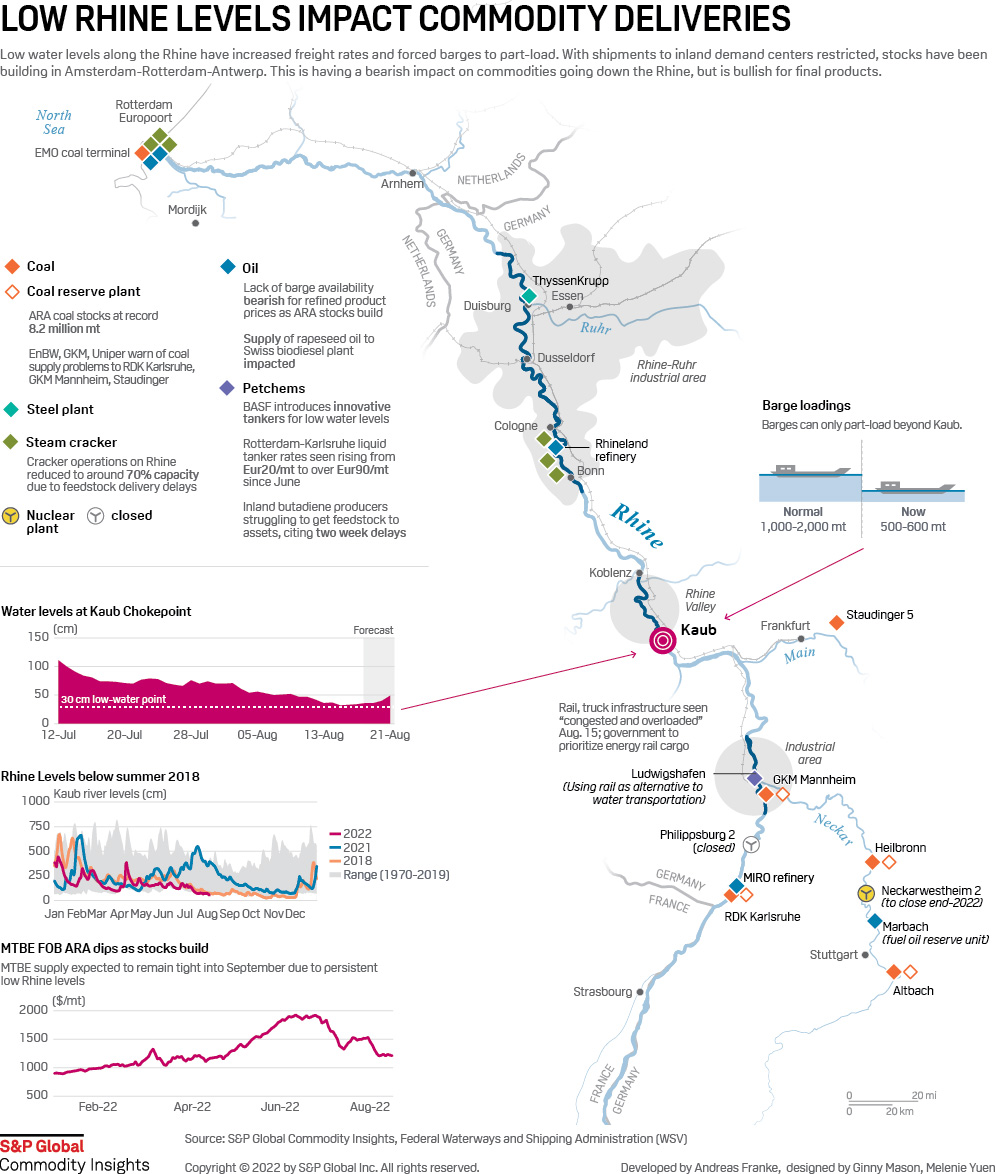
This map shows the problem.

Source: S&P Global Commodity Insights.

The depth measurements at Kaub, shown in the middle of the map, increased in the last few days due to extensive rain in Switzerland, but remain far below normal levels. There’s not enough water to float some barges that would normally be used for river cargo and petroleum products.

It’s a blow for the EU caused by a natural problem. Is global warming to blame? We don’t know, but cyclical droughts have been known for years, and clearly disrupt our plans. Trucking congestion is rising fast, and is neither as efficient nor as clean as the barge traffic.

John Kingston Friday, August 19, 2022

Rapidly plunging Rhine remains supply chain problem even as some relief looms – FreightWaves

‘Synchro-modality’ the key to solving congestion problems at Europe’s ports

And what is this ‘synchro-modality’?

Barge operators in Europe are calling for greater cooperation between ocean carriers, port terminals, and barge operators to make sure the goods flow smoothly to and from ships, port terminals and barges.

Barges, like containerships, take up quay space. The very large container ships now take up a lot of berth space, and it can be hard to schedule in the much smaller barges. So detailed joint planning is needed to make the loading and unloading happen as quickly as possible. It will only be possible if all the parties involved in moving the containers cooperate. And that will include warehouses and trucks as well.

A good prescription for future cooperation? I’m not sure, but somehow cooperation and sharing of information is essential.

By Alexander Whiteman 20/10/2021

‘Synchro-modality’ the key to solving congestion problems at Europe’s ports – The Loadstar