Category Archives: Managerial Econ

Posts relevant to Managerial Economics.

Global Seaborne Trade Hits $35 Trillion

The UN Trade and Development’s (UNCTAD) final Global Trade Update of 2025 is a very interesting report. Far from the death of international marine trade, the volume (by value) is surging 7% in 2025. That’s largely due to the increased trade between Asia and the developing world, largely in the South and Africa. US trade is distinctly off, but that’s not stopping the rest of the world from profiting by international trade.

Trade inflation increased in Q2 and Q3 2025, but is set to decrease in
Q4 2025. The graph shows overall price of traded goods: trailing four quarters and quarterly growth. The data do not include services.

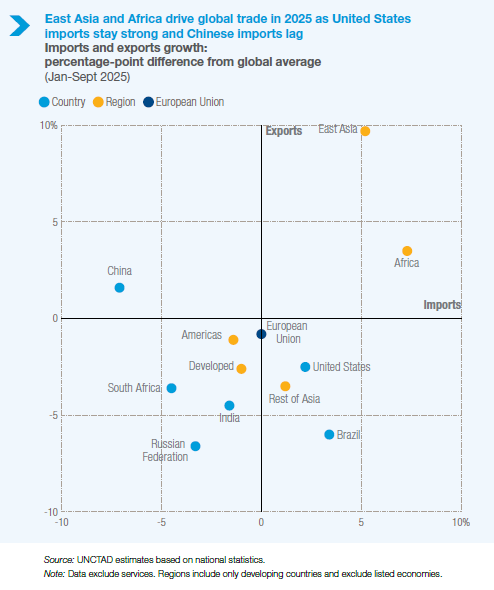
This chart shows that trade indeed has the power to drive costs down for consumers. Tariffs may have a short-term effect, but international trade finds a way to get around the restrictions. No market in the world is so big that you have to trade there. And ultimately the futility of tariffs hits home, and countries back off from imposing them. A quadrant diagram of exports and imports shows how East Asia and Africa are driving global trade now. They are the two regions showing positive percentage growth in both exports and imports through September 2025. (Again services are excluded).
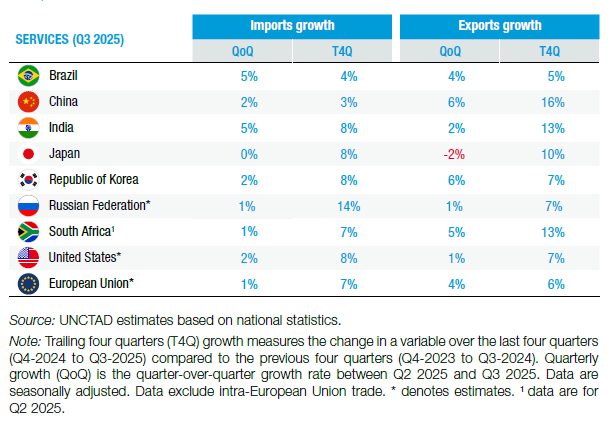
Services trade growth continued to be strong. This chart shows China, India, Japan, and South Africa led export growth by percentage, while many developed countries continued to increase major imports of services.

The whole report makes interesting reading. Kudos to the authors. It can be found here:


Mike Schuler

Total Views: 742 December 9, 2025

Chinese buy cheaper Brazilian soybeans

The deal made with China and the US over trade included soybean purchases from the US. However it seems to have handed Chinese businesses an advantage in negotiating with Brazilian shippers of soybeans. Brazilian export prices eased up as a result of the announcement, providing an opening for large purchases from Brazil.

The so-called US-China agreement on soybeans has yet to be confirmed by the Chinese side, so we still don’t know if it’s real. But the leverage for China over Brazil’s soybean producers has increased for real, and will for a while. This may be a much larger advantage for China as a whole than decreasing tariffs for US soybeans later on will be.

Stockpiles of soybeans are growing in the US as the harvest ends, with many unsold beans. The door to China trade may not come quick enough for many farmers, causing a need to store longer. Chinese soybean consumers and may get a better deal from both parties.

Clever negotiating.

Reuters

https://gcaptain.com/chinese-buyers-purchase-brazilian-soybeans-as-prices-ease-over-us-china-trade-thaw/

Supply chain choke points matter!

China expert Leland Miller, co-founder and CEO of China Beige Book International, says that trade is not the issue. The real question is control of supply chain choke points.

These could be supplies of scarce materials, such as rare earths, that are used in worldwide manufacturing processes. It could also be control over key ports or routes that supply products to the world.

Tariffs don’t matter much in this context; they can change, be skirted, or negotiated. Miller pointed out that worldwide, tariffs aren’t actually that high. Control over supply can be used to cut off countries or individual firms that aren’t doing what you want.

Looked at in this light, we can see the China-US struggle over ownership of the Hutchison Panama Canal ports as an effort to control a choke point in trade. We can also see the Houthi effort to gum up the Strait of Hormuz and the Red Sea as a control effort— to improve Israel’s behavior towards Gaza; with the help of Iran. The Hecksher-Ohlin theory of trade says that nations should trade when there is an imbalance in resources of whatever kind– labor, raw materials, educational capacity, agricultural land. And to exploit these advantages to defeat competitors is as old as warfare itself. Miller believes the Chinese are positioning themselves to wipe out economic competition when they see fit.

The US government will then become a participant, and perhaps a controller, of the free markets. That’s already happening as the US government takes a stake in companies here in the US. So it won’t be free enterprise, but government-influenced markets.

I don’t believe selling interests is necessarily our best course as a nation. Business becomes dealmaking in exchange for foreign cash, that evaporates into the hands of a few rich owners. The people, or workers, don’t benefit; instead they see the higher prices brought on by controls on supply.

John Kingston Tuesday, October 21, 2025

https://www.freightwaves.com/news/china-expert-miller-why-supply-chain-choke-points-matter-most