Category Archives: Managerial Econ

Posts relevant to Managerial Economics.

Chinese ships dropped from U.S. routes

It seems that there is enough extra capacity in container shipping carriers’ fleets so that Chinese-built or Chinese owned ships need not be used on Asia-Pacific routes. Carriers have already announced plans to redeploy Chinese-built ships to other routes. So these shipping lines won’t be paying the US port access fees Trump put into place.

Will anyone be paying them? That’s the question now. The Trump administration’s estimates of the revenue these charges will bring in are way too high. No big money for US shipping improvements.

It’s another example of international ocean carriers and shippers’ immense innovativeness when a barrier to trade is erected. These entrepreneurs will always find a way around the barrier. One example here is ships calling at Canadian ports like Prince Rupert or Mexican ports like Ensenada instead of their US counterparts, avoiding the fees, but still able to provide good service via rail into US customers.

Something similar will happen with US tariffs. Enterprises will find a way around the rules.

That’s been happening since the dawn of navigational history, if not before. The American Revolution was in part about avoidance of requirements imposed by England on the shipment of goods between England and its colonies. The American cargo fleet, run by entrepreneurial sea captains and shipping firms, was an end-around the British shipment rules. Imposing those rules made the Americans mad, and added to the furor about independence.

With the Trump tariffs, too, international commerce will find a way. The result will be much lower tariff fee collections than Trump’s ridiculous projections. It won’t pay for much of anything, let alone trillions. We’re only seeing big numbers now because shippers get caught in the uncertainty; thinking the tariffs are off, they ship the goods, but by the time the goods arrive there’s a tariff again. But once burned, twice shy!

We haven’t seen big declines in Asia-West Coast trade yet, even though container unloadings at the West coast ports are down somewhat. But they are coming. Once firms get serious about minimizing landed cost, shipments could drop another 30% or more. And firms will make sure what they do have to ship is paying lower rates, even if they need to shift the source to another country.

The long-term lesson of history is that Tariffs are a weak tool for boosting a nation’s interests. Most often they wind up just making folks in trade mad, and making them less likely to support the tariffing nation’s interests in any way.

Stuart Chirls Friday, September 12, 2025

https://www.freightwaves.com/news/rates-spin-as-chinese-ships-dropped-from-u-s-routes
When more is less

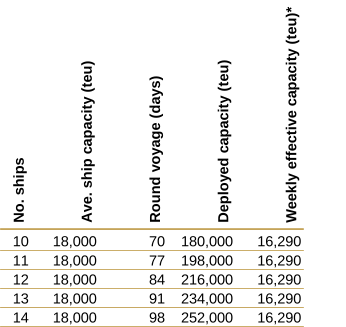
Drewry’s has an interesting Container Insight feature that clearly shows how container lines can add ships to their fleet and maintain a fixed effective capacity on a route. The essence of it in simplest form is to go more slowly. Consider their example, in Figure 1.

Figure 1: How to hide containership capacity

Note: * Based on a fixed-day-weekly end-to-end westbound Asia to North Europe service with no wayport / intermediate calls; assumes High-Cube capacity reduction of 8.5% and out-of-scope reduction of 1% (differs by trade).

Source: Drewry Maritime Research

Frequency on the route in Figure 1 stays the same, and the average capacity remains constant. The effective capacity of the trade lane stays the same.

So liner companies have quite a bit of flexibility to deploy their ships and manage the supply. In times when the demand is dropping, however, there are limits to what these policies can do. And all the strategies are not equally profitable. In times of financial pressure there would be motives for firms to use the cheapest solution instead of the one best suited to the customers’ needs, the customer being the shippers.

Understanding your shippers’ needs and developing schedules and provisioning of the routes to meet those real needs is the best way for success.

Drewry – Weekly Feature Articles – When more is less (or net neutral)

Drewry – Weekly Feature Articles – When more is less (or net neutral)

How changes in supply chain finance disclosure could impact shippers

I’ve been waiting to publish this for quite a while, I know, but I think it’s an important issue. For smaller shippers and carriers, like small independent trucking firms, cash flow is extremely important. Factoring invoices can be a way to insure that the bulk of the money for a bill comes in at a known time, allowing plans for use of the money to be made. It’s also a way for the payer of an invoice, the shipper, to set payment dates at known times, so their cash flow can be managed.

According to the article, there have been recent changes to how factoring is reported on accounting records. In fact, firms did not need to disclose that they were using factoring until the new FASB rule went into effect after Dec 15, 2022.

What this means is that for fiscal years that begin after Dec 15, 2022, the key terms of any supplier finance programs must be disclosed, FASB regulations say: “The key terms of the supplier finance program, including a description of the payment terms (including payment timing and basis for its determination) and assets pledged as security or other forms of guarantees provided for the committed payment to the finance provider or intermediary”.

This includes the amount outstanding that remains unpaid by the buyer at the end of the annual period, a description of where these commitments are shown in the balance sheet, and a “rollforward” including the amount of obligations confirmed and the amount subsequently paid.

These are important rules, because a part of the firm’s activity will be disclosed. It’s always possible to fool around with accounts receivable or payable to make figures look as you wish— that’s usually where delinquent payables or receivables are displayed. But disclosing the amount and timing of the actual obligations at least annually is a good start, especially when factoring is used to help a company running close to the margins maintain a regular cash flow.

It’s also important when you are planning to acquire a small firm. Investigate how the small firm is handling its receivables; are they factoring them? And if so, what is the nature of the deals being contracted. Small firms may not have to fully comply with FASB standards, since they aren’t public companies. Having a firm’s bookkeeper prepare the information required by FASB on supplier financing would be an excellent start. Make sure you fully understand the potential risk in your investment.

Todd Maiden·Saturday, January 07, 2023

How changes in supply chain finance disclosure could impact shippers – FreightWaves

Bryan Strickland, September 30, 2022

FASB updates reporting standard for supplier finance programs