Ultra-large container vessels are coming to West Africa. There is pent-up demand for goods in West Africa and throughout the continent. That’s because African economies are slowly improving, creating more consumers and businesses with money to spend.
Infrastructure to handle the ULCVs has been in short supply, but after considerable investment over the past few years, the giants can now land in numerous African ports.
With the impending container charges imposed by the US on containers arriving at its shores, more carriers and shippers are looking for ways to avoid landing in the US. Increasing West African trade is a natural way to use that capacity.
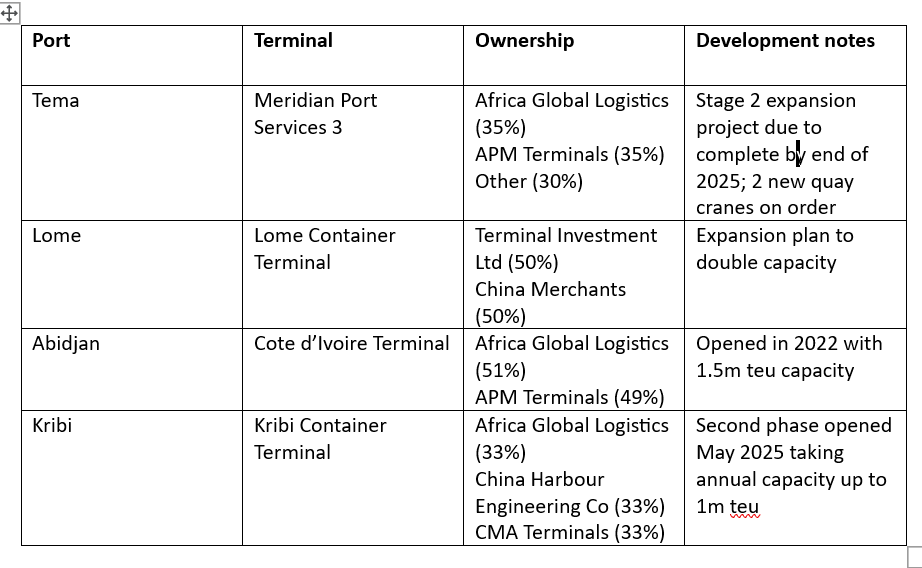
MSC is a major player in this trade. Their situation is helped by the fact that MSC has partial interests in port terminals in key West African locations, as the table below from the article shows. Tema is located in Ghana, Lome in Nigeria, Abidjan in Cote d’Ivoire, and Kribi in Cameroon. MSC has investments in Africa Global Logistics, which operates terminals at three of these ports; and a share in TIL, which has a terminal in Lome.
It’s good to see West Africa getting better access to the world’s goods. Trade improves the lives of both partners, exporter and importer.
Now is the time for labor unions to press ports and railways for new benefits for workers. There is a perfect storm of labor stoppages about to take place.
Thursday (that’s two days from this writing) the Teamsters Canada union (TCRC) expects to strike the CPKC railroad, one of the two largest in Canada. CPKC is also a large US and Mexico railway, and we’ve yet to see if US unions will honor a Canadian strike. The Canadian National (CN) rail line has blocked the strike by giving a lockout notice to the union. So there’s a high likelihood that most Canadian rail shipments will be shut down later this week.
The TCRC has turned down offers made in January, April and May. The labor agreements with the rails expired at the end of 2023, and the workers are working under the old contract. There have also been some rules changes by the government to reduce fatigue, that are not accounted for in the contracts. In fact, the union claims the rails want to ‘gut the collective agreement of all safety-critical fatigue provisions’. That may be hyperbole, but it’s indicative of the bitterness of disagreement.
The Teamsters represent about 10,000 workers. The Labor Minister has not issued an order for binding arbitration, so it’s likely there will be stoppages.
The cessation of rail movements means there are likely to be major disruptions at ports, where rail takes goods into the interior of Canada and also to the US. The rails are already announcing embargos which mean that they will not accept new shipments in certain areas because of expected port congestion.
The Port of Vancouver has already ordered ships on their way there to slow-steam because they fear they will not be able to move cargo out or into the port.
To top off the labor confusion, the US East Coast Ports are engaged in negotiations with the International Longshoremens Association (ILA), the major union representing 85,000 members. The ILA has indicated that October 1 will begin a strike if a new contract is not agreed. There does not seem to be a clear path to agreement.
Shippers and Ocean Carriers are already preparing. Cargo is shifting to the West Coast US Ports, where an agreement was completed last year. I expect the East Coast ILA members expect similar if not better contracts, because East Coast ports have been prospering for the last couple of years. Their first glitch was when the Panama Canal reduced its traffic due to an extended drought. Traffic started shifting to the West Coast then. Now the Panama Canal is near its former levels, and traffic is rising again. The East Coast Ports do not need a strike right now.
But that’s exactly why the unions are playing hardball.
Drewry is well-known for its expertise in maritime-related matters. In a recent market opinion piece, they suggest that maritime emissions can be reduced rather simply, with port call optimization. They mean to reduce the time ships sit near a port waiting for their berth to open up.
Some ports have been successful with appointment windows. But the Drewry approach includes slow steaming to hit the port berthing window close to the time, instead of standing offshore running engines and emitting pollution. The slow steaming itself is a tested measure for reducing emissions, though it doesn’t eliminate them. The two efforts combined could save a lot of pollution, and now in some places such as the EU, emission charges based on actual fuel use numbers.
Eliminating waste in a system, such as waiting time waste, is a tried and true operations management or lean technique. But in the case of maritime shipping and ports, a lot of coordination is required. Systems need to be in place to provide accurate information about ocean carrier voyage schedules. Sailing times between ports can vary a lot, because of factors such as weather and route adjustments.
But also, both ocean carriers and ports need to share information and cooperate on setting berthing schedules. A late loading in Shanghai, for instance, will affect the projected arrival time in Long Beach. the two ports and the carrier will need to share up-to-the-minute (or hour) information about progress. Will they do it? It will require a level of interaction never before seen.
I think that ultimately, ports and carriers will be driven to this by the gains that can be made. but I think it will be a long time coming.
Update: Port optimization can actually prevent deaths. Hong Kong University of Science and Technology (HKUST) has recently studied the number of deaths that could be prevented by port waiting time improvement.









 Supply Chain and Logistics