Category Archives: Sustainability

WASP project ends as winds blow fair

The EU’s Wind Assisted Ship Propulsion (WASP) project has ended. So far we seem to have favorable findings concerning the viability of retrofitting ships with wind propulsion units in addition to conventional power.

Estimates seem to be coming in at up to 10% savings. This is in the North Sea, where the winds blow heavy. However, 10% is not to be sneezed at. It’s a significant reduction in both energy and GHG emissions.

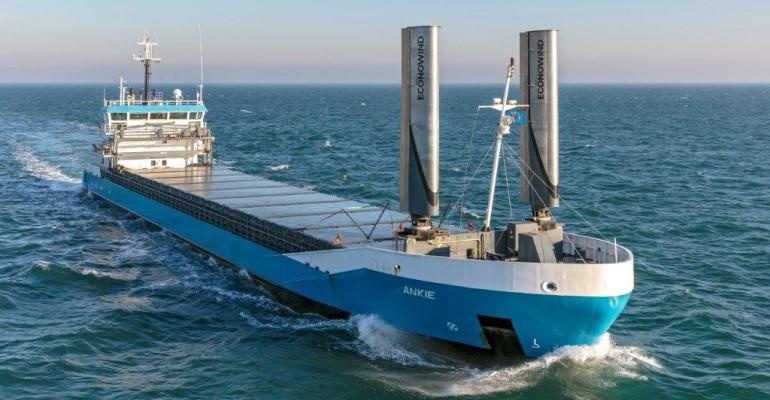
The picture of a bulker fitted with the sails shows one way to add the wind power.

Cooperation between shipowners and technology developers as well as university researchers is key. The list of partners is impressive.

This statement is from their website:

“The project brings together universities, wind-assist technology providers with ship owners to research, trial and validate the operational performance of a selection of wind propulsion solutions on five vessels thus enabling wind propulsion technology market penetration and contributing to a greener North Sea transport system through harvesting the region’s abundant wind potential.”

Source: https://northsearegion.eu/wasp/

WASP has published their last newsletter, and also other publications. It’s interesting reading. There is also a final webinar.

Since I sailed as a kid, I’ve been interested in commercial applications of wind power. It’s exciting to see new engineering marvels tailored for the maritime world. Let’s hope the WASP research will lead to more and better wind power for ships.

Seatrade logo

Paul Bartlett | Jun 30, 2023

WASP project ends as winds blow fair

Project to establish ammonia bunkering for Norwegian offshore sector

This is the kind of cooperative project that can provide success in ESG innovation. It’s a sort of ‘green corridor’ project, with a network of bunkering terminals, and ships to service offshore oil operations in the Norwegian Continental Shelf.

By 2030 about 80 new or rebuilt ships, powered by ammonia, will be servicing the oil operations in that area. Let’s hope it works out.

The problems of handling ammonia at sea are fairly well understood. We have to see what technology they develop to insure safety and easy handling by seamen and shoreside workers.

 Adis Ajdin June 27, 2023

Project launched to establish ammonia bunkering for Norwegian offshore sector

EU ETS at a glance

I found this article very informative. It’s from Bureau Veritas, a classification society based in the EU.

It makes very clear how the EU’s emissions trading system (ETS) will work for the maritime industry. It’s part of the Fit for 55 package that aims to reduce emissions by maritime and other sectors in the EU.

The timeline is very important for shipowners and ship charterers. The rules require payments for emission credits, so there will be a financial impact. It remains to be seen how chartering contracts will divide the costs of the credits between shipowners and charterers, but the financial burden will be there.

Most people agree that the emissions trading credit system is an extremely important motivator for participants in the maritime industry to get serious about reducing emissions. We are seeing activity now to reduce emissions, but the pace has to pick up if the EU goals of a 55% reduction by 2030 are to be met. Investment is needed, and internalizing the cost of emissions through the trading of credits is an important lever to use. It’s a good example of a sensible regulation to impel action. More nations should try it.

The FAQ format of the article makes it easy to see the answers.

One unfortunate issue is the somewhat longer time frame for implementation of the ETS; the first bite starts in January 2024, covering 40% of emissions. This escalates to 70% in 2025 and 100% in 2026. Another critique of the system is that for ships that either enter or exit the EU ports fro outside the EU, they only pay for half the emissions. It’s a compromise that is necessary, since nations outside the EU might have their own emissions trading regimes, or none at all. Having it apply only to EU port visits insures more cooperation.

The basis of the trading is an updated MRV plan, which must be kept updated. There will be an accredited verifier of the plan for each fleet owner. The fleet’s individual greenhouse gas (GHG) emissions must be monitored from January 1 of 2025, and a report submitted by March. Then by September, the emissions will be calculated (surrendered, in the words of the document) and the emissions credits purchased on 40% of it.

Penalties include expulsion orders from EU ports, or a flag detention order until obligations are fulfilled, for EU member state flagged ships.

EU Emissions Trading System Directive | Bureau Veritas M&O

EU Emissions Trading System Directive | Bureau Veritas M&O