Category Archives: Sustainability

Klaipeda looks to position itself as the Blue Economy capital of the Baltics

Klaipeda is in Lithuania, the only substantial port in that country. Geographically it is well-positioned for the maritime industry of the Baltic Sea. A map is instructive.

Lithuania is close to Russia on the east, and Sweden on the west, and also on routes to Finland, Denmark, Germany, Poland, and Norway. There are many opportunities for trade over the sea here.

The conference planned by Klaipeda is connected with Norway, one of the most important locations for maritime innovation.

I’m planning to attend online. I will be listening especially for green innovations and plans to meet European sustainability and ESG goals for the maritime industry.

The Baltic States area has become more important due to the war in the Crimea. Lithuania blocks access to the Russian port of Kaliningrad, which is in an island of Russian territory separated from the main body of Russia. Recently permission was granted to allow transport across Lithuania to Russia, despite the sanctions on Russian shipping. Lithuania is an EU country.

Press Release.

Klaipeda looks to position itself as the Blue Economy capital of the Baltics – bruce@ahartman.net – ahartman.net Mail

Eclipse Ventures Launches Framework to Quantify Climate Impact Potential for Technologies Disrupting Physical Industries

Eclipse Ventures is a VC firm based in Palo Alto, CA. Their goal here is to provide venture investors with information on the carbon reduction potential of different technologies for physical industries. It actually goes further to identify a few companies working on each sort of technology. For investors, it gives a tool to estimate the market for a technology and an indication of how a startup might perform.

It does so using an open platform called CRANE, which they claim will soon be open-source. CRANE was developed by Prime Coalition, a climate non-profit, and Rho Impact, a climate advisory service.

The idea of such a tool is to encourage investors to back firms that will genuinely reduce carbon impact. Time will tell if people will use the tool, and also how accurate its prognostication is.

I am usually quite skeptical of ‘black-box’ predictors and analytical tools. It’s important to understand how they are actually doing the computations.

However, physical industries are major contributors to carbon pollution, and offer a tremendous opportunity for carbon reduction. Any way we measure it, reducing carbon output in those industries is a priority. Clearly identifying startups that could make an impact in those physical areas would be good.

We can couple that with the fact that physical industry startups have different requirements from software and artificial intelligence startups. They need substantial early funding, because their physical solutions require a test bed. And they need to be located near the physical processes they are trying to improve, rather than in some incubator or accelerator near the money sources.

Physical products from the start need to deal with serviceability. The ability to service the product must be designed in from the start. Products that fail to be serviceable will never be selected by operations people.

Software, on the other hand, follows a development path using a minimum viable product, which meets some customer needs, but not others. Software developers today rely on feedback from users to make the product more serviceable. Early adopters provide that input and drive the serviceability trajectory. And the engineers, or a few added customer engineers, can provide the support. As more and more users appear, they need more and more help and place larger demands on the software firm. Eventually, if a software firm is successful, the service of existing customers becomes much more important and more costly than new development. This trajectory has played out so often in the software industry as to be a cliche.

But the big jump in software service expense most often occurs long after the firm has exited the VC or early funding stages, either through an IPO or private placement or through sale to a large company. Early investors no longer have responsibility for the financing. So the venture investors don’t care.

This phenomenon explains why software ventures get funded more easily than physical product ventures.

I’m glad to see someone trying to make the case for physical industry investment, especially for sustainability and carbon intensity.

Full report: https://eclipse.vc/eco-report/

NEWS PROVIDED BY Eclipse Ventures 

Aug 10, 2022, 09:00 ET

Eclipse Ventures Launches Framework to Quantify Climate Impact Potential for Technologies Disrupting Physical Industries

Liners get a preview of alternative fuel costs

A new technical and commercial comparison of alternative fuels for ocean carriers compares expected bunker costs for different size and differently equipped ships. Alphaliner, a consultancy for ocean carriers, has reviewed that comparison.

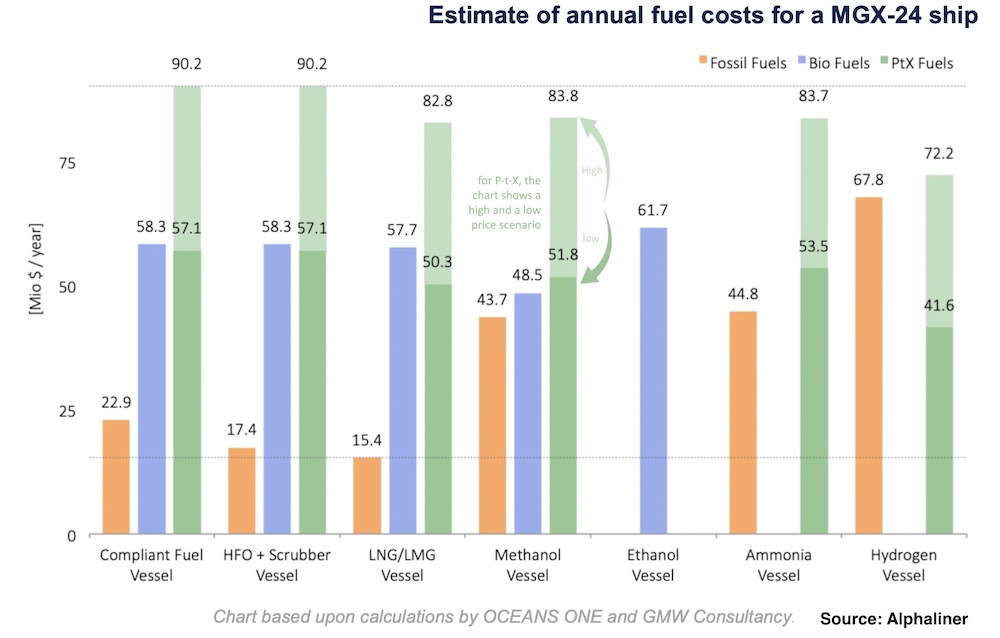
Alphaliner’s review shows the ship owner and operator what they can expect in economy over the next few years. The results indicate that as the new regulations for CO2 emissions kick in, fuel costs will become a much larger percentage of total ship operating costs, perhaps double, or even more.

For instance, the graph they publish shows fuel costs for differently equipped Megamax-24 (MGX-24) ships. A megamax-24 ship is typically 400 meters long and 61 meters wide, with a depth of about 33.2 meters. It should carry around 23,500 twenty-foot equivalent (TEU) containers (Alphaliner newsletter).

The graph compares use of fossil fuels, bio fuels, and power-to-fuel (PtX) fuels (read about them). The PtX fuels convert renewable sources such as wind, sun, hydro, and geothermal, to fuel products such as hydrogen, ammonia, or products containing carbon, such as syn-crude. If carbon is used in the PtX process it should be from non-fossil sources or unavoidable industrial carbon emissions capture and reuse.

Source: Splash247 article.

Even bio-fuels cost a lot more than conventional fuels when all the upstream supply chain emissions are considered, for these very large ships.

The graph seems to imply that scrubbers are still a very important technology in the fight to clear the air. And LNG has a role to play, though it might be temporary. At their best, the PtX technologies such as electric-powered ships are comparable to or better than bio-fueled vessels.

There’s clearly a long way to go for ocean shipping to go where it needs to in the race to clean up global emissions.

However, some of these non-fossil technologies will adapt over the next few years, and costs will come down. It’s hard to do much more with the fossil fuel technology.

The argument Alphaliner makes is that soon fixed costs will be a smaller part of the total cost of a large ship than fuel operating costs. As these proportions change, emphasis will come more on building ships with desirable emissions control power systems, since the availability and price of fuel will be driving overall costs.

That’s an interesting point. We will see the extent to which it influences the next generation or two of ship orders.

Sam Chambers July 27, 2022

Liners get a preview of alternative fuel costs – Splash247