Impact of Trade Wars on Sustainable Energy Projects

How will the trade wars affect sustainable energy projects and products? S&P Global has a report that analyzes this.

Any long-term conclusions are risky, given the US propensity to alter course (TACO tactics). But thanks to them for giving it a try.

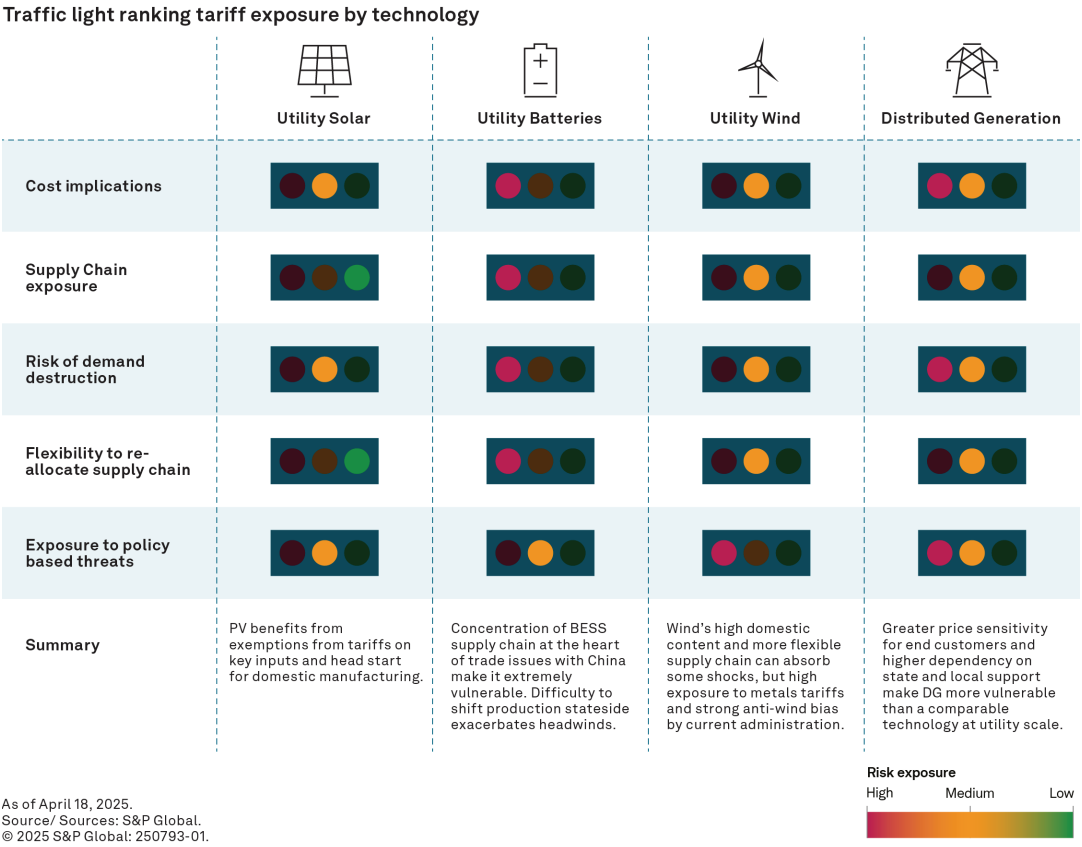
This traffic light analysis is helpful to understand the implications for different utility grade technologies.

Batteries seem to be hit the hardest. Wind falls within the medium range for most criteria. However, it suffers from policy bias by the current US administration. Distributed generation, such as home solar, is also at risk because of policy and cost implications.

Retaliatory measures from trade partners add more complexity and unpredictability to decisions for these technologies.

The full report is available here.

Energy Transition, Electric Power, Renewables, May 28, 2025

Analysis by Paola Perez Pena, Alex Kaplan, Tiffany Wang, John Murray, Timothy Stephure. With contribution from Indra Mukherjee, Tom Kim, Jiani Wang, Jessica Jin, George Hilton, Cinthya Pena, and Edurne Zoco

https://www.spglobal.com/commodity-insights/en/news-research/blog/energy-transition/052825-the-new-normal-how-trade-tensions-and-policy-uncertainty-may-reshape-the-us-cleantech-landscape

State of Logistics 2025 Report

The 2025 State of Logistics Report is out. It’s commissioned by the  Council of Supply Chain Management Professionals (CSCMP) and prepared by global consulting firm Kearney with help from Penske Logistics.

Its title is “Navigating through the Fog”, which captures the confusion and uncertainty of the scene today.

Report highlights include:

  • A notable report statistic, U.S. business logistics costs, is $2.3 trillion, which translates to 8.7% of the national GDP.
  • There are multiple reasons why demand has not yet fully recovered. Chief among them are simultaneous geopolitical conflicts around the world, climate change (which has affected shipping lanes), high inflation, high interest rates, and, apart from the U.S., sluggish demand.
  • As a result of the economic headwinds and geopolitical instability, the continued fragmentation of global trade is complicating supply chain transactions. Since the 2023 report was released, over 1,000 U.S. freight brokers have shuttered their doors.
  • Some of the largest manufacturers and retailers are seeking to monetize their own logistics capabilities while viewing their supply chain successes as a service to market and profit from.

The annual report is well worth reading as a snapshot of what’s going on. But in these volatile times, it’s really hard to make predictions. Hats off to the authors for trying.

Download the report

I liked this graphic from the report, which shows predicted changes in international goods flows between 2021 and 2031. With all the geopolitical issues we’re facing, things could change overnight, but one thing we see is a mammoth reduction in US trade with China. And they’re predicting even a bigger reduction in trade between the EU and Russia.

How Ultra-Large Container Ships are Transforming West Africa

Ultra-large container vessels are coming to West Africa. There is pent-up demand for goods in West Africa and throughout the continent. That’s because African economies are slowly improving, creating more consumers and businesses with money to spend.

Infrastructure to handle the ULCVs has been in short supply, but after considerable investment over the past few years, the giants can now land in numerous African ports.

With the impending container charges imposed by the US on containers arriving at its shores, more carriers and shippers are looking for ways to avoid landing in the US. Increasing West African trade is a natural way to use that capacity.

MSC is a major player in this trade. Their situation is helped by the fact that MSC has partial interests in port terminals in key West African locations, as the table below from the article shows. Tema is located in Ghana, Lome in Nigeria, Abidjan in Cote d’Ivoire, and Kribi in Cameroon. MSC has investments in Africa Global Logistics, which operates terminals at three of these ports; and a share in TIL, which has a terminal in Lome.

It’s good to see West Africa getting better access to the world’s goods. Trade improves the lives of both partners, exporter and importer.

Gavin van Marle  04/06/2025

https://theloadstar.com/asia-west-africa-ulcv-deployment-opens-new-markets-for-carriers